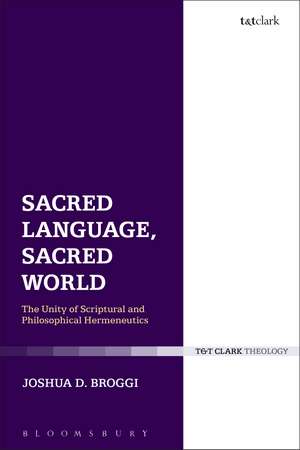
Sacred Language, Sacred World: The Unity of Scriptural and Philosophical Hermeneutics
Autor Dr Joshua D. Broggien Limba Engleză Paperback – 26 iul 2018
Joshua Broggi challenges this arrangement by re-reading the primary texts as theological resources; he defends an alternative theological appropriation of their philosophical work through a close engagement with portions of their argument.
What emerges from Broggi's examination is an account of the unity of tradition, reason, and scriptural language. This account goes beyond claims of their relatedness, which are uncontroversial, and advances the stronger argument that they name the very same thing. Although initially counterintuitive, the central task set by both Heidegger and Gadamer is the investigation of that one phenomenon. This argument challenges the pervasive image in which Christians rely on 'tradition' to 'reason' about the meaning of 'scripture'. It puts into question the injunction that theologians should balance the resources of scripture, tradition, and reason. Broggi offers an account of Christian life as more fundamental than certain entities which are distilled out of it, namely: scripture, tradition and reason.
Preț: 260.43 lei
Preț vechi: 346.34 lei
-25%
Puncte Express: 391
Carte tipărită la comandă
Livrare economică 01-15 decembrie
Livrare prin curier în România Termenul estimat este afișat lângă disponibilitate.
Transport gratuit de la 400.00 lei Plată online sau ramburs, în funcție de opțiunile comenzii.
Retur gratuit în 14 zile Comandă securizată și suport în română.
Specificații
ISBN-13: 9780567683656
ISBN-10: 0567683656
Pagini: 234
Dimensiuni: 156 x 234 x 13 mm
Greutate: 0.34 kg
Ediția:NIPPOD
Editura: Bloomsbury Publishing
Colecția T&T Clark
Locul publicării:London, United Kingdom
ISBN-10: 0567683656
Pagini: 234
Dimensiuni: 156 x 234 x 13 mm
Greutate: 0.34 kg
Ediția:NIPPOD
Editura: Bloomsbury Publishing
Colecția T&T Clark
Locul publicării:London, United Kingdom
V-ar putea interesa
-
 A Political History of Early ChristianityAllen Brent-11%Preț: 325.76 lei366.12 lei
 -
 Chesterton and Tolkien as TheologiansRev'd Canon Professor Alison MilbankPreț: 276.19 lei
 -
 Simple TruthsFulton SheenPreț: 86.52 lei
 -
 The Glories of MaryAlphonsus LiguoriPreț: 150.70 lei
 -
 Resounding Truth - Christian Wisdom in the World of MusicJeremy S. BegbiePreț: 212.51 lei
 -
 Truth DecayDouglas GroothuisPreț: 216.06 lei
 -
 Pocket Handbook of Christian ApologeticsPeter KreeftPreț: 96.24 lei
 -
 A Ready Defense: The Best of Josh McDowellJosh McDowellPreț: 168.33 lei
 -
 HeavenRandy AlcornPreț: 179.43 lei
 -
 -8%Preț: 604.37 lei656.93 lei
 -
 Time and EternityWilliam Lane CraigPreț: 150.79 lei
 -
 Fifty Reasons Why Jesus Came to DieJohn PiperPreț: 64.06 lei
 -
 Postmodernism 101Heath WhitePreț: 133.38 lei
 -
 Skeletons of a Course of Theological Lectures.Charles Grandison FinneyPreț: 190.64 lei
Cuprins
Abbreviations
Introduction
1. How to Read this Book
2. Narrative and World
3. A Tale of Interpretations
Part I: Heidegger
1. Being and Time
The Very Possibility of Reading Scripture Wrongly
What Sort of Book is Being and Time
The Argument in Being and Time
2. Tools in the World
A Phenomenology of Tools, §15
Broken Tools: A Gloss of §16
The Inhabited Taxonomy, §18
Language as an Everyday Tool
3. Scripture in the World
The One Thing Named by 'Scripture', 'Tradition', and 'Reason'
The Unity of Background Commitments
Language and Taxonomy
Finite Reason
Part II: Gadamer
4. Truth and Method
Approaching Gadamer
The Scope and Argument of Truth and Method
The Opening Discussion
5. Reading Rightly
The 'Hermeneutical Circle' and the Ethics of Thought
The First Ethical Principle: Start Rightly
The Second Ethical Principle: Wait Long
6. Reading in the World
'The Principle of Wirkungsgeschichte'
Gadamer's Use of Hegel
Alterity in the Metaphor of Horizons
Gadamer's Logic of Unity
7. Conclusions
The Pitt Rivers Museum
Theology and the Gordian Knot of Self-Consciousness
What Can Theologians Say?
The Unity of Scripture, Tradition, and Reason
Scripture in the World
Bibliography
Index
Introduction
1. How to Read this Book
2. Narrative and World
3. A Tale of Interpretations
Part I: Heidegger
1. Being and Time
The Very Possibility of Reading Scripture Wrongly
What Sort of Book is Being and Time
The Argument in Being and Time
2. Tools in the World
A Phenomenology of Tools, §15
Broken Tools: A Gloss of §16
The Inhabited Taxonomy, §18
Language as an Everyday Tool
3. Scripture in the World
The One Thing Named by 'Scripture', 'Tradition', and 'Reason'
The Unity of Background Commitments
Language and Taxonomy
Finite Reason
Part II: Gadamer
4. Truth and Method
Approaching Gadamer
The Scope and Argument of Truth and Method
The Opening Discussion
5. Reading Rightly
The 'Hermeneutical Circle' and the Ethics of Thought
The First Ethical Principle: Start Rightly
The Second Ethical Principle: Wait Long
6. Reading in the World
'The Principle of Wirkungsgeschichte'
Gadamer's Use of Hegel
Alterity in the Metaphor of Horizons
Gadamer's Logic of Unity
7. Conclusions
The Pitt Rivers Museum
Theology and the Gordian Knot of Self-Consciousness
What Can Theologians Say?
The Unity of Scripture, Tradition, and Reason
Scripture in the World
Bibliography
Index
Recenzii
Sacred Language, Sacred World addresses the question, "when interpreting scripture, what does it mean to have commitments?" In the course of offering various answers, it also aims to overcome false separations between things that belong together. Thematically, it argues that scripture, tradition and reason are identical, in the sense that all of these things, when treated in theology, are different ways of investigating the same insight. Disciplinarily, it shows that World Christianity, Philosophical Theology and Biblical Interpretation belong together: Kimbanguist interpretation of the Bible in the Belgian Congo is skillfully woven together with detailed (and novel) interpretations of Heidegger and Gadamer. In an era of sometimes damaging over-specialisation in academic inquiry, Broggi boldly crosses borders and queries familiar nostrums. This important book, displaying great independence of mind, places philosophical classics in the service of theological interpretation of scripture.
Broggi's creative engagement with Heidegger and Gadamer generates a thought-provoking and potentially fruitful way of understanding how reason presents itself in (and so may absent itself from) religious traditions.
Broggi is excellent in his use of Heidegger and Gadamer. Bridging the gap between textual and philosophical hermeneutics is no easy task, yet Broggi's careful analysis presents a compelling argument for a reimagined look at the unity of scripture, tradition, and reason. Broggi is a careful and precise writer, making this work easily accessible to those unfamiliar with Heidegger or Gadamer. Broggi's text is a masterful achievement for theology, hermeneutics, and philosophy.
Broggi's creative engagement with Heidegger and Gadamer generates a thought-provoking and potentially fruitful way of understanding how reason presents itself in (and so may absent itself from) religious traditions.
Broggi is excellent in his use of Heidegger and Gadamer. Bridging the gap between textual and philosophical hermeneutics is no easy task, yet Broggi's careful analysis presents a compelling argument for a reimagined look at the unity of scripture, tradition, and reason. Broggi is a careful and precise writer, making this work easily accessible to those unfamiliar with Heidegger or Gadamer. Broggi's text is a masterful achievement for theology, hermeneutics, and philosophy.