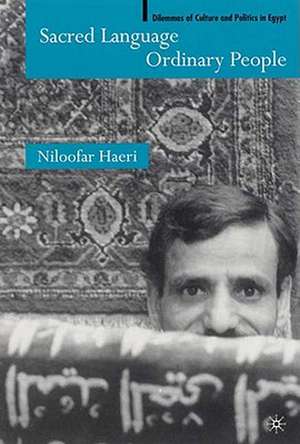
Sacred Language, Ordinary People
Autor N. Haerien Limba Engleză Paperback – 24 feb 2003
Preț: 392.32 lei
Puncte Express: 588
Carte tipărită la comandă
Livrare economică 18 noiembrie-02 decembrie
Livrare prin curier în România Termenul estimat este afișat lângă disponibilitate.
Transport gratuit de la 400.00 lei Plată online sau ramburs, în funcție de opțiunile comenzii.
Retur gratuit în 14 zile Comandă securizată și suport în română.
Specificații
ISBN-13: 9780312238971
ISBN-10: 0312238975
Pagini: 184
Ilustrații: XVI, 184 p.
Dimensiuni: 154 x 202 x 11 mm
Greutate: 0.23 kg
Ediția:2003 edition
Editura: Palgrave Macmillan US
Locul publicării:New York, United States
ISBN-10: 0312238975
Pagini: 184
Ilustrații: XVI, 184 p.
Dimensiuni: 154 x 202 x 11 mm
Greutate: 0.23 kg
Ediția:2003 edition
Editura: Palgrave Macmillan US
Locul publicării:New York, United States
V-ar putea interesa
-
 Covering IslamEdward W. Said-20%Preț: 74.01 lei92.49 lei
 -
 Human Rights in the Middle EastM. MonshipouriPreț: 306.63 lei
 -
 Preț: 249.28 lei
 -
 Islam Dot ComM. El-Nawawy-15%Preț: 641.41 lei754.60 lei
 -
 Forming a Culture of PeaceK. KorostelinaPreț: 391.23 lei
 -
 Weimar Film and Modern Jewish IdentityO. AshkenaziPreț: 390.48 lei
 -
 Preț: 402.81 lei
 -
 Iraq's Last JewsT. MoradPreț: 218.43 lei
 -
 -23%Preț: 276.46 lei359.33 lei
 -
 The Unfinished Tower of BabelRobert L. BonnPreț: 63.76 lei
 -
 Scandal in a Digital AgeHinda MandellPreț: 370.46 lei
 -
 50 Islam Ideas You Really Need to KnowMona Siddiqui-23%Preț: 74.70 lei96.98 lei
 -
 Radicalized: New Jihadists and the Threat to the WestPeter R. Neumann-20%Preț: 130.61 lei163.65 lei
 -
 The New Threat From Islamic MilitancyJason Burke-19%Preț: 63.07 lei77.88 lei
 -
 -26%Preț: 200.30 lei269.10 lei
 -
 -24%Preț: 157.98 lei208.16 lei
Cuprins
Introduction Humble Custodians of the Divine Word: Classical Arabic in Daily Life Text Regulation and Site Ideology Creating Contemporaneity: Struggles with Form Persistent Dilemmas: Pleasure, Power, and Ambiguity Conclusion
Recenzii
'[T]his is one of the most interesting books I have ever read on language. It is certainly unique insofar as the study of Arabic is concerned, for no linguistic ethnography exists for Classical Arabic'. - Steven C. Caton, Professor of Contemporary Arab Studies, Harvard University
'I don't know of anyone who has carved out the subject Haeri is pursuing in such original fashion. She writes clearly about a very complicated set of issues, and she has a wonderful way of blending theory with empirical work'. - Philip S. Khoury, Professor of History, Massachusetts Institute of Technology
'Haeri's fine book explores one of the most fundamental distinctions in human communication systems-formal versus informal-by examining one of the world's most important official languages-Classical Arabic. She shows that understanding the role of formal language in society is crucial to an understanding of the state and its relation to symbolic capital. This subtle and well-written analysis is only possible because Haeri relies on concrete ethnographic data of language in practice for her examples'. - Joel Kuipers, George Washington University, Institute for Ethnographic Research
'I don't know of anyone who has carved out the subject Haeri is pursuing in such original fashion. She writes clearly about a very complicated set of issues, and she has a wonderful way of blending theory with empirical work'. - Philip S. Khoury, Professor of History, Massachusetts Institute of Technology
'Haeri's fine book explores one of the most fundamental distinctions in human communication systems-formal versus informal-by examining one of the world's most important official languages-Classical Arabic. She shows that understanding the role of formal language in society is crucial to an understanding of the state and its relation to symbolic capital. This subtle and well-written analysis is only possible because Haeri relies on concrete ethnographic data of language in practice for her examples'. - Joel Kuipers, George Washington University, Institute for Ethnographic Research
Notă biografică
NILOOFAR HAERI is Professor of Anthropology at Johns Hopkins University. She was a Bunting Fellow at the Radcliffe Institute for Advanced Study at Harvard University (1999-2000) and is an internationally recognized scholar of Arabic. She has conducted research on language change and its relation to class and gender in Egypt. Among her publications are The Sociolinguistic Market of Cairo: Gender, Class, and Education (Kegan Paul International, 1996) and Structuralist Studies in Arabic Linguistics: Papers Published by Charles Ferguson 1948-1992, with K. Belnap (E. J. Brill, 1997).