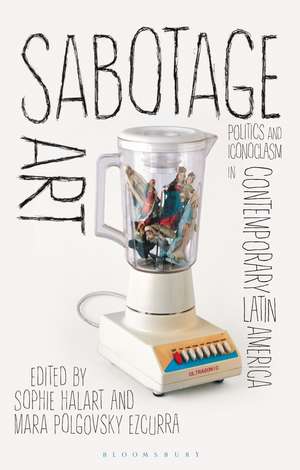
Sabotage Art: Politics and Iconoclasm in Contemporary Latin America
Editat de Sophie Halart, Mara Polgovsky Ezcurraen Limba Engleză Hardback – 31 mar 2016
Preț: 771.37 lei
Preț vechi: 1242.02 lei
-38%
Puncte Express: 1157
Carte disponibilă
Livrare economică 28 octombrie-11 noiembrie
Livrare prin curier în România Termenul estimat este afișat lângă disponibilitate.
Transport gratuit pentru acest produs Plată online sau ramburs, în funcție de opțiunile comenzii.
Retur gratuit în 14 zile Comandă securizată și suport în română.
Specificații
ISBN-13: 9781784532253
ISBN-10: 1784532258
Pagini: 256
Ilustrații: 56 bw integrated
Dimensiuni: 138 x 216 x 28 mm
Greutate: 0.45 kg
Editura: Bloomsbury Publishing
Colecția I.B.Tauris
Locul publicării:London, United Kingdom
ISBN-10: 1784532258
Pagini: 256
Ilustrații: 56 bw integrated
Dimensiuni: 138 x 216 x 28 mm
Greutate: 0.45 kg
Editura: Bloomsbury Publishing
Colecția I.B.Tauris
Locul publicării:London, United Kingdom
V-ar putea interesa
-
 The Avant Garde: A Very Short IntroductionDavid Cottington-20%Preț: 56.31 lei70.71 lei
 -
 -17%Preț: 90.66 lei109.40 lei
 -
 -22%Preț: 167.71 lei213.73 lei
 -
 Alberto Giacometti: The Art of RelationTimothy Mathews-19%Preț: 183.46 lei225.17 lei
 -
 -26%Preț: 172.03 lei231.87 lei
 -
 Aftershock: The Ethics of Contemporary Transgressive ArtKieran Cashell-20%Preț: 191.41 lei239.43 lei
 -
 Baudrillard Reframed: Interpreting Key Thinkers for the ArtsKim Toffoletti-23%Preț: 127.71 lei165.73 lei
 -
 Junk: Art and the Politics of TrashGillian Whiteley-20%Preț: 168.61 lei210.27 lei
Cuprins
Acknowledgements
List of Images
Introduction
Mara Polgovsky Ezcurra and Sophie Halart7
Part I: Ensnaring, Burning, Trespassing: Material Sabotage
1. Marta Minujin's Self-Sabotage: From Existentialism to Counterculture
Catherine Spencer19
2. Shaman, Thespian, Saboteur: Marcos Kurtycz and the Ritual Poetics of Iconoclasm
Mara Polgovsky Ezcurra40
3. Pictorial Eviscerations, Emblems, and Self-Immolation in Mexico: Dissensus in the work of Enrique Guzmán and Nahum B. Zenil
Erica Segre63
4. Bureaucratic Sabotage: Knocking at the door of the 'Big Monster'
Zanna Gilbert 69
Part II: Cannons and Canons: Explosive vs. Implosive Postures
5. Cogs and Clogs: Sabotage as Noise in Post-1960s Chilean and Argentine Art and Art History
Sophie Halart114
6. Impossible Objects: Gabriel Orozco's Empty Shoe Box and Yielding Stone
Natasha Adamou 137
7. El Museo de la Calle. Art, Economy and the Paradoxes of Bartering
Olga Fernández López157
8. Stay at Your Own Risk: Disturbing Ideas of Community in Two Projects by Elkin Calderón
Carla Macchiavello177
9. 'The Space of Appearance': Performativity and Aesthetics in the Politicization of Mexico's Public Sphere
Robin Greeley196
Notes on Contributors
Index
Images
List of Images
Introduction
Mara Polgovsky Ezcurra and Sophie Halart7
Part I: Ensnaring, Burning, Trespassing: Material Sabotage
1. Marta Minujin's Self-Sabotage: From Existentialism to Counterculture
Catherine Spencer19
2. Shaman, Thespian, Saboteur: Marcos Kurtycz and the Ritual Poetics of Iconoclasm
Mara Polgovsky Ezcurra40
3. Pictorial Eviscerations, Emblems, and Self-Immolation in Mexico: Dissensus in the work of Enrique Guzmán and Nahum B. Zenil
Erica Segre63
4. Bureaucratic Sabotage: Knocking at the door of the 'Big Monster'
Zanna Gilbert 69
Part II: Cannons and Canons: Explosive vs. Implosive Postures
5. Cogs and Clogs: Sabotage as Noise in Post-1960s Chilean and Argentine Art and Art History
Sophie Halart114
6. Impossible Objects: Gabriel Orozco's Empty Shoe Box and Yielding Stone
Natasha Adamou 137
7. El Museo de la Calle. Art, Economy and the Paradoxes of Bartering
Olga Fernández López157
8. Stay at Your Own Risk: Disturbing Ideas of Community in Two Projects by Elkin Calderón
Carla Macchiavello177
9. 'The Space of Appearance': Performativity and Aesthetics in the Politicization of Mexico's Public Sphere
Robin Greeley196
Notes on Contributors
Index
Images
Recenzii
Nelly Richard once commented on the difficulty of reading the politics of Latin American contemporary art abroad without reducing the works to a testimonial function or, alternatively, stripping them of their incisive concreteness. This wonderful collection speaks to the emergence of a critical discourse on Latin American art that manages to hold form and politics not just in the balance but to read one through the other: a truly groundbreaking achievement.
Sabotage Art provides a welcome shift of emphasis amidst perennial redefinitions of "political art" in Latin America. Framing sabotage as a "positional choice with regard to the institution" allows Halart, Polgovsky Ezcurra and their collaborators to critically interrogate the longstanding association of Latin American art with struggle or "adversity" for both historical case studies and the market delirium over "contemporary art". This book makes for an excellent teaching resource on overlooked artists such as Paulo Bruscky, Enrique Guzman, Marcos Kurtycz, and Edgardo Antonio Vigo, offers fresh examinations of canonized avant-gardes in Argentina and Chile, and considers recent participatory projects in Bogotá and Mexico City. Yet it is most valuable in the sum total of its discrete chapters, which together demonstrate a range of new methods for a field now hitting its stride.
Sabotage Art provides a welcome shift of emphasis amidst perennial redefinitions of "political art" in Latin America. Framing sabotage as a "positional choice with regard to the institution" allows Halart, Polgovsky Ezcurra and their collaborators to critically interrogate the longstanding association of Latin American art with struggle or "adversity" for both historical case studies and the market delirium over "contemporary art". This book makes for an excellent teaching resource on overlooked artists such as Paulo Bruscky, Enrique Guzman, Marcos Kurtycz, and Edgardo Antonio Vigo, offers fresh examinations of canonized avant-gardes in Argentina and Chile, and considers recent participatory projects in Bogotá and Mexico City. Yet it is most valuable in the sum total of its discrete chapters, which together demonstrate a range of new methods for a field now hitting its stride.