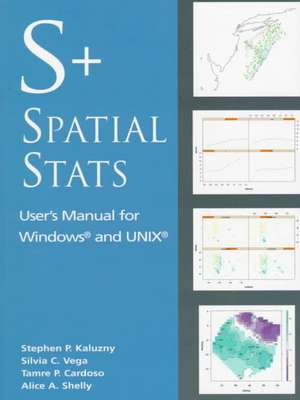
S+SpatialStats: User’s Manual for Windows® and UNIX®
Autor Stephen P. Kaluzny, Silvia C. Vega, Tamre P. Cardoso, Alice A. Shellyen Limba Engleză Paperback – 24 mar 1998
Preț: 620.55 lei
Preț vechi: 730.06 lei
-15%
Puncte Express: 931
Carte tipărită la comandă
Livrare economică 28 noiembrie-12 decembrie
Livrare prin curier în România Termenul estimat este afișat lângă disponibilitate.
Transport gratuit pentru acest produs Plată online sau ramburs, în funcție de opțiunile comenzii.
Retur gratuit în 14 zile Comandă securizată și suport în română.
Specificații
ISBN-13: 9780387982267
ISBN-10: 0387982264
Pagini: 328
Ilustrații: XVI, 328 p.
Dimensiuni: 178 x 235 x 17 mm
Greutate: 0.56 kg
Ediția:1998
Editura: Springer
Colecția Springer
Locul publicării:New York, NY, United States
ISBN-10: 0387982264
Pagini: 328
Ilustrații: XVI, 328 p.
Dimensiuni: 178 x 235 x 17 mm
Greutate: 0.56 kg
Ediția:1998
Editura: Springer
Colecția Springer
Locul publicării:New York, NY, United States
V-ar putea interesa
-
 -20%Preț: 564.35 lei705.43 lei
 -
 Data Analysis and Graphics Using RJohn Maindonald-20%Preț: 760.71 lei950.88 lei
 -
 TI-Nspire For DummiesJeff Mccalla-20%Preț: 119.21 lei149.02 lei
 -
 Beginning R - The Statistical Programming LanguageMark Gardener-20%Preț: 177.32 lei221.66 lei
 -
 Preț: 267.25 lei
 -
 MATLAB Optimization TechniquesCesar Lopez-20%Preț: 462.89 lei578.61 lei
 -
 The Art of R ProgrammingNorman Matloff-35%Preț: 253.50 lei392.87 lei
 -
 IBM SPSS Statistics 19 Made SimpleColin D. Gray-20%Preț: 454.13 lei567.67 lei
 -
 MATLAB® for Engineers ExplainedFredrik Gustafsson-20%Preț: 347.32 lei434.15 lei
 -
 First Guide to Statistical Computations in RTorben Martinussen-34%Preț: 131.01 lei199.05 lei
Public țintă
ResearchCuprins
1 Introduction to Spatial Data and S+SpatialStats.- 1.1 Types of Spatial Data.- 1.2 Analysis of Spatial Data.- 1.3 Stochastic Model for Spatial Data.- 1.4 Spatial Analysis Tools in S+SpatialStats.- 1.5 Limitations.- 2 Getting Started with S+SpatialStats.- 2.1 Starting and Quitting S+SpatialStats.- 2.2 Getting Help for S+SpatialStats Functions in Windows.- 2.3 Graphics Devices.- 2.4 Using Trellis Graphics in S+SpatialStats.- 2.5 Importing and Exporting Spatial Data.- 2.6 Sample Data Sets Available in S+SpatialStats.- 3 Visualizing Spatial Data.- 3.1 EDA Tools.- 3.2 Applications of EDA to Geostatistical Data.- 3.3 Applications of EDA to Lattice Data.- 3.4 Applications of EDA to Point Patterns.- 3.5 Hexagonal Binning.- 4 Analyzing Geostatistical Data.- 4.1 Variogram Estimation.- 4.2 Modeling the Empirical Variogram.- 4.3 Kriging.- 4.4 Simulating Geostatistical Data.- 5 Analyzing Lattice Data.- 5.1 Spatial Neighbors.- 5.2 Spatial Autocorrelation.- 5.3 Spatial Regression Models.- 5.4 Simulating Lattice Data.- 6 Analyzing Spatial Point Patterns.- 6.1 Objects of Class “spp”.- 6.2 Measures of Spatial Randomness.- 6.3 Examining First- and Second-Order Properties.- 6.4 Simulating Point Patterns.- 7 S+SpatialStats and GIS.- 7.1 ARC/INFO Coverages and Spatial Data Analysis.- 7.2 Example: Analysis of a Point Coverage.- 7.3 Example: Analysis of a Polygon Coverage.- 7.4 Example: Analysis of a Grid.- Appendices.- A.1.1 Requirements.- A.1.2 Installation Procedure.- A.1.3 Verifying Installation.- C Sample Data Sets.- D Function Reference.
Recenzii
From a review:
SHORT BOOK REVIEWS
"The book is well laid out, similar in style to a number of LaTex manuals, which I find aesthetically pleasing and easy to navigate. A concise introduction gives a good overview of the three types of spatial data and some associated spatial statistical concepts. ... I highly recommend this book."
Caracteristici
The only manual available for this S-PLUS software module * S-PLUS books continue to be fast-sellers as use of the software is rapidly growing * First comprehensive, object-oriented package for the analysis of spatial data * Used to analyze data in environmental, mining, and petroleum engineering; natural resources; geography; epidemiology; demography For both Windows and UNIX platforms