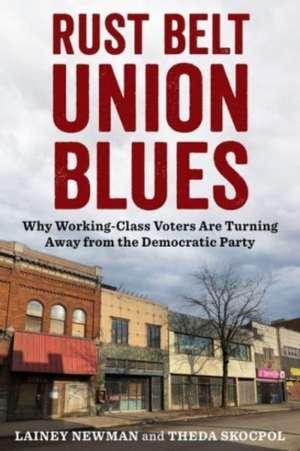
Rust Belt Union Blues
Autor Lainey Newman, Theda Skocpolen Limba Engleză Hardback – 19 sep 2023
Descoperim în Rust Belt Union Blues o perspectivă inedită asupra declinului sindicalismului american, care nu se limitează la factori economici, ci investighează erodarea legăturilor comunitare. Ceea ce aduce nou lucrarea semnată de Lainey Newman și Theda Skocpol este demonstrația faptului că loialitatea politică a muncitorilor nu era bazată doar pe avantaje financiare, ci pe o identitate socială profundă, cultivată în afara orelor de program. Remarcăm rigurozitatea cu care autoarele documentează modul în care „omul de sindicat” a fost înlocuit de structuri alternative de socializare, precum cluburile de tir sau mega-bisericile, care au reorientat busola politică spre conservatorism. Comparabil cu The Decline of Organized Labor in the United States de Michael Goldfield în rigurozitate, volumul de față este însă actualizat pentru a explica ascensiunea populismului de tip Trump în regiunile industriale. Structura cărții este concepută pentru a ghida cititorul de la fundamentele sociale ale sindicatelor postbelice (Capitolul 2), prin criza economică internă și externă a marilor organizații de muncă, până la analiza actuală a tiparelor de vot din Pennsylvania. Apreciem utilizarea anexelor ce conțin întrebări de interviu și analize vizuale ale buletinelor informative, oferind o bază factuală solidă pentru concluzia că democrații și-au pierdut credibilitatea prin dispariția din viața cotidiană a muncitorilor. Este o analiză esențială pentru înțelegerea modului în care identitatea socială dictează comportamentul electoral în secolul XXI.
Preț: 175.41 lei
Carte disponibilă
Livrare economică 02-16 noiembrie
Livrare express 16-22 octombrie pentru 34.04 lei
Specificații
ISBN-10: 0231208820
Pagini: 328
Dimensiuni: 224 x 148 x 25 mm
Greutate: 0.52 kg
Editura: Columbia University Press
V-ar putea interesa
-
 -34%Preț: 759.22 lei1147.46 lei
 -
 -20%Preț: 96.71 lei120.37 lei
 -
 -8%Preț: 575.26 lei625.29 lei
 -
 Does Policy Analysis Matter?Lee S. FriedmanPreț: 234.82 lei
 -
 Vision and Method in Historical SociologyTheda SkocpolPreț: 401.19 lei
 -
 Social Revolutions in the Modern WorldTheda SkocpolPreț: 250.07 lei
 -
 Preț: 315.23 lei
 -
 Preț: 383.29 lei
 -
 The Politics of Social Policy in the United StatesMargaret Weir-19%Preț: 526.47 lei649.97 lei
 -
 Trading Barriers – Immigration and the Remaking of GlobalizationMargaret Peters-23%Preț: 698.38 lei906.98 lei
 -
 Communism`s Shadow – Historical Legacies and Contemporary Political AttitudesGrigore Pop–eleches-27%Preț: 697.55 lei955.54 lei
 -
 Citizenship, Identity and Belonging in KenyaZarina PatelPreț: 80.56 lei
 -
 States and Social RevolutionsTheda SkocpolPreț: 142.32 lei
 -
 -18%Preț: 1251.34 lei1526.02 lei
 -
 Algeria and France: From Colonialism to CooperationDorothy PicklesPreț: 389.62 lei
 -
 The Nature of the Italian Party System: A Regional Case StudyGeoffrey PridhamPreț: 410.99 lei
 -
 International Diplomacy and Colonial RetreatKent FedorowichPreț: 472.93 lei
 -
 Four Studies on the Economic Development of TurkeyJohn F. KolarsPreț: 470.92 lei
 -
 Preț: 478.45 lei
 -
 Physicians and the Peace MovementNick LewerPreț: 464.26 lei
 -
 -33%Preț: 639.19 lei958.19 lei
 -
 -27%Preț: 78.93 lei107.69 lei
 -
 Preț: 312.23 lei
De ce să citești această carte
Această lucrare publicată de Columbia University Press este indispensabilă pentru cei care doresc să înțeleagă rădăcinile sociologice ale schimbărilor politice din SUA. Cititorul câștigă o perspectivă clară asupra modului în care pierderea comunităților sindicale a lăsat un vid social umplut de mișcări conservatoare. Este o resursă valoroasă pentru studenții la științe politice și sociologie care caută să explice fenomenul „Trump Red” dincolo de simplele statistici economice.
Cuprins
Acknowledgments
List of Figures and Tables
1. Understanding Social and Political Change in the Rust Belt
2. The Social Underpinnings of the ¿Union Man¿
3. The Economic Breakdown of Big Labor from Without and Within
4. Union Membership Transformed
5. From Union Blue to Trump Red
6. On Union Decline and the Potential for Resurgence
Appendix A. Voting Patterns in Western Pennsylvania
Appendix B. Sample Interview Questions
Appendix C. Photographs in IBEW and USW Newsletters
Appendix D. Local Union Mentions in IBEW and USW Newsletters
Notes
Glossary
Index
Descriere
In the heyday of American labor, the influence of local unions extended far beyond the workplace. Unions were embedded in tight-knit communities, touching nearly every aspect of the lives of members--mostly men--and their families and neighbors. They conveyed fundamental worldviews, making blue-collar unionists into loyal Democrats who saw the party as on the side of the working man. Today, unions play a much less significant role in American life. In industrial and formerly industrial Rust Belt towns, Republican-leaning groups and outlooks have burgeoned among the kinds of voters who once would have been part of union communities. Lainey Newman and Theda Skocpol provide timely insight into the relationship between the decline of unions and the shift of working-class voters away from Democrats. Drawing on interviews, union newsletters, and ethnographic analysis, they pinpoint the significance of eroding local community ties and identities. Using western Pennsylvania as a case study, Newman and Skocpol argue that union members' loyalty to Democratic candidates was as much a product of the group identity that unions fostered as it was a response to the Democratic Party's economic policies. As the social world around organized labor dissipated, conservative institutions like gun clubs, megachurches, and other Republican-leaning groups took its place. Rust Belt Union Blues sheds new light on why so many union members have dramatically changed their party politics. It makes a compelling case that Democrats are unlikely to rebuild credibility in places like western Pennsylvania unless they find new ways to weave themselves into the daily lives of workers and their families.