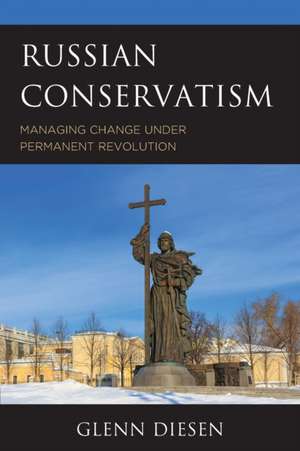
Russian Conservatism: Managing Change under Permanent Revolution
Autor Glenn Diesenen Limba Engleză Paperback – 19 aug 2022
Preț: 221.74 lei
Preț vechi: 307.44 lei
-28%
Puncte Express: 333
Carte tipărită la comandă
Livrare economică 07-21 decembrie
Livrare prin curier în România Termenul estimat este afișat lângă disponibilitate.
Transport gratuit de la 400.00 lei Plată online sau ramburs, în funcție de opțiunile comenzii.
Retur gratuit în 14 zile Comandă securizată și suport în română.
Specificații
ISBN-13: 9781538150009
ISBN-10: 153815000X
Pagini: 256
Dimensiuni: 150 x 228 x 18 mm
Greutate: 0.38 kg
Editura: Bloomsbury Publishing
Colecția Rowman & Littlefield
Locul publicării:New York, United States
ISBN-10: 153815000X
Pagini: 256
Dimensiuni: 150 x 228 x 18 mm
Greutate: 0.38 kg
Editura: Bloomsbury Publishing
Colecția Rowman & Littlefield
Locul publicării:New York, United States
Cuprins
Foreword by Vladimir Yakunin
Introduction
1. Theorising Russian Conservatism
2. The Eurasian Schism in Russian Conservatism
3. The Rise of Conservatism from the Early 19th Century
4. After the Crimean War: The Great Reforms and Revolutions
5. Reforming the Concept of a Conservative Political Economy
6. Conservatism Under Communism and the Advent of Eurasiansim
7. The Liberal Revolution of the 1990s
8. The Return of Russian Conservatism under Putin
9. The End of the Occidental Era and the Birth of Greater Eurasia
10. Russia as an International Conservative Power
Conclusion: Taming Russia's Revolutionary Impulses
Bibliography
Introduction
1. Theorising Russian Conservatism
2. The Eurasian Schism in Russian Conservatism
3. The Rise of Conservatism from the Early 19th Century
4. After the Crimean War: The Great Reforms and Revolutions
5. Reforming the Concept of a Conservative Political Economy
6. Conservatism Under Communism and the Advent of Eurasiansim
7. The Liberal Revolution of the 1990s
8. The Return of Russian Conservatism under Putin
9. The End of the Occidental Era and the Birth of Greater Eurasia
10. Russia as an International Conservative Power
Conclusion: Taming Russia's Revolutionary Impulses
Bibliography
Recenzii
A remarkably well researched and intellectually persuasive book. Glenn Diesen manages to elegantly avoid biases of Russian and foreign authors writing on the subject. And it is highly relevant in the times of the unleashing struggle to fill the ideological void created by evaporation of communism and liberalism. A must reading for Russian intellectual class, too."
A much needed study of Russian political philosophy that casts important light on Russian politics today."
There is nothing more revolutionary in Russia than conservatism - the evolutionary adaptation to change and necessity. This paradox lies at the heart of Diesen's original and challenging study. He analyses how Russian conservatism is developing in the context of restoring political subjectivity to Eurasia and the emergence of post-Western ideas of modernity. This is an essential contribution to important debates.
A long-awaited comprehensive study of the genesis, historical evolution and modern manifestations of the Russian conservatism. The author did a great job in demystifying the conservative mindset in Russia and in explaining its spectacular resilience.
The author's detailed scientific work presents the historical evolution and role of Russian conservatism to explain the continued relevance of traditional Russian civilizational ideas. Deserving of special attention, the author concludes that contemporary conservatism intensifies competition between various civilization projects, which marks the return to Russia's pre-revolutionary interpretations of its metaphysical place and role in the world - as a possible saviour of Europe (the West) from the inevitable catastrophic consequences of the universalist model of economic, political and social development.
There is a lot to internalize and learn from this book.... [T]his is a welcome contribution to a theoretical framework. Political science in general, and International Relations in particular, is not known for its reactionary biases, to put it mildly, and therefore by definition lacks theoretical contributions from that side, which is a disservice to a neutral study of historical analysis. In that light, this book fills a notable gap.
A much needed study of Russian political philosophy that casts important light on Russian politics today."
There is nothing more revolutionary in Russia than conservatism - the evolutionary adaptation to change and necessity. This paradox lies at the heart of Diesen's original and challenging study. He analyses how Russian conservatism is developing in the context of restoring political subjectivity to Eurasia and the emergence of post-Western ideas of modernity. This is an essential contribution to important debates.
A long-awaited comprehensive study of the genesis, historical evolution and modern manifestations of the Russian conservatism. The author did a great job in demystifying the conservative mindset in Russia and in explaining its spectacular resilience.
The author's detailed scientific work presents the historical evolution and role of Russian conservatism to explain the continued relevance of traditional Russian civilizational ideas. Deserving of special attention, the author concludes that contemporary conservatism intensifies competition between various civilization projects, which marks the return to Russia's pre-revolutionary interpretations of its metaphysical place and role in the world - as a possible saviour of Europe (the West) from the inevitable catastrophic consequences of the universalist model of economic, political and social development.
There is a lot to internalize and learn from this book.... [T]his is a welcome contribution to a theoretical framework. Political science in general, and International Relations in particular, is not known for its reactionary biases, to put it mildly, and therefore by definition lacks theoretical contributions from that side, which is a disservice to a neutral study of historical analysis. In that light, this book fills a notable gap.