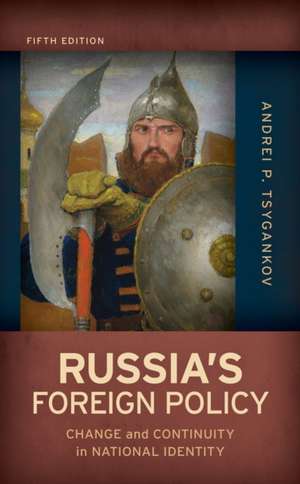
Russia's Foreign Policy: Change and Continuity in National Identity
Autor Andrei P. Tsygankoven Limba Engleză Paperback – 10 feb 2019
Preț: 357.25 lei
Carte tipărită la comandă
Livrare economică 09-23 iunie
Specificații
ISBN-10: 1538124076
Pagini: 312
Dimensiuni: 152 x 229 x 19 mm
Greutate: 0.45 kg
Editura: Rowman & Littlefield
V-ar putea interesa

Descriere
Now fully updated and revised, this clear and comprehensive text explores the past thirty years of Soviet/Russian international relations, comparing foreign policy formation under Gorbachev, Yeltsin, Medvedev, and Putin. Challenging conventional views of Moscow's foreign policy, Andrei Tsygankov shows that definitions of national interest depend on visions of national identity and is rooted both in history and domestic politics. Yet the author also highlights the role of the external environment in affecting the balance of power among competing domestic groups.
Drawing on both Russian and Western sources, Tsygankov shows how Moscow's policies have shifted under different leaders' visions of Russia's national interests. He gives an overview of the ideas and pressures that motivated Russian foreign policy in six different periods: the Gorbachev era of the late 1980s, the liberal "Westernizers" era under Kozyrev in the early 1990s, the relatively hardline statist policy under Primakov, the more pragmatic course of limited cooperation under Putin and then Medvedev, and the assertive policy Putin has implemented since his return to power. Evaluating the successes and failures of Russia's foreign policies, Tsygankov explains its many turns as Russia's identity and interaction with the West have evolved.
The book concludes with reflections on the emergence of the post-Western world and the challenges it presents to Russia's enduring quest for great-power status along with its desire for a special relationship with Western nations.
Cuprins
Note on the Transliteration
Chronology of Key Foreign Policy Events, 1979-2022
Preface
1. Understanding Change and Continuity in Russia's Foreign Policy
2. The Cold War Crisis and the New Thinking, 1985-1991
3. The Post-Soviet Decline and Attempts at Cooperation, 1991-2004
4. Recovery and Assertiveness, 2005-2011
5. Civilizational Turn and New Assertiveness, 2012-2020
6. The Russia-West Crisis, the War in Ukraine, and a Post-Western World, 2021-
7. Conclusion and Lessons
Further Reading
Essay Questions
Topics for Discussion or Simulation
Recenzii
This newest edition of Russia's Foreign Policy: Change and Continuity in National Identity, as earlier ones, provides a superb treatment of Russian foreign policy by one of the leading analysts in the field. Tsygankov is especially strong in his focus on the factors that influence the decision making, not just on the policy and its successes and failures.
In this sixth edition Andrei Tsygankov demonstrates once again his wide ranging and in depth knowledge of Russian foreign policy and domestic politics. Importantly, he never loses sight of the longue duree of Russian politics and history, situating more contemporary events in the appropriate cultural and historical context. This book is invaluable in showing how Russian foreign policy is situated in civilizational discourses which are increasingly relevant across the globe.
[While] Tsygankov points out the importance of the Western recognition of Russia in shaping Russian foreign policy, he also highlights the domestic factors and developments that resulted in Russian assertiveness. This book is a must-read for those who want to understand how Russia and the West ended up in today's stalemate over international issues.