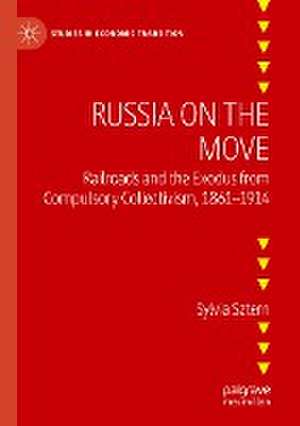
Russia on the Move: Studies in Economic Transition
Autor Sylvia Szternen Limba Engleză Paperback – 20 feb 2023
This book highlights the profound effect that the development of the railroads had on Russian economic and political institutions and practices. It will be of indispensable valueto students and researchers interested in transitional economics and economic history.
Din seria Studies in Economic Transition
- 18%
 Preț: 960.64 lei
 - 18%
 Preț: 1089.28 lei
 -
 Preț: 374.56 lei
 - 18%
 Preț: 702.65 lei
 - 18%
 Preț: 859.76 lei
 - 15%
 Preț: 612.68 lei
 - 15%
 Preț: 619.41 lei
 -
 Preț: 372.13 lei
 -
 Preț: 341.50 lei
 - 15%
 Preț: 611.12 lei
 - 15%
 Preț: 614.25 lei
 - 18%
 Preț: 862.50 lei
 - 15%
 Preț: 610.96 lei
 -
 Preț: 369.02 lei
 - 18%
 Preț: 961.09 lei
 -
 Preț: 376.23 lei
 - 15%
 Preț: 611.43 lei
 - 15%
 Preț: 613.94 lei
 - 18%
 Preț: 706.34 lei
 - 18%
 Preț: 705.84 lei
 -
 Preț: 374.14 lei
 - 18%
 Preț: 703.43 lei
 - 18%
 Preț: 702.51 lei
 - 15%
 Preț: 608.46 lei
 - 15%
 Preț: 616.63 lei
 - 15%
 Preț: 614.11 lei
 - 15%
 Preț: 620.03 lei
 - 15%
 Preț: 616.63 lei
 - 15%
 Preț: 616.45 lei
 -
 Preț: 377.91 lei
 - 18%
 Preț: 816.24 lei
 -
 Preț: 373.98 lei
 - 15%
 Preț: 616.01 lei
 - 18%
 Preț: 752.14 lei
 - 15%
 Preț: 617.95 lei
 - 28%
 Preț: 593.55 lei
Preț: 682.34 lei
Preț vechi: 802.75 lei
-15%
Puncte Express: 1024
Carte tipărită la comandă
Livrare economică 08-22 iunie
Specificații
ISBN-13: 9783030892876
ISBN-10: 3030892875
Pagini: 548
Ilustrații: XXXI, 513 p. 39 illus., 37 illus. in color.
Dimensiuni: 148 x 210 x 30 mm
Greutate: 0.7 kg
Ediția:1st ed. 2022
Editura: Palgrave MacMillan
Colecția Studies in Economic Transition
Seria Studies in Economic Transition
Locul publicării:Cham, Switzerland
ISBN-10: 3030892875
Pagini: 548
Ilustrații: XXXI, 513 p. 39 illus., 37 illus. in color.
Dimensiuni: 148 x 210 x 30 mm
Greutate: 0.7 kg
Ediția:1st ed. 2022
Editura: Palgrave MacMillan
Colecția Studies in Economic Transition
Seria Studies in Economic Transition
Locul publicării:Cham, Switzerland
Cuprins
1. Russia on the Move: Railroads and the Exodus from Compulsory Collectivism, 1861–1914.- 2. From Hierarchy to Egalitarianism: From Gerschenkron to Gregory—Deduction and Induction from NIE/AEI Complementarity and the Regulationist Model.- 3. Through the Lenses of Theory: New Institutional Economics and American Evolutionary Institutionalism— Railroads, Specialization, and Democracy in Late Tsarist Russia.- 4. Industrialization as a Precipitant of Tensions Between Tsardom and Nascent Civil Society.- 5. Peasantry and Land in Industrializing Late Tsarist Russia.- 6. The Railroads and the Metamorphoses of the Mir: Westernizer and Slavophile Conceptions Revisited.- 7. Secularization and Pious Subversion: To the Constitution by Rail.- 8. From Janus to Janus: Peter I, Nicholas II, and Industrialization.- 9. Was Stalin Necessary? Railroads and the Crumbling of the Obshchina in Tsarist Russia.- 10. Individualism and Collectivism: Measuring the Transition to Modernity in Tsarist RussianPeasant Society, Penza Province, 1913.- 11. Measurable Power: Railroads, Literacy, and the Crafts Artel—Hierarchy in Disarray in Late Imperial Russia.- 12. Epilogue.
Textul de pe ultima copertă
This book explores the impact of railroads on 19thcentury Russian peasant collectivism. The mutual-insurance mechanism in a precarious agricultural environment, provided bya structured communal-village system predicated on the reputation and authorityof community norms,is exposed to rationalist exchange—occasioning an institutional adaptation process:the individualization of property rights in land. Spatial-mobility technology animated market integration, specialization, literacy,and human-capital acquisition among peasant wage workers who commuted from their villages.Temporarily rising transaction costs forced the Tsar to concede household property rights in land in the so-called Stolypin reform of 1906.This challenge to the imperial patrimony, powered by the railroads, steered late imperial Russia toward constitutional governance.The spatial-mobility technology gave peasants access to centers of agglomeration of knowledge, changedcognitive perceptions of distance, and reduced the uncertainty and opportunity costs of travel. The empirical findings in this monograph corroborate the conclusion that the railroads occasioned a cultural revolution in late imperial Russia and made Stalin unnecessary for the modernization of the Euro-asian giant.
This book highlights the profound effect that the development of the railroads had on Russian economic and political institutions and practices. It will be of indispensable valueto students and researchers interested in transitional economics and economic history.
Sylvia Sztern is a post-doctoral fellow at the Hebrew University of Jerusalem.
This book highlights the profound effect that the development of the railroads had on Russian economic and political institutions and practices. It will be of indispensable valueto students and researchers interested in transitional economics and economic history.
Sylvia Sztern is a post-doctoral fellow at the Hebrew University of Jerusalem.
Caracteristici
Details the impact modernization and technology had on the economic attitudes of late Tsarist Russia Utilises mutual-dependence models of land cultivation to highlight the emergence of voluntary cooperation Uses econometric methods to provide insight into the impact of railroad technology on property rights