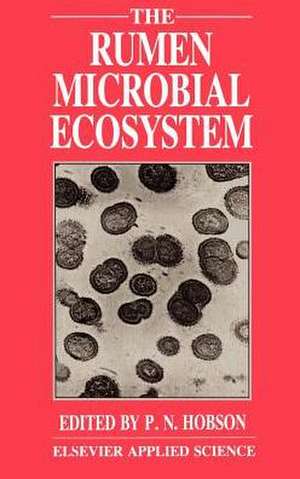
Rumen Microbial Ecosystem
Editat de P.N. Hobson, C. S. Stewarten Limba Engleză Hardback – 31 dec 1988
Preț: 1761.90 lei
Preț vechi: 2148.66 lei
-18%
Puncte Express: 2643
Carte tipărită la comandă
Livrare economică 17 noiembrie-01 decembrie
Livrare prin curier în România Termenul estimat este afișat lângă disponibilitate.
Transport gratuit pentru acest produs Plată online sau ramburs, în funcție de opțiunile comenzii.
Retur gratuit în 14 zile Comandă securizată și suport în română.
Specificații
ISBN-13: 9781851661886
ISBN-10: 1851661883
Pagini: 540
Ilustrații: XII, 527 p.
Dimensiuni: 178 x 254 x 34 mm
Greutate: 0.93 kg
Ediția:1989
Editura: SPRINGER NETHERLANDS
Colecția Springer
Locul publicării:Dordrecht, Netherlands
ISBN-10: 1851661883
Pagini: 540
Ilustrații: XII, 527 p.
Dimensiuni: 178 x 254 x 34 mm
Greutate: 0.93 kg
Ediția:1989
Editura: SPRINGER NETHERLANDS
Colecția Springer
Locul publicării:Dordrecht, Netherlands
V-ar putea interesa
-
 Microbial Pest ControlSushil Khetan-15%Preț: 579.34 lei681.58 lei
 -
 Insect Cell Culture EngineeringMattheus F. A. Goosen-15%Preț: 533.11 lei627.19 lei
 -
 Feathered Critter Friends Vol. IIIRob BentonPreț: 310.51 lei
 -
 Feathered Critter Friends Vol. IVRob BentonPreț: 310.51 lei
 -
 Brazil and La PlataC S StewartPreț: 225.45 lei
 -
 A Residence in the Sandwich Islands.C S StewartPreț: 196.87 lei
 -
 Preț: 197.31 lei
 -
 A Residence In The Sandwich IslandsC. S. StewartPreț: 199.36 lei
 -
 Preț: 67.21 lei
 -
 Preț: 67.21 lei
 -
 Éléments de l'histoire naturelle des animaux. Partie 2Alphonse Milne-EdwardsPreț: 200.29 lei
 -
 Essai d'une faune entomologique de l'archipel indo-néerlandais. Famille des pentatomidesSnellen van VollenhovenPreț: 94.91 lei
 -
 Preț: 86.37 lei
 -
 Preț: 87.25 lei
 -
 Preț: 362.06 lei
 -
 L'homme et les animaux. Les reptiles et les batraciensAlfred Edmund BrehmPreț: 329.19 lei
 -
 -18%Preț: 750.75 lei915.55 lei
 -
 Von Wundern und TierenWilhelm BölschePreț: 179.85 lei
 -
 Organismal and Molecular MalacologySajal Ray-23%Preț: 798.05 lei1036.43 lei
 -
 -23%Preț: 1240.72 lei1611.33 lei
Public țintă
ResearchCuprins
1 Introduction.- 1.1 Humans and herbivores.- 1.2 The ruminants.- 1.3 The rumen and its development.- 1.4 The functioning rumen.- 1.5 The future.- References.- 2 The rumen bacteria.- 2.1 Substrate specificities of rumen bacteria.- 2.2 Major groups of rumen bacteria.- 2.3 Methods for the isolation, enumeration and cultivation of rumen bacteria.- References.- 3 The rumen protozoa.- 3.1 The entodiniomorphid protozoa.- 3.2 The holotrich protozoa.- 3.3 Interaction of rumen ciliates with other microbial groups in the rumen.- 3.4 The importance of protozoa to the ruminant.- References.- 4 The rumen anaerobic fungi.- 4.1 Taxonomy.- 4.2 Genera and species.- 4.3 Fine structure.- 4.4 Life cycles in vivo.- 4.5 Estimation of population density and biomass.- 4.6 Isolation and culture.- 4.7 Chemical composition.- 4.8 Intermediary metabolism.- 4.9 Fermentation of carbohydrates.- 4.10 Enzymology of lignocellulose catabolism by rumen anaerobic fungi.- 4.11 Nucleic acids of anaerobic fungi.- 4.12 Cloning genes of rumen fungi.- 4.13 Regulation of lignocellulolytic enzyme production in rumen fungi.- 4.14 Attack on plant tissues.- 4.15 Fungal interactions with rumen bacteria.- 4.16 Fungal interactions with rumen protozoa.- 4.17 Transfer between animals.- 4.18 Antibiotic sensitivities.- 4.19 Effects of diet on rumen fungal populations.- 4.20 Conclusions.- Acknowledgement.- References.- 5 Development of, and natural fluctuations in, rumen microbial populations.- 5.1 Rumen ciliate protozoa.- 5.2 Rumen flagellate protozoa.- 5.3 Anaerobic fungi.- 5.4 Rumen bacteria.- 5.5 Interrelationships between rumen microbial populations.- References.- 6 Energy-yielding and energy-consuming reactions.- 6.1 Strategies for rumen microorganisms.- 6.2 Energy-yielding reactions.- 6.3 Energy-consuming reactions.- 6.4 VFAs and low pH.- 6.5 Ionophores.- 6.6 Metabolic regulation.- 6.7 Starvation.- 6.8 Conclusions.- References.- 7 Metabolism of nitrogen-containing compounds.- 7.1 Flow of nitrogenous compounds through the rumen.- 7.2 Breakdown of dietary nitrogenous compounds.- 7.3 Anabolic nitrogen metabolism.- 7.4 Conclusion.- References.- 8 Polysaccharide degradation by rumen microorganisms.- 8.1 Structure and digestion of plant storage polysaccharides.- 8.2 Structure of plant cell walls.- 8.3 Digestion of plant cell walls by rumen microorganisms.- 8.4 Limitations to polysaccharide degradation.- Acknowledgements.- References.- 9 Lipid metabolism in the rumen.- 9.1 Role of microorganisms in ruminant lipid metabolism.- 9.2 Composition of dietary lipids.- 9.3 Hydrolysis of dietary lipids.- 9.4 Biohydrogenation in the rumen.- 9.5 Other lipid transformations.- 9.6 Effect of lipids on rumen fermentation.- 9.7 Composition of microbial lipids.- 9.8 Biosynthesis of microbial lipids.- 9.9 Conclusions.- References.- 10 Genetics of rumen bacteria.- 10.1 Molecular ecology.- 10.2 Mutagenesis in rumen bacteria.- 10.3 Gene and protein structure and expression in rumen bacteria.- 10.4 Gene transfer in rumen bacteria.- 10.5 Conclusions.- References.- 11 Microbe-microbe interactions.- 11.1 Nutritional interactions.- 11.2 Interactions and nitrogen compounds.- 11.3 Carbohydrate fermentation.- 11.4 Amensalistic interactions.- 11.5 Interactions and diversity.- References.- 12 Compartmentation in the rumen.- 12.1 Compartmental models.- 12.2 The rumen simulation technique (Rusitec): a model multicompartment system.- 12.3 The rumen as a multicompartment system.- 12.4 Some consequences of compartmentation in the rumen.- 12.5 Concluding remarks.- References.- 13 Manipulation of ruminal fermentation.- 13.1 Therumen fermentation.- 13.2 The aim in manipulating ruminal fermentation.- 13.3 Modification of the ruminal fermentation pattern.- 13.4 Approaches to modification of ruminal fermentation.- 13.5 Modifiers of ruminal microbial activity.- 13.6 Conclusions.- References.- 14 Digestive disorders and nutritional toxicity.- 14.1 Rumen dysfunctions associated with microbial activities.- 14.2 Neurological dysfunctions associated with microbial activities in the rumen.- 14.3 Microbial transformation.- 14.4 Strategies for addressing toxicity problems in ruminants.- References.- 15 Biological models of the rumen function.- 15.1 Defined bacterial populations without protozoa.- 15.2 The young ruminant.- 15.3 The ‘adult’ ruminant.- References.- 16 Rumen mathematical modelling.- 16.1 Rumen models.- 16.2 History of fermenter and rumen modelling.- 16.3 Modelling the main digestive events.- 16.4 Aggregation of several digestive events.- 16.5 Whole-rumen models.- 16.6 Conclusions.- References.