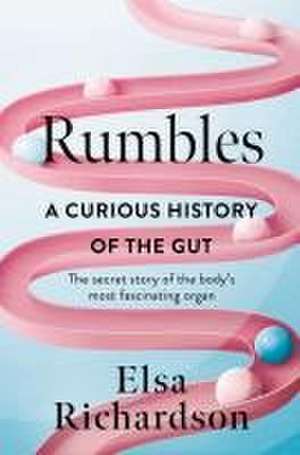
Rumbles
Autor Elsa Richardsonen Limba Engleză Hardback – oct 2024
Preț: 157.07 lei
Preț vechi: 165.33 lei
-5%
Puncte Express: 236
Carte disponibilă
Livrare economică 09-23 noiembrie
Livrare prin curier în România Termenul estimat este afișat lângă disponibilitate.
Transport gratuit de la 400.00 lei Plată online sau ramburs, în funcție de opțiunile comenzii.
Retur gratuit în 14 zile Comandă securizată și suport în română.
Specificații
ISBN-13: 9781639367245
ISBN-10: 1639367241
Pagini: 336
Dimensiuni: 160 x 232 x 30 mm
Greutate: 0.49 kg
Editura: Pegasusbooks
ISBN-10: 1639367241
Pagini: 336
Dimensiuni: 160 x 232 x 30 mm
Greutate: 0.49 kg
Editura: Pegasusbooks
V-ar putea interesa
-
 The Second BrainMichael GershonPreț: 107.09 lei
 -
 The Mind-Gut ConnectionEmeran MayerPreț: 107.34 lei
 -
 The Gut-Brain ParadoxMd Gundry-5%Preț: 178.31 lei187.69 lei
 -
 Why Do People Get Ill?Darian LeaderPreț: 116.92 lei
 -
 EmotionalLeonard Mlodinow-19%Preț: 63.69 lei78.82 lei
 -
 Preț: 91.50 lei
 -
 Madness: A Very Short IntroductionAndrew Scull-20%Preț: 57.15 lei71.12 lei
 -
 Gut: An Owner's GuideAustin Chiang-16%Preț: 92.67 lei110.80 lei
 -
 Soft: A Brief History of SentimentalityFerdinand Mount-25%Preț: 108.92 lei144.40 lei
 -
 Feeling Your Feelings: The Head-to-Toe Science of EmotionsTanya Lloyd Kyi-19%Preț: 99.08 lei122.03 lei
 -
 -18%Preț: 70.68 lei86.61 lei
 -
 Mind Your GutMegan Riehl-19%Preț: 99.70 lei122.71 lei
 -
 Introducing Mind and BrainAngus GellatlyPreț: 63.34 lei
 -
 Well BeingsJames RileyPreț: 95.16 lei
 -
 The Beating Heart: The Art and Science of Our Most Vital OrganRobin Choudhury-32%Preț: 184.62 lei270.97 lei
 -
 Hamel-Akre, J: Art of Not EatingJessica Hamel-Akre-23%Preț: 110.71 lei143.22 lei
 -
 The Art of Not EatingJessica Hamel-Akre-24%Preț: 79.32 lei103.82 lei
 -
 The Gut: A Pocket PrimerAmy Fleming-19%Preț: 52.09 lei64.24 lei
Notă biografică
Elsa Richardson is an academic at the University of Strathclyde. She holds a Chancellor's Fellowship in the History of Health and Wellbeing at the Centre for the Social History of Health and Healthcare. In addition to lecturing in the history of medicine and her own research, she also curates arts and science events for public institutions, including the Wellcome Collection. In 2018, she was named one of ten New Generation Thinkers by BBC Radio 3, BBC Arts, and the Arts and Humanities Research Council.
Recenzii
Absolutely delicious
A vivid cultural history of changing metaphorical, political and scientific visions of our guts
A brilliant new cultural history of the gut
I loved Rumbles - a fascinating, erudite and entertaining journey through the gut-brain connection that, despite the many claims of modern-day doctors, has fascinated physicians for hundreds of years
Fascinating ... a window onto our relationship with the gut as mediated by medicine, literature, politics and language.
Absorbing, serpentine ... Elsa Richardson has assembled a choice selection of ingredients.
A thrilling and surprising journey into the science and culture of an organ that refuses to be civilised
Rumbles is more than just an extremely entertaining romp through the history of the gut and all its literary, biomedical, metaphorical, and political permutations. Marshalling a wealth of resources, Richardson offers eye-popping (and sometimes gut-wrenching) insight into how our presumed cutting-edge understanding of the gut is not as new as we might want to believe. Rumbles will persuade you that to listen to the 'rumbles' of our gut is to immerse ourselves in an abiding historical legacy, for better or for worse
Rumbles is a charming, compelling compendium of ideas and a fascinating foray into corners of history. Richardson is interested in the gut's workings, but she is also interested in its symbolism, in other words, why we are all sick to our stomachs. Rumbles could not come at a more apt or more dyspeptic moment; its discussion of gut disease as an emblem of modernity leaves readers with much to digest. It is the perfect book for our golden age of indigestion.
Elsa Richardson's Rumbles surveys ideas about our digestive organs, from the suggestion by the Greek physician Galen that the stomach has its own intelligence, through dramatic metaphors of the body politic, and ideas of the intestines as a bustling Victorian kitchen, a delicate garden or an implacable enemy of human progress
Elsa Richardson's Rumbles also tries to recontextualise the past-and, by extension, the present. Her subject is the gut, a "confederacy of organs" that is often looked down upon in favour of the highfalutin accomplishments of the brain. However, the gut has a rich cultural history that ought to wow - rather than repel - us. Did you know, for instance, the classical physician Galen believed that the human digestive system is what enabled us to have a culture in the first place?
A vivid cultural history of changing metaphorical, political and scientific visions of our guts
A brilliant new cultural history of the gut
I loved Rumbles - a fascinating, erudite and entertaining journey through the gut-brain connection that, despite the many claims of modern-day doctors, has fascinated physicians for hundreds of years
Fascinating ... a window onto our relationship with the gut as mediated by medicine, literature, politics and language.
Absorbing, serpentine ... Elsa Richardson has assembled a choice selection of ingredients.
A thrilling and surprising journey into the science and culture of an organ that refuses to be civilised
Rumbles is more than just an extremely entertaining romp through the history of the gut and all its literary, biomedical, metaphorical, and political permutations. Marshalling a wealth of resources, Richardson offers eye-popping (and sometimes gut-wrenching) insight into how our presumed cutting-edge understanding of the gut is not as new as we might want to believe. Rumbles will persuade you that to listen to the 'rumbles' of our gut is to immerse ourselves in an abiding historical legacy, for better or for worse
Rumbles is a charming, compelling compendium of ideas and a fascinating foray into corners of history. Richardson is interested in the gut's workings, but she is also interested in its symbolism, in other words, why we are all sick to our stomachs. Rumbles could not come at a more apt or more dyspeptic moment; its discussion of gut disease as an emblem of modernity leaves readers with much to digest. It is the perfect book for our golden age of indigestion.
Elsa Richardson's Rumbles surveys ideas about our digestive organs, from the suggestion by the Greek physician Galen that the stomach has its own intelligence, through dramatic metaphors of the body politic, and ideas of the intestines as a bustling Victorian kitchen, a delicate garden or an implacable enemy of human progress
Elsa Richardson's Rumbles also tries to recontextualise the past-and, by extension, the present. Her subject is the gut, a "confederacy of organs" that is often looked down upon in favour of the highfalutin accomplishments of the brain. However, the gut has a rich cultural history that ought to wow - rather than repel - us. Did you know, for instance, the classical physician Galen believed that the human digestive system is what enabled us to have a culture in the first place?