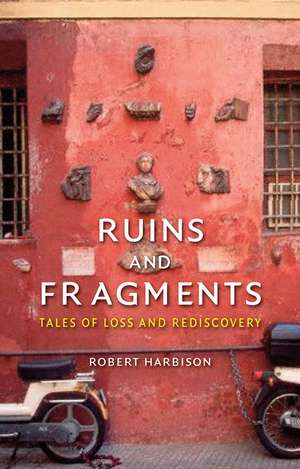
Ruins and Fragments
Autor Robert Harbisonen Limba Engleză Hardback – mai 2015
În calitate de critici de arhitectură și observatori ai fenomenului cultural, suntem de părere că volumul Ruins and Fragments semnat de Robert Harbison reprezintă o incursiune senzorială fascinantă în estetica incompletului. Harbison ne propune o perspectivă curatorială riguroasă, invitându-ne să decodificăm de ce obiectele fragmentate exercită o atracție mai puternică asupra imaginației noastre decât formele finisate, „prea netede”. Autorul ne ghidează printr-un peisaj vast, unde ruina nu este un punct final, ci un fundament pentru creație, investigând modul în care fragmentele antice au fost recuperate și cum arhitectura contemporană, prin exemple precum Neues Museum din Berlin, alege să integreze cicatricele istoriei în structuri noi.
Ca și Ruins of Modernity, lucrarea pune în valoare modul în care modernitatea s-a definit prin confruntarea cu trecutul, dar cu un accent pe experiența psihologică și tactilă a fragmentului, dincolo de contextul strict politic. Structura cărții este una progresivă, pornind de la „Rough Edges” (Margini brute) și evoluând spre „Ruined Narratives”, demonstrând că fragmentarea este o stare de spirit ce infuzează literatura lui T.S. Eliot sau Joyce la fel de mult ca zidurile Romei. Această abordare amintește de temele explorate de Harbison în Eccentric Spaces, unde analiza se concentra pe interacțiunea dintre imaginația umană și spațiile locuite, însă aici accentul cade pe frumusețea disrupției.
Recomandăm această lectură pentru tonul său poetic și analitic, care transformă o cercetare academică într-o meditație profundă despre memorie și uitare. Este o experiență de lectură bogată în referințe vizuale, de la colaje la cinematografie, ce ne forțează să acceptăm discontinuitatea ca fiind trăsătura fundamentală a existenței noastre.
Preț: 228.53 lei
Preț vechi: 312.49 lei
-27%
Carte disponibilă
Livrare economică 18-25 mai
Livrare express 02-08 mai pentru 119.03 lei
Specificații
ISBN-10: 1780234473
Pagini: 272
Ilustrații: 60 halftones
Dimensiuni: 146 x 224 x 30 mm
Greutate: 0.47 kg
Editura: REAKTION BOOKS
V-ar putea interesa
-
 Preț: 210.52 lei
 -
 The Alienation EffectOwen HatherleyPreț: 265.57 lei
 -
 On WeatheringMohsen (Dean Mostafavi-8%Preț: 242.32 lei263.96 lei
 -
 Experiencing ArchitectureSteen Eiler Rasmussen-20%Preț: 247.85 lei310.46 lei
 -
 The Waste Land and Other PoemsT S EliotPreț: 54.68 lei
 -
 The Dehumanization of Art and Other Essays on Art, Culture, and LiteratureJose Ortega y. GassetPreț: 87.02 lei
 -
 B is for Bauhaus: An A-Z of the Modern WorldDeyan SudjicPreț: 103.87 lei
 -
 Architreasures: A Journey Through 20th-Century ArchitectureGeoffrey Goddard-8%Preț: 386.51 lei420.12 lei
 -
 Curated Decay: Heritage beyond SavingCaitlin DeSilveyPreț: 175.59 lei
 -
 Wabi-Sabi for Artists, Designers, Poets & PhilosophersLeonard KorenPreț: 99.86 lei
 -
 Preț: 355.18 lei
 -
 Preț: 379.81 lei
 -
 FragilityAlain CorbinPreț: 66.18 lei
 -
 Language of ArchitectureAndrea Simitch-19%Preț: 179.13 lei221.81 lei
 -
 Up in the AirHolly SmithPreț: 146.78 lei
 -
 Book of RuinsJohn Dixon HuntPreț: 390.60 lei
 -
 Ruins and ResilienceKarel Doing-20%Preț: 203.91 lei254.56 lei
 -
 Ruins and Other PoemsSamer Abu Hawwash-21%Preț: 100.94 lei128.40 lei
 -
 Urban RuinsElisa PiliaPreț: 310.94 lei
 -
 Peter Lynch: Fragments and CoherencePeter Lynch-21%Preț: 210.88 lei265.48 lei
De ce să citești această carte
Suntem de părere că această carte este esențială pentru cititorul care caută să înțeleagă melancolia și forța creatoare a ruinelor. Veți câștiga o perspectivă nouă asupra arhitecturii moderne și a literaturii clasice, învățând să vedeți în fragment nu o pierdere, ci o invitație la reconstrucție mentală. Este o recomandare ideală pentru arhitecți, artiști vizuali și pasionați de istoria ideilor care doresc să exploreze estetica „marginii brute”.
Despre autor
Robert Harbison este un distins teoretician și istoric, recunoscut pentru analizele sale interdisciplinare asupra spațiului și formei. A susținut prelegeri la instituții de prestigiu precum Museum of Modern Art din New York, Architectural Association din Londra și universitățile Stanford și Cornell. În lucrările sale anterioare, precum Eccentric Spaces sau „Pharaoh's Dream”, Harbison s-a remarcat prin capacitatea de a face conexiuni inedite între psihologia umană, geografie și arhitectură. Această expertiză îi permite să abordeze tema ruinelor nu doar ca vestigii arheologice, ci ca elemente vii ale culturii vizuale și literare occidentale.
Descriere scurtă
Harbison guides us through ruins and fragments, both ancient and modern, visual and textual, showing us how they are crucial to understanding our current mindset and how we arrived here. First looking at ancient fragments, he examines the ways we have recovered, restored, and exhibited them as artworks. Then he moves on to modernist architecture and the ways that it seeks a fragmentary form, examining modern projects that have been designed into existing ruins, such as the Castelvecchio in Verona, Italy and the reconstruction of the Neues Museum in Berlin. From there he explores literature and the works of T. S. Eliot, Montaigne, Coleridge, Joyce, and Sterne, and how they have used fragments as the foundation for creating new work. Likewise he examines the visual arts, from Schwitters’ collages to Ruskin’s drawings, as well as cinematic works from Sergei Eisenstein to Julien Temple, never shying from more deliberate creators of ruin, from Gordon Matta-Clark to countless graffiti artists.
From ancient to modern times and across every imaginable form of art, Harbison takes a poetic look at how ruins have offered us a way of understanding history and how they have enabled us to create the new.
Notă biografică
Cuprins
1. Rough Edges
2. Fragmented Wholes
3. Modernist Ruin
4. Interrupted Texts
5. Ruined Narratives
6. Art and Destruction
7. Dreams of Recovery
Epilogue: Remembering and Forgetting
Notes
Acknowledgements
Photo Acknowledgements
Index
Recenzii
“Harbison proves a keen observer of the paradoxes of reconstruction.”