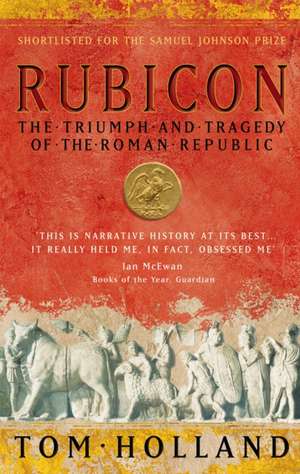
Rubicon: The Triumph and Tragedy of the Roman Republic
Autor Tom Hollanden Limba Engleză Paperback – 10 iun 2004
Recomandăm Rubicon studenților la istorie, cercetătorilor perioadei clasice și cititorilor pasionați de mecanismele puterii politice, care vor găsi aici o analiză incisivă a prăbușirii democrației romane. Remarcăm modul în care Tom Holland reușește să transforme datele istorice riguroase într-o narațiune vibrantă, fără a sacrifica acuratețea academică pentru spectacol. Această ediție publicată de Abacus aduce în prim-plan tragedia unei republici care, deși poseda instituții solide, s-a prăbușit sub greutatea propriilor ambiții și a conflictelor interne. Lucrarea extinde cadrul propus de Crossing the Rubicon de Luca Fezzi prin integrarea unei perspective culturale mai largi, explicând nu doar succesiunea evenimentelor militare, ci și mentalitatea colectivă a elitei romane. În timp ce Caesar Against Rome de Ramon Jiménez se concentrează strict pe conflictul civil, Holland oferă un context social și religios mult mai bogat, facilitat de cele 24 de ilustrații care completează textul. Ritmul este alert, comparabil cu viteza unei curse de care, reușind să mențină tensiunea istorică pe parcursul celor 464 de pagini. În contextul operei sale, Rubicon servește drept fundație pentru Dynasty, unde Holland explorează consecințele acestui colaps prin prisma primei dinastii imperiale. Dacă în Persian Fire autorul analiza ciocnirea dintre civilizații, aici se apleacă asupra autodistrugerii unei structuri politice unice, oferind o lecție despre fragilitatea libertăților civile în fața populismului și a dictaturii.
Preț: 82.15 lei
Preț vechi: 109.27 lei
-25%
Carte disponibilă
Livrare economică 16-30 noiembrie
Livrare express 30 octombrie-05 noiembrie pentru 56.02 lei
Specificații
ISBN-10: 034911563X
Pagini: 464
Ilustrații: Section: 24, b/w and col
Dimensiuni: 128 x 195 x 31 mm
Greutate: 0.4 kg
Editura: Little Brown
Colecția Abacus
Locul publicării:London, United Kingdom
V-ar putea interesa
-
 Crusades, TheThomas AsbridgePreț: 147.61 lei
 -
 Over the Edge of the WorldLaurence BergreenPreț: 125.31 lei
 -
 CultishAmanda MontellPreț: 165.60 lei
 -
 Sapiens: A Brief History of Human KindYuval Noah Harari-16%Preț: 80.90 lei95.89 lei
 -
 The Making of EuropeRobert Bartlett-17%Preț: 77.80 lei94.11 lei
 -
 A Reader on ReadingAlberto ManguelPreț: 393.03 lei
 -
 -25%Preț: 82.30 lei109.69 lei
 -
 The History of the Medieval WorldSusan Wise BauerPreț: 268.94 lei
 -
 Guns, Germs, and SteelJared DiamondPreț: 229.99 lei
 -
 Guns, Germs, and SteelJared DiamondPreț: 121.26 lei
 -
 What Do You Care What Other People ThinkRichard P. FeynmanPreț: 62.10 lei
 -
 OrientalismEdward W. SaidPreț: 123.84 lei
 -
 The Gods ThemselvesIsaac AsimovPreț: 57.31 lei
 -
 Preț: 397.67 lei
 -
 Bury My Heart at Wounded KneeDee BrownPreț: 143.67 lei
 -
 S.P.Q.RMary BeardPreț: 261.42 lei
 -
 The Broken RoadPatrick Leigh FermorPreț: 110.36 lei
 -
 John Williams: Collected Novels (Loa #349)John WilliamsPreț: 271.38 lei
 -
 S.P.Q.RMary BeardPreț: 120.79 lei
 -
 Lost TimeJozef CzapskiPreț: 84.99 lei
 -
 The Sea and CivilizationLincoln Paine-15%Preț: 202.54 lei239.28 lei
 -
 SPQR: A History of Ancient RomeProfessor Mary Beard-15%Preț: 82.54 lei96.86 lei
 -
 Don QuixoteMiguel De Cervantes-14%Preț: 130.25 lei151.71 lei
 -
 Moby-DickHerman Melville-16%Preț: 106.23 lei126.32 lei
De ce să citești această carte
Cititorul câștigă o înțelegere profundă a modului în care o republică se poate transforma în imperiu prin ambiție și corupție. Este o lectură esențială pentru cei care doresc să înțeleagă rădăcinile politicii moderne, prezentată cu spirit critic și rigoare istorică. Această ediție premiată oferă echilibrul perfect între erudiție și accesibilitate, fiind un punct de referință în bibliografia istoriei Europei.
Despre autor
Tom Holland este un istoric, scriitor și realizator de emisiuni premiat, recunoscut pentru capacitatea sa de a aduce istoria antică în atenția publicului larg. A fost distins cu premiul Asociației Clasice pentru contribuția sa la promovarea civilizației greco-romane și a ocupat funcția de președinte al Societății Autorilor. Pe lângă succesul seriei de volume despre Roma, precum Rubicon și Dynasty, Holland a realizat numeroase documentare pentru BBC și Channel 4 și este co-prezentatorul popularului podcast „The Rest is History”. Nota: Informațiile biografice despre actorul Tom Holland din baza de date sunt eronate în acest context; autorul este istoricul britanic născut în 1968.
Descriere
'The bloodstained drama of the last decades of the Roman republic... is told afresh with tremendous wit, narrative verve and insight'
'I owe a debt of gratitude to Tom Holland not just for reminding me of the great figures who bestrode the Roman world - Pompey and Crassus, Cato, Cicero and Caesar - but for explaining what it was that made Rome the greatest superpower the world has known, why it lasted so long and what caused its eventual fall' Daily Mail'Gripping and hugely entertaining. It is a story crammed with drama and spectacle... but the real attraction of Holland's book is the wit and contemporary sensibility that he brings to his often bloody tale' Books of the Year, Sunday Times
'This is narrative history at its best... it really held me, in fact, obsessed me' Ian McEwan, Books of the Year, Guardian
THE TOP TEN SUNDAY TIMES BESTSELLER
Recenzii
'A modern, well-paced and finely observed history which entertains as it informs' Observer
'The bloodstained drama of the last decades of the Roman republic... is told afresh with tremendous wit, narrative verve and insight' Independent on Sunday
'Gripping and hugely entertaining. It is a story crammed with drama and spectacle... but the real attraction of Holland's book is the wit and contemporary sensibility that he brings to his often bloody tale' Books of the Year, Sunday Times
[Pax PB cover, Dynasty reissue cover]
This is narrative history at its best... It really held me, in fact, obsessed me... Bloody and labyrinthine political intrigue and struggle, brilliant oratory, amazing feats of conquest and cruelty. Holland's lucid account of this alien civilisation moves at a fine pace. He makes no facile comparisons with our times, but you sense you are witnessing through him the enduring difficulty of reconciling power and peace
The blood-stained drama of the last decades of the Roman Republic . . . is told afresh with tremendous wit, narrative verve and insight . . . What characters there were in this drama! He resurrects them with a novelistic luminosity which illuminates not only that lost world, but our own as well
Holland has the rare gift of making deep scholarship accessible and exciting. A brilliant and completely absorbing study
Holland writes throughout with wonderful zest... this is a terrific read and a remarkable piece of scholarship. As an introduction to Roman history, it is unlikely to be bettered
Tom Holland's excellent new study of the fall of the Republic... re-evaluating Rome for a new generation
A modern, well-paced and finely observed history which entertains as it informs
It's terrific and I'm so grateful to Tom Holland for reminding me, so vividly, of not just the Roman Empire but of the people it produced and influenced
I am afraid I have read nothing but books about the Roman Empire, the most gripping of which was Tom Holland's Rubicon
A fine achievement, a book which will still deserve to be read when the political fashion has moved on . . . For any newcomer who wants the story of the Republic [and] who is tired of hearing people bang on about what the Romans did for us and wants to know what (and how) the Romans did for themselves, this is probably as good as it gets
A model of exactly how a popular history of the classical world should be written . . . a riveting study of the period . . . the most readable book on the later Roman republic since Ronald Syme's The Roman Revolution . . . Next time someone asks me why they should study Roman history, Rubicon will be one of the first books that I shall direct them to
The story of Rome's experiment with republicanism - peopled by such giants as Caesar, Pompey, Cato and Cicero - is told with perfect freshness, fine wit and true scholarship
Tom Holland's Rubicon makes history read like a thrilling mafia epic. Classical celebrities who flit across the subconscious of half-educated people like me keep walking in and swaggering about, all alive
A history of the Roman Republic at the height of its fame . . . The excitement of this book lies in the knowledge that once the summit is reached, either of a mountain or a civilisation, the trail leads downwards
An excellent and extremely readable study of the last days of the Roman republics
Ancient history often descends to us either through impregnable academic works or the sword-and-sandal epics of the cinema. What Holland achieves is to draw from both genres to write a modern, well-paced and finely observed history which entertains as it informs
The Republic won an empire, and destroyed itself in doing so. Tom Holland tells the story of how this came about, and does so with splendid verve . . . His writing is as pellucid as Macauley's
Engrossing . . . a lively narrative style . . . A thoroughly worthwhile and timely project - an account of a formative period of Western history that manages to be accessible and not over-simplified
A master of the telling detail . . . Rubicon is unrivalled in revealing the humbug behind the cant and stripping Julius Caesar and company of their moral finery
For the student of contemporary politics as well as the classicist, Tom Holland's account of the last century or so of the Roman Republic is timely. It enables the reader to re-live the slow, bloodstained collapse of a system, not only as a fascinating drama in its own right, but as a morality tale . . . This gripping narrative resurrects some of the half-forgotten personalities and events that shaped who we are. In the light of the parallels between the two great imperial republics, it can be recommended as an instructive beach-read for senior politicians on both sides of the Atlantic
Fresh and vivid . . . Holland's strength is as a narrative historian and there is no better and clearer guide to the tangled political events of 100-44 bc . . . if a new readership is to be won for ancient history, it is books like this that will pave the way
Rubicon . . . is no dry history: it is immensely readable, a perfect combination of authoritative scholarship and racy narrative . . . all Holland's people are real and alive. Sometimes they even talk
Holland paints a vivid social portrait of the Roman world . . . Ideal bedside reading for George W. Bush
Explosive stuff . . . a seriously intelligent history of the late republic that approximates as closely to the condition of the novel as should be allowed. Concentrating on the characters, plotting their interactions, rise and fall with considerable narrative skill, writing with élan and gusto . . . It is a history for our times . . . One can see classicists like Paul Wolfowitz in the White House eagerly seizing this book to find out how to deal with those tricky middle-easterners . . . a wickedly enjoyable book and a very sharp "reading" of the late Roman republic
Holland brings to vivid life the names found in thousands of schoolbooks . . . and gives them both personality and relevance. . . . With authoritative prose, this comes as recommended reading for those interested in the ancient world
Always readable and often beautiful . . . essential reading for anyone interested in ancient history. However, it also says more about our modern civilisation than many books that more overtly address the contemporary political and social issues . . . [Holland] blows the dust off an ancient civilisation, and shows that we still have plenty to learn from the past
Holland brings a diverse cast of characters to life and in his descriptions of the skullduggery, luxury and squalor of ancient Rome he's marvellously entertaining
This is the best one-volume narrative history of the Rome between King Tarquin and Emperor Augustus I have ever read. The story of Rome's experiment with republicanism - peopled by such giants as Caesar, Pompey, Cato and Cicero - is told with perfect freshness, fine wit and true scholarship.
Explosive stuff...a seriously intelligent history... [written] with elan and gusto... It is a history for our times... Wickedly enjoyable.
The only way to kindle the interest of a new generation in the Greek and Roman world... Holland paints a vivid social portrait of the Roman World
Notă biografică
Visit the author's website at www.tom-holland.org.
Extras
The Paradoxical Republic
Ancestral Voices
In the beginning, before the Republic, Rome was ruled by kings. About one of these, a haughty tyrant by the name of Tarquin, an eerie tale was told. Once, in his palace, an old woman came calling on him. In her arms she carried nine books. When she offered these to Tarquin he laughed in her face, so fabulous was the price she was demanding. The old woman, making no attempt to bargain, turned and left without a word. She burned three of the books and then, reappearing before the king, offered him the remaining volumes, still at the same price as before. A second time, although with less self-assurance now, the king refused, and a second time the old woman turned and left. By now Tarquin had grown nervous of what he might be turning down, and so when the mysterious crone reappeared, this time holding only three books, he hurriedly bought them, even though he had to pay the price originally demanded for all nine. Taking her money, the old woman then vanished, never to be seen again.
Who had she been? Her books proved to contain prophecies of such potency that the Romans soon realized that only one woman could possibly have been their author--the Sibyl. Yet this was an identification that only begged further questions, for the legends told of the Sibyl were strange and puzzling. On the presumption that she had foretold the Trojan War, men debated whether she was a compound of ten prophetesses, or immortal, or destined to live a thousand years. Some--the more sophisticated--even wondered whether she existed at all. In fact, only two things could be asserted with any real confidence--that her books, inscribed with spidery and antique Greek, certainly existed, and that within them could be read the pattern of events that were to come. The Romans, thanks to Tarquin's belated eye for a bargain, found themselves with a window to the future of the world.
Not that this helped Tarquin much. In 509 bc he succumbed to a palace coup. Kings had been ruling in Rome for more than two hundred years, ever since the city's foundation, but Tarquin, the seventh in line, would also be the last.* With his expulsion, the monarchy itself was overthrown, and, in its place, a free republic proclaimed. From then on, the title of "king" would be regarded by the Roman people with an almost pathological hatred, to be shrunk from and shuddered at whenever mentioned. Liberty had been the watchword of the coup against Tarquin, and liberty, the liberty of a city that had no master, was now consecrated as the birthright and measure of every citizen. To preserve it from the ambitions of future would-be tyrants, the founders of the Republic settled upon a remarkable formula. Carefully, they divided the powers of the exiled Tarquin between two magistrates, both elected, neither permitted to serve for longer than a year. These were the consuls, and their presence at the head of their fellow citizens, the one guarding against the ambitions of the other, was a stirring expression of the Republic's guiding principle--that never again should one man be permitted to rule supreme in Rome. Yet, startling though the innovation of the consulship appeared, it was not so radical as to separate the Romans entirely from their past. The monarchy might have been abolished, but very little else. The roots of the new Republic reached far back in time--often very far back indeed. The consuls themselves, as a privilege of their office, bordered their togas with the purple of kings. When they consulted the auspices they did so according to rites that predated the very foundation of Rome. And then, of course, most fabulous of all, there were the books left behind by the exiled Tarquin, the three mysterious rolls of prophecy, the writings of the ancient and quite possibly timeless Sibyl.
So sensitive was the information provided by these that access to them was strictly regulated as a secret of the state. Citizens found copying them would be sewn into a sack and dropped into the sea. Only in the most perilous of circumstances, when fearsome prodigies warned the Republic of looming catastrophe, was it permitted to consult the books at all. Then, once every alternative had been exhausted, specially appointed magistrates would be mandated to climb to the temple of Jupiter, where the books were kept in conditions of the tightest security. The scrolls would be spread out. Fingers would trace the faded lines of Greek. Prophecies would be deciphered, and advice taken on how best to appease the angered heavens.
And advice was always found. The Romans, being a people as practical as they were devout, had no patience with fatalism. They were interested in knowing the future only because they believed that it could then better be kept at bay. Showers of blood, chasms spitting fire, mice eating gold: terrifying prodigies such as these were regarded as the equivalent of bailiffs' duns, warnings to the Roman people that they stood in arrears with the gods. To get back in credit might require the introduction of a foreign cult to the city, the worship of a divinity who had hitherto been unknown. More typically, it would inspire retrenchment, as the magistrates desperately sought to identify the traditions that might have been neglected. Restore the past, the way that things had always been, and the safety of the Republic would be assured.
This was a presumption buried deep in the soul of every Roman. In the century that followed its establishment, the Republic was repeatedly racked by further social convulsions, by demands from the mass of citizens for expanded civic rights, and by continued constitutional reforms--and yet throughout this turbulent period of upheaval, the Roman people never ceased to affect a stern distaste for change. Novelty, to the citizens of the Republic, had sinister connotations. Pragmatic as they were, they might accept innovation if it were dressed up as the will of the gods or an ancient custom, but never for its own sake. Conservative and flexible in equal measure, the Romans kept what worked, adapted what had failed, and preserved as sacred lumber what had become redundant. The Republic was both a building site and a junkyard. Rome's future was constructed amid the jumble of her past.
The Romans themselves, far from seeing this as a paradox, took it for granted. How else were they to invest in their city save by holding true to the customs of their ancestors? Foreign analysts, who tended to regard the Romans' piety as "superstition,"1 and interpreted it as a subterfuge played on the masses by a cynical ruling class, misread its essence. The Republic was not like other states. While the cities of the Greeks were regularly shattered by civil wars and revolutions, Rome proved herself impervious to such disasters. Not once, despite all the social upheavals of the Republic's first century of existence, had the blood of her own citizens been spilled on her streets. How typical of the Greeks to reduce the ideal of shared citizenship to sophistry! To a Roman, nothing was more sacred or cherished. After all, it was what defined him. Public business--res publica--was what "republic" meant. Only by seeing himself reflected in the gaze of his fellows could a Roman truly know himself a man.
And by hearing his name on every tongue. The good citizen, in the Republic, was the citizen acknowledged to be good. The Romans recognized no difference between moral excellence and reputation, having the same word, honestas, for both. The approval of the entire city was the ultimate, the only, test of worth. This was why, whenever resentful citizens took to the streets, it would be to demand access to yet more honors and glory. Civil unrest would invariably inspire the establishment of a new magistracy: the aedileship and tribunate in 494, the quaestorship in 447, the praetorship in 367. The more posts there were, the greater the range of responsibilities; the greater the range of responsibilities, the broader the opportunities for achievement and approbation. Praise was what every citizen most desired--just as public shame was his ultimate dread. Not laws but the consciousness of always being watched was what prevented a Roman's sense of competition from degenerating into selfish ambition. Gruelling and implacable though the contest to excel invariably was, there could be no place in it for ill-disciplined vainglory. To place personal honor above the interests of the entire community was the behavior of a barbarian--or worse yet, a king.
In their relations with their fellows, then, the citizens of the Republic were schooled to temper their competitive instincts for the common good. In their relations with other states, however, no such inhibitions cramped them. "More than any other nation, the Romans have sought out glory and been greedy for praise."2 The consequences for their neighbors of this hunger for honor were invariably devastating. The legions' combination of efficiency and ruthlessness was something for which few opponents found themselves prepared. When the Romans were compelled by defiance to take a city by storm, it was their practice to slaughter every living creature they found. Rubble left behind by the legionaries could always be distinguished by the way in which severed dogs' heads or the dismembered limbs of cattle would lie strewn among the human corpses.3 The Romans killed to inspire terror, not in a savage frenzy but as the disciplined components of a fighting machine. The courage they brought to service in the legions, steeled by pride in their city and faith in her destiny, was an emotion that every citizen was brought up to share. Something uniquely lethal--and, to the Romans, glorious--marked their way of war.
Even so, it took time for the other states of Italy to wake up to the nature of the predator in their midst. For the first century of the Republic's existence the Romans found it a struggle to establish their supremacy over cities barely ten miles from their own gates. Yet even the deadliest carnivore must have its infancy, and the Romans, as they raided cattle and skirmished with petty hill tribes, were developing the instincts required to dominate and kill. By the 360s bc they had established their city as the mistress of central Italy. In the following decades they marched north and south, crushing opposition wherever they met it. By the 260s, with startling speed, they had mastered the entire peninsula. Honor, of course, had demanded nothing less. To states that humbly acknowledged their superiority, the Romans would grant such favors as a patron condescends to grant his clients, but to those who defied them, only ceaseless combat. No Roman could tolerate the prospect of his city losing face. Rather than endure it, he would put up with any amount of suffering, go to any lengths.
The time soon came when the Republic had to demonstrate this in a literal struggle to the death. The wars with Carthage were the most terrible it ever fought. A city of Semitic settlers on the North African coast, dominating the trade routes of the western Mediterranean, Carthage possessed resources at least as great as Rome's. Although predominantly a maritime power, she had indulged herself for centuries with bouts of warfare against the Greek cities of Sicily. Now, poised beyond the Straits of Messina, the Romans represented an ominous but intriguing new factor in Sicily's military equation. Predictably, the Greeks on the island could not resist embroiling the Republic in their perennial squabbles with Carthage. Equally predictably, once invited in, the Republic refused to play by the rules. In 264 Rome transformed what had been a minor dispute over treaty rights into a total war. Despite a lack of any naval tradition, and the loss of fleet after fleet to enemy action or storms, the Romans endured over two decades of appalling casualties to bring Carthage, at last, to defeat. By the terms of the peace treaty forced on them, the Carthaginians undertook a complete withdrawal from Sicily. Without ever having intended it, Rome found herself with the nucleus of an overseas empire. In 227 Sicily was constituted as the first Roman province.
The theater of the Republic's campaigning was soon to grow even wider. Carthage had been defeated, but not smashed. With Sicily lost, she next turned her imperial attentions to Spain. Braving the murderous tribes who swarmed everywhere in the mountains, the Carthaginians began to prospect for precious metals. The flood of wealth from their mines soon enabled them to contemplate resuming hostilities. Carthage's best generals were no longer under any illusions as to the nature of the enemy they faced in the Republic. Total war would have to be met in kind, and victory would be impossible unless Roman power were utterly destroyed.
It was to achieve this that Hannibal, in 218, led a Carthaginian army from Spain, through southern Gaul and over the Alps. Displaying a mastery of strategy and tactics far beyond that of his opponents, he brought three Roman armies to sensational defeat. In the third of his victories, at Cannae, Hannibal wiped out eight legions, the worst military disaster in the Republic's history. By every convention and expectation of contemporary warfare, Rome should have followed it by acknowledging Hannibal's triumph, and attempting to sue for peace. But in the face of catastrophe, she showed only continued defiance. Naturally, at such a moment, the Romans turned for guidance to the prophecies of the Sibyl. These prescribed that two Gauls and two Greeks be buried alive in the city's marketplace. The magistrates duly followed the Sibyl's advice. With this shocking act of barbarism, the Roman people demonstrated that there was nothing they would not countenance to preserve their city's freedom. The only alternative to liberty--as it had always been--was death.
And grimly, year by year, the Republic hauled itself back from the brink. More armies were raised; Sicily was held; the legions conquered Carthage's empire in Spain. A decade and a half after Cannae Hannibal faced another Roman army, but this time on African soil. He was defeated. Carthage no longer had the manpower to continue the struggle, and when her conqueror's terms were delivered, Hannibal advised his compatriots to accept them. Unlike the Republic after Cannae, he preferred not to risk his city's obliteration. Despite this, the Romans never forgot that in Hannibal, in the scale of his exertions, in the scope of his ambition, they had met the enemy who was most like themselves. Centuries later statues of him were still to be found standing in Rome. And even after they had reduced Carthage to an impotent rump, confiscating her provinces, her fleet, her celebrated war-elephants, the Romans continued to dread a Carthaginian recovery. Such hatred was the greatest compliment they could pay a foreign state. Carthage could not be trusted in her submission. The Romans looked into their own souls and attributed the implacability they found there to their greatest foe.
From the Hardcover edition.