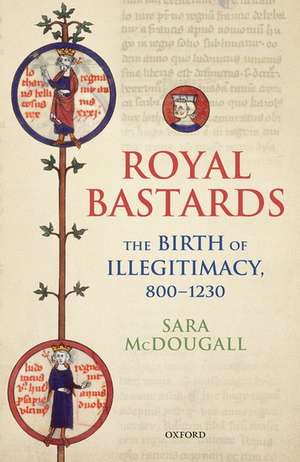
Royal Bastards: The Birth of Illegitimacy, 800-1230: Oxford Studies In Medieval European History
Autor Sara McDougallen Limba Engleză Hardback – 3 noi 2016
Preț: 777.10 lei
Preț vechi: 1120.51 lei
-31%
Puncte Express: 1166
Carte tipărită la comandă
Livrare economică 03-09 decembrie
Livrare prin curier în România Termenul estimat este afișat lângă disponibilitate.
Transport gratuit pentru acest produs Plată online sau ramburs, în funcție de opțiunile comenzii.
Retur gratuit în 14 zile Comandă securizată și suport în română.
Specificații
ISBN-13: 9780198785828
ISBN-10: 0198785828
Pagini: 336
Dimensiuni: 161 x 241 x 23 mm
Greutate: 0.63 kg
Editura: OUP OXFORD
Colecția OUP Oxford
Seria Oxford Studies In Medieval European History
Locul publicării:Oxford, United Kingdom
ISBN-10: 0198785828
Pagini: 336
Dimensiuni: 161 x 241 x 23 mm
Greutate: 0.63 kg
Editura: OUP OXFORD
Colecția OUP Oxford
Seria Oxford Studies In Medieval European History
Locul publicării:Oxford, United Kingdom
V-ar putea interesa
-
 -28%Preț: 374.06 lei520.53 lei
 -
 Enlightened Metropolis: Constructing Imperial Moscow, 1762-1855Alexander M. Martin-17%Preț: 352.99 lei423.65 lei
 -
 -25%Preț: 349.93 lei468.55 lei
 -
 Anglo-Saxon Deviant Burial CustomsAndrew Reynolds-26%Preț: 361.78 lei487.65 lei
 -
 -21%Preț: 356.98 lei450.45 lei
 -
 -24%Preț: 173.04 lei227.26 lei
 -
 Vergil in Russia: National Identity and Classical ReceptionZara Martirosova Torlone-31%Preț: 930.52 lei1354.34 lei
 -
 The Beau Street HoardEleanor Ghey-13%Preț: 40.79 lei46.83 lei
 -
 The LighthouseKeith MccloskeyPreț: 92.33 lei
 -
 Written in BloodPaul Adams-17%Preț: 111.56 lei134.77 lei
 -
 Paddy FinucaneDoug StokesPreț: 80.53 lei
 -
 The Blue ArenaBob SpurdlePreț: 70.81 lei
 -
 The Men Who Lost AmericaAndrew O'Shaughnessy-55%Preț: 125.72 lei276.76 lei
Recenzii
McDougall employs an impressive array of sources, including individual case studies, theological writings, chronicles, genealogies, letters, charters, and literary works, providing a rare glimpse into the lives of an array of noble families. The significance of maternal lineage in determining status calls into question past tendencies to discount the importance of royal wives and mothers during this period. McDougall situates the sources, particularly those issued by the church, within the wider context of the individual disputes that prompted their production. This approach allows McDougall to identify the full range of factors that informed attitudes about royal succession between 900 and 1250, providing an important caution against the temptation to "read back" terms and practices on the past.
With tremendous patience, [McDougall] skillfully and deeply contextualizes familiar primary sources (legal treatises, theological texts, chronicles, letters, and legal documents), taking nothing for granted. She takes great care to avoid facile assumptions about etymology and linguistic shifts while carefully accounting for authorial bias and purpose. She casts a sceptical eye at all the secondary literature on the subject of legitimacy as she tries to determine, as much as possible, what illegitimacy meant to kings and queens as they measured throne worthiness...This book is essential reading for all scholars, particularly those with an interest in monarchy and political theory.
By reassessing traditional theories on illegitimacy and offering an alternative reading of primary sources, this study will likely serve as a stepping stone for new studies on marriage and inheritance practices in the Middle Ages.
McDougall employs an impressive array of sources, including individual case studies, theological writings, chronicles, genealogies, letters, charters, and literary works, providing a rare glimpse into the lives of an array of noble families.
Sara McDougall has written a brilliant and important book, one that should be essential reading as we reevaluate the assumptions of traditional scholarship on how political communities in medieval Europe were formed and maintained. ... Her deep reading into the secondary literature and her willingness to reference works of scholars who are writing "against the grain" mark her as belonging to the community of trailblazers who demand that traditional political history be challenged, especially in the realm of assumptions about gender, women's roles, and female status. Both are deeply appreciated by this reader.
Sara McDougall's new book on bastardy in the Middle Ages is a fundamental contribution to the field of family history, remarkable for the breadth and number of examples provided across Europe and the Mediterranean throughout four centuries, the in-depth analysis of literary, documentary and legislative sources considered, and the convincing nature of the case she puts forward.
This will remain a landmark study, a profound insight into a fundamental principle of social organization.
undoubtedly a significant work of scholarship, rich in detailed discussion, and full of thought-provoking suggestions that are sure to stimulate new research ... this book sets the agenda for a thoughtful reassessment of the ideas, laws, and practices of medieval inheritance and marriage as a whole, and will repay the reader's engagement with its suggestions.
This is Sara McDougall's second book and it should establish her as one of the high flyers among American medieval historians ... she concentrates on royal cases -- explored in rich detail though without wasted words -- which should interest political historians even if they are not particularly concerned with medieval marriage as such, but the thesis applies more generally, a fortiori. She attacks the conventional narrative with the verve of a brilliant litigator with all the facts at her command, ranging from Merovingian Francia to the thirteenth century ... [an] important contribution to our understanding of politics, inheritance and the papacy in the Middle Ages.
With tremendous patience, [McDougall] skillfully and deeply contextualizes familiar primary sources (legal treatises, theological texts, chronicles, letters, and legal documents), taking nothing for granted. She takes great care to avoid facile assumptions about etymology and linguistic shifts while carefully accounting for authorial bias and purpose. She casts a sceptical eye at all the secondary literature on the subject of legitimacy as she tries to determine, as much as possible, what illegitimacy meant to kings and queens as they measured throne worthiness...This book is essential reading for all scholars, particularly those with an interest in monarchy and political theory.
By reassessing traditional theories on illegitimacy and offering an alternative reading of primary sources, this study will likely serve as a stepping stone for new studies on marriage and inheritance practices in the Middle Ages.
McDougall employs an impressive array of sources, including individual case studies, theological writings, chronicles, genealogies, letters, charters, and literary works, providing a rare glimpse into the lives of an array of noble families.
Sara McDougall has written a brilliant and important book, one that should be essential reading as we reevaluate the assumptions of traditional scholarship on how political communities in medieval Europe were formed and maintained. ... Her deep reading into the secondary literature and her willingness to reference works of scholars who are writing "against the grain" mark her as belonging to the community of trailblazers who demand that traditional political history be challenged, especially in the realm of assumptions about gender, women's roles, and female status. Both are deeply appreciated by this reader.
Sara McDougall's new book on bastardy in the Middle Ages is a fundamental contribution to the field of family history, remarkable for the breadth and number of examples provided across Europe and the Mediterranean throughout four centuries, the in-depth analysis of literary, documentary and legislative sources considered, and the convincing nature of the case she puts forward.
This will remain a landmark study, a profound insight into a fundamental principle of social organization.
undoubtedly a significant work of scholarship, rich in detailed discussion, and full of thought-provoking suggestions that are sure to stimulate new research ... this book sets the agenda for a thoughtful reassessment of the ideas, laws, and practices of medieval inheritance and marriage as a whole, and will repay the reader's engagement with its suggestions.
This is Sara McDougall's second book and it should establish her as one of the high flyers among American medieval historians ... she concentrates on royal cases -- explored in rich detail though without wasted words -- which should interest political historians even if they are not particularly concerned with medieval marriage as such, but the thesis applies more generally, a fortiori. She attacks the conventional narrative with the verve of a brilliant litigator with all the facts at her command, ranging from Merovingian Francia to the thirteenth century ... [an] important contribution to our understanding of politics, inheritance and the papacy in the Middle Ages.
Notă biografică
Sara McDougall is Associate Professor of History at John Jay College of Criminal Justice of the City University of New York and is a member of the doctoral faculty at the CUNY Graduate Center. Her research focuses primarily on marriage and law in medieval Europe. She is the author of Bigamy and Christian Identity in Late Medieval Champagne (2012) and has also published on adultery, marriage, illicit sex, and the role of gender in canon law. She was a Mellon fellow in Historical Studies at the Institute for Advanced Study in Princeton in 2014-2015.