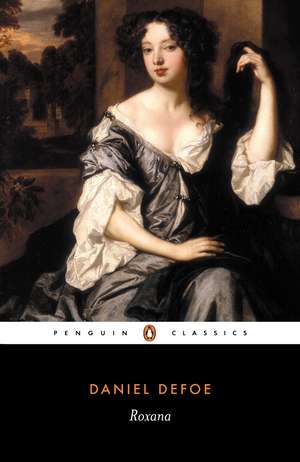
Roxana
Autor Daniel Defoe Editat de David Blewetten Limba Engleză Paperback – 27 apr 2006
Roxana (1724) was Defoe's last novel. It is a fascinating work, simultaneously strange and tragic, which dramatizes the moral deterioration and degradation of its complex heroine. Mlle Beleau, or Roxana as she becomes known, enters upon a career as a courtesan. She passes from one protector to another in England, France and Holland and amasses much wealth. But she is fatally torn between the dull virtue of middle-class respectability and the evil attractions of the beckoning city lights. The only one of Defoe's novels that does not end with the triumph of its protagonist, Roxana is nevertheless a triumphant work of art. It is of enormous historical and social interest, highlighting as it does the complex relationship that existed in Defoe's time between public respectability and private corruption.
For more than seventy years, Penguin has been the leading publisher of classic literature in the English-speaking world. With more than 1,700 titles, Penguin Classics represents a global bookshelf of the best works throughout history and across genres and disciplines. Readers trust the series to provide authoritative texts enhanced by introductions and notes by distinguished scholars and contemporary authors, as well as up-to-date translations by award-winning translators.
Preț: 95.20 lei
Puncte Express: 143
Carte tipărită la comandă
Livrare economică 28 noiembrie-12 decembrie
Livrare prin curier în România Termenul estimat este afișat lângă disponibilitate.
Transport gratuit de la 400.00 lei Plată online sau ramburs, în funcție de opțiunile comenzii.
Retur gratuit în 14 zile Comandă securizată și suport în română.
Specificații
ISBN-13: 9780140431490
ISBN-10: 0140431497
Pagini: 418
Dimensiuni: 111 x 181 x 25 mm
Greutate: 0.39 kg
Editura: Penguin Classics
Locul publicării:London, United Kingdom
ISBN-10: 0140431497
Pagini: 418
Dimensiuni: 111 x 181 x 25 mm
Greutate: 0.39 kg
Editura: Penguin Classics
Locul publicării:London, United Kingdom
V-ar putea interesa
-
 Robinson CrusoeDaniel DefoePreț: 28.01 lei
 -
 The Fortunate Mistress (Roxana)Daniel Defoe-19%Preț: 69.99 lei86.39 lei
 -
 Mary BartonElizabeth Gaskell-15%Preț: 135.14 lei158.85 lei
 -
 The Rover - Second EditionAphra Behn-17%Preț: 130.56 lei157.40 lei
 -
 East LynneEllen Wood-15%Preț: 180.36 lei211.72 lei
 -
 The MoonstoneWilkie Collins-15%Preț: 154.35 lei180.94 lei
 -
 Moll FlandersDaniel Defoe-16%Preț: 140.12 lei167.23 lei
 -
 The Red Badge of CourageStephen Crane-18%Preț: 104.01 lei126.11 lei
 -
 Tender Buttons: Objects, Food, RoomsGertrude Stein-19%Preț: 132.49 lei162.67 lei
 -
 A City Girl: A Realistic StoryMargaret Harkness-23%Preț: 164.20 lei212.95 lei
 -
 When the Sleeper WakesH. G. WellsPreț: 223.15 lei
 -
 -17%Preț: 146.04 lei176.30 lei
 -
 Étrennes Aux Royalistes, Ou Revue, En Forme d'Épître, de Quelques Actes Du MinistèreHippolyte Delphis De La CourPreț: 72.65 lei
 -
 Preț: 72.87 lei
 -
 Les frères d'armesÉdouard DelpratPreț: 79.50 lei
 -
 Preț: 87.20 lei
 -
 AngéliqueCamille DelthilPreț: 79.18 lei
 -
 FramèsCamille DelthilPreț: 86.78 lei
 -
 Clara Coudray. Tome 1Delvallé-BoissièrePreț: 130.99 lei
 -
 Mes heures de solitudeMarc DémarisPreț: 87.38 lei
 -
 Le député de Villétrange (pamphlet d'actualité)Félix DémarquezPreț: 239.36 lei
 -
 L'enfant de la morteHenri DemessePreț: 192.73 lei
 -
 Les drames de la familleHenri DemessePreț: 200.29 lei
 -
 Le travailC. DemeusePreț: 79.18 lei
 -
 Lettres bordelaises humoristiquesDémocritePreț: 79.38 lei
 -
 Légende d'YperdammeEugène DemolderPreț: 131.62 lei
 -
 Fièvres Du Jour: La Famille Guillaume l'Institutrice Un Vieux LionHippolyte-Jules DemolièrePreț: 208.32 lei
 -
 Petits Drames Bourgeois: Études de Moeurs. Tome 2Hippolyte-Jules DemolièrePreț: 193.03 lei
Descriere
Beautiful, proud Roxana is terrified of being poor. When her foolish husband leaves her penniless with five children, she must choose between being a virtuous beggar or a rich whore. A vivid satire on a dissolute society, this book presents a psychologically acute evocation of the ways in which vanity and ambition can corrupt the human soul.
Recenzii
Almost three hundred years after its first publication, Roxana continues to challenge readers, who, though compelled by Roxana’s story, are often baffled by her complex relationships to her children, her fortune, and her vices. As one of Daniel Defoe’s four major fictions, Roxana has long been understood as central to the history of the novel, and provides readers with Defoe’s sharpest and most specific commentary on the complexities of life in seventeenth-century London. This edition offers a range of contemporary documents that will help readers understand the struggles of Roxana’s life as series of metaphoric engagements with pressing issues of her time.
“Rare is that edition that gives us a fresh interpretation of a primary work, but that is precisely what Melissa Mowry has accomplished in this excellent edition. The introduction details Roxana’s place in Defoe’s career and the ways the novel evokes his Dissenter politics, while also shedding new light on the novel’s imbrication in debates about political sovereignty, feminism, and prostitution. The supplementary materials are all artfully chosen to produce fresh readings of the novel. Finally, the inclusion of some of the alternate endings written for Roxana, along with a brief reception history of Defoe’s work, invites speculation about changes in the representation of gender and sexuality over the course of the long eighteenth century in Britain.” — Scarlet Bowen, University of Colorado
“Rare is that edition that gives us a fresh interpretation of a primary work, but that is precisely what Melissa Mowry has accomplished in this excellent edition. The introduction details Roxana’s place in Defoe’s career and the ways the novel evokes his Dissenter politics, while also shedding new light on the novel’s imbrication in debates about political sovereignty, feminism, and prostitution. The supplementary materials are all artfully chosen to produce fresh readings of the novel. Finally, the inclusion of some of the alternate endings written for Roxana, along with a brief reception history of Defoe’s work, invites speculation about changes in the representation of gender and sexuality over the course of the long eighteenth century in Britain.” — Scarlet Bowen, University of Colorado
Cuprins
Acknowledgements
Introduction
Daniel Defoe: A Brief Chronology
Defoe’s Times: A Brief Chronology
A Note on the Text
Roxana
Appendix A: Roxana’s Shifting Identity and the Tradition of Whore Biography
Introduction
Daniel Defoe: A Brief Chronology
Defoe’s Times: A Brief Chronology
A Note on the Text
Roxana
Appendix A: Roxana’s Shifting Identity and the Tradition of Whore Biography
- From The Lawyer’s Clarke Trappan’d by the Crafty Whore of Canterbury (1663)
- From The London Jilt (1683)
- From The Whores Rhetorick (1683)
- A True Copie of the Petition of the Gentlewomen, and Tradesmens-Wives (1641)
- Mary Collier, The Woman’s Labour: An Epistle to Mr. Stephen Duck (1739)
- Poor-Whores Petition (1668)
- The Gracious ANSWER … To the Poor-Whores Petition(1668)
- John Dunton, The Night-Walker (1696)
- The Character of a Town-Miss (1680)
- Auction of Whores (1691)
- From Matthew Hale, A Discourse Touching Provision for the Poor (1683)
- From Thomas Firman, Some Proposals for the imployment of the Poor (1681)
- From Daniel Defoe, The Poor Man’s Plea (1698)
- From Daniel Defoe, Every-Body’s Business is No-Body’s Business (1725)
- From Bernard Mandeville, Modest Defense of the Publick Stews (1724)
- From Daniel Defoe, Some Considerations Upon Street-Walkers (1726)
- From Mary Astell, Some Considerations on Marriage (1700/1706)
- From Daniel Defoe, Conjugal Lewdness (1727)
- Daniel Defoe, The fortunate mistress (1740)
- Daniel Defoe, The history of Mademoiselle de Beleau (1775)
- From Charles Gildon, The Life and Strange Surprizing Adventures of Mr. Daniel Defoe (1719)
- From The History of Mademoiselle de Beleau; or,The New Roxana (1775)
- John Howlett, The Insufficiency of the Causes to which the Increase of the Poor’s Rates Have Been Commonly Ascribed (1788)
- George Chalmers, The Life of Daniel Defoe (1790)
- Thomas Ruggles, The History of the Poor (1797)
- The Penny Magazine of the Society for the Diffusion of Useful Knowledge (1833)