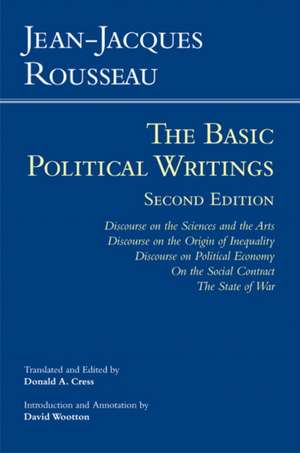
Rousseau: The Basic Political Writings: Discourse on the Sciences and the Arts, Discourse on the Origin of Inequality, Discourse on Political Economy, On the Social Contract, The State of War
Autor Jean-Jacques Rousseau Donald A. Cress Introducere de David Woottonen Limba Engleză Paperback – 15 iun 2012
This substantially revised new edition of Rousseau: The Basic Political Writings features a brilliant new Introduction by David Wootton, a revision by Donald A. Cress of his own 1987 translation of Rousseau's most important political writings, and the addition of Cress' new translation of Rousseau's State of ?War. New footnotes, headnotes, and a chronology by David Wootton provide expert guidance to first-time readers of the texts.
Preț: 125.49 lei
Preț vechi: 153.32 lei
-18%
Puncte Express: 188
Carte disponibilă
Livrare economică 31 octombrie-14 noiembrie
Livrare express 17-23 octombrie pentru 48.29 lei
Livrare prin curier în România Termenul estimat este afișat lângă disponibilitate.
Transport gratuit de la 400.00 lei Plată online sau ramburs, în funcție de opțiunile comenzii.
Retur gratuit în 14 zile Comandă securizată și suport în română.
Specificații
ISBN-13: 9781603846738
ISBN-10: 1603846735
Pagini: 320
Dimensiuni: 152 x 229 x 17 mm
Greutate: 0.23 kg
Ediția:Second Edition,2
Editura: Hackett Publishing Company,Inc
Colecția Hackett Publishing Company, Inc.
Locul publicării:United States
ISBN-10: 1603846735
Pagini: 320
Dimensiuni: 152 x 229 x 17 mm
Greutate: 0.23 kg
Ediția:Second Edition,2
Editura: Hackett Publishing Company,Inc
Colecția Hackett Publishing Company, Inc.
Locul publicării:United States
V-ar putea interesa
-
 Atheism from the Reformation to the EnlightenmentMichael Hunter-33%Preț: 1292.87 lei1929.00 lei
 -
 Color for Philosophers: Unweaving the RainbowC. L. Hardin-25%Preț: 352.46 lei466.98 lei
 -
 Selected Philosophical Papers of Robert BoyleRobert Boyle-17%Preț: 134.23 lei162.06 lei
 -
 Philosophical Problems and Arguments: An IntroductionJ. W. Cornman-17%Preț: 148.74 lei178.92 lei
 -
 Mind, Man, and MachinePaul T. Sagal-19%Preț: 58.18 lei72.17 lei
 -
 Hegel: Phenomenology and SystemH. S. Harris-19%Preț: 306.84 lei380.75 lei
 -
 Considerations Sur Le Gouvernement de Pologne (French Edition)Jean-Jacques RousseauPreț: 50.73 lei
 -
 Les Reveries Du Promeneur SolitaireJean-Jacques RousseauPreț: 44.78 lei
 -
 Preț: 105.84 lei
 -
 Über die ErziehungJean-Jacques RousseauPreț: 449.93 lei
 -
 EssaysMichel De MontaignePreț: 71.57 lei
Cuprins
Preface; Introduction; Chronology of Jean-Jacques Rousseau; A brief guide to further reading; A note on the texts; A note on the translations; A note on the editorial notes and index; Discourse on the Sciences and Arts or First Discourse; Preface; Part I; Part II; Replies to Critics; Letter to M. l'Abbé Raynal; Observations [to Stanislas, King of Poland]; Letter to Grimm; Last Reply; Letter about a New Refutation; Preface to Narcissus; Preface of a Second Letter to Bordes; Discourse on the Origin and Foundations of Inequality Among Men or Second Discourse; Epistle Dedicatory; Preface; Exordium; Part I; Part II; Rousseau's notes; Replies to critics; Letter to Philopolis; Reply to Charles-Georges Le Roy; Letter to Voltaire; Essay on the Origin of Languages; Idea of the method in the composition of a book; Discourse on the Virtue a Hero Most Needs or On Heroic Virtue; List of abbreviations and textual conventions; Editorial notes; Index of editors, translators, and annotators; General index.
Notă biografică
Jean-Jacques Rousseau (28 June 1712 - 2 July 1778) was a Genevan philosopher, writer and composer. His political philosophy influenced the progress of the Enlightenment throughout Europe, as well as aspects of the French Revolution and the development of modern political, economic and educational thought. His Discourse on Inequality and The Social Contract are cornerstones in modern political and social thought. Rousseau's sentimental novel Julie, or the New Heloise (1761) was important to the development of preromanticism and romanticism in fiction. His Emile, or On Education (1762) is an educational treatise on the place of the individual in society. Rousseau's autobiographical writings-the posthumously published Confessions (composed in 1769), which initiated the modern autobiography, and the unfinished Reveries of a Solitary Walker (composed 1776-1778)-exemplified the late-18th-century Age of Sensibility, and featured an increased focus on subjectivity and introspection that later characterized modern writing. Rousseau befriended fellow philosophy writer Denis Diderot in 1742, and would later write about Diderot's romantic troubles in his Confessions. During the period of the French Revolution, Rousseau was the most popular of the philosophers among members of the Jacobin Club. He was interred as a national hero in the Panthéon in Paris, in 1794, 16 years after his death.