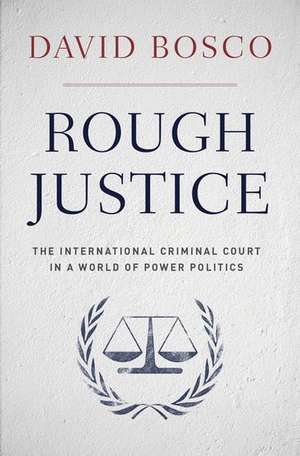
Rough Justice: The International Criminal Court's Battle to Fix the World, One Prosecution at a Time
Autor David Boscoen Limba Engleză Hardback – 30 ian 2014
Preț: 370.22 lei
Preț vechi: 442.75 lei
-16%
Puncte Express: 555
Carte disponibilă
Livrare economică 29 octombrie-04 noiembrie
Livrare prin curier în România Termenul estimat este afișat lângă disponibilitate.
Transport gratuit de la 400.00 lei Plată online sau ramburs, în funcție de opțiunile comenzii.
Retur gratuit în 14 zile Comandă securizată și suport în română.
Specificații
ISBN-13: 9780199844135
ISBN-10: 0199844135
Pagini: 312
Dimensiuni: 236 x 160 x 33 mm
Greutate: 0.54 kg
Editura: Oxford University Press
Colecția OUP USA
Locul publicării:New York, United States
ISBN-10: 0199844135
Pagini: 312
Dimensiuni: 236 x 160 x 33 mm
Greutate: 0.54 kg
Editura: Oxford University Press
Colecția OUP USA
Locul publicării:New York, United States
Recenzii
Excellent.
One of — if not, the — most significant contributions to understanding relationships between states and the ICC in recent years.
The best account so far of the trajectory of the ICC from its optimistic origins to the more constrained court of today.... Written in an engaging and accessible style, the book should be of interest to the nonspecialist as well.
Energetic, well-written, and genuinely informative.
A rigorously researched and credible piece of work with the readability and up-to-date feeling of a blog.... Rough Justice is an excellent work on the recent history of the ICC, succinct and subtle in its analysis.
David Bosco's Rough Justice is one of - if not, the - most significant contributions to understanding relationships between states and the ICC in recent years. Impressively researched, accessibly composed and cogently argued, Bosco skilfully lays out a political history of the Court that not only elucidates why and how powerful states engage with the ICC but also how the Court manages its relations with the states upon which its legitimacy and effectiveness depend ... Both liberal and realist oriented scholars should read Bosco's sophisticated account of the ICC.
One of — if not, the — most significant contributions to understanding relationships between states and the ICC in recent years.
The best account so far of the trajectory of the ICC from its optimistic origins to the more constrained court of today.... Written in an engaging and accessible style, the book should be of interest to the nonspecialist as well.
Energetic, well-written, and genuinely informative.
A rigorously researched and credible piece of work with the readability and up-to-date feeling of a blog.... Rough Justice is an excellent work on the recent history of the ICC, succinct and subtle in its analysis.
David Bosco's Rough Justice is one of - if not, the - most significant contributions to understanding relationships between states and the ICC in recent years. Impressively researched, accessibly composed and cogently argued, Bosco skilfully lays out a political history of the Court that not only elucidates why and how powerful states engage with the ICC but also how the Court manages its relations with the states upon which its legitimacy and effectiveness depend ... Both liberal and realist oriented scholars should read Bosco's sophisticated account of the ICC.
Notă biografică
David Bosco teaches international politics and law at American University's School of International Service. He is the author of Five to Rule Them All: The UN Security Council and the Making of the Modern World. A graduate of Harvard Law School, he is a former attorney and senior editor at Foreign Policy magazine. He writes the Multilateralist blog for Foreign Policy.
Cuprins
- Introduction
- 1. A Framework for Analysis
- 2. Origins
- 3. The Phantom Court (1998-2002)
- 4. Caution and Consensus (July 2002-March 2005)
- 5. Breakthrough (2005-2008)
- 6. Power Plays (2008-2012)
- Conclusion: A Constrained Court