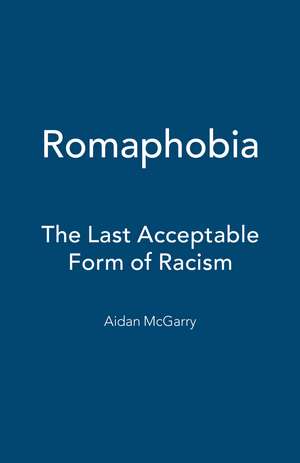
Romaphobia: The Last Acceptable Form of Racism
Autor Dr Aidan McGarryen Limba Engleză Paperback – 15 feb 2017
Romaphobia allows us to unpick this relationship between identity and belonging, and shows the way towards the inclusion of Roma in society, providing vital insights for other marginalized communities.
Preț: 135.43 lei
Preț vechi: 149.38 lei
-9%
Puncte Express: 203
Carte tipărită la comandă
Livrare economică 07-21 decembrie
Livrare prin curier în România Termenul estimat este afișat lângă disponibilitate.
Transport gratuit de la 400.00 lei Plată online sau ramburs, în funcție de opțiunile comenzii.
Retur gratuit în 14 zile Comandă securizată și suport în română.
Specificații
ISBN-13: 9781783603992
ISBN-10: 1783603992
Pagini: 306
Ilustrații: Halftones, black and white 5
Dimensiuni: 138 x 214 x 18 mm
Greutate: 0.38 kg
Editura: Bloomsbury Publishing
Colecția Zed Books
Locul publicării:London, United Kingdom
ISBN-10: 1783603992
Pagini: 306
Ilustrații: Halftones, black and white 5
Dimensiuni: 138 x 214 x 18 mm
Greutate: 0.38 kg
Editura: Bloomsbury Publishing
Colecția Zed Books
Locul publicării:London, United Kingdom
V-ar putea interesa
-
 -18%Preț: 333.88 lei406.19 lei
 -
 -22%Preț: 205.02 lei261.46 lei
 -
 -11%Preț: 315.81 lei354.46 lei
 -
 -31%Preț: 470.04 lei677.72 lei
 -
 Multiculturalism and Minority Rights in the Arab WorldWill Kymlicka-30%Preț: 833.41 lei1191.06 lei
 -
 The First Civil Right: How Liberals Built Prison AmericaNaomi Murakawa-18%Preț: 302.03 lei367.61 lei
 -
 Bound to AppearHuey CopelandPreț: 477.68 lei
 -
 I Met Lucky PeopleYaron Matras-18%Preț: 64.88 lei79.03 lei
 -
 The True AmericanAnand GiridharadasPreț: 102.16 lei
 -
 Language and Muslim ChildhoodsGarcia-Sanchez-8%Preț: 652.54 lei709.28 lei
 -
 Preț: 239.58 lei
 -
 -25%Preț: 276.77 lei368.86 lei
 -
 Anders Breivik and the Rise of IslamophobiaSindre BangstadPreț: 159.63 lei
 -
 Preț: 166.21 lei
 -
 -43%Preț: 91.83 lei161.55 lei
 -
 -15%Preț: 263.45 lei309.86 lei
 -
 -16%Preț: 256.53 lei304.23 lei
Cuprins
1. Romaphobia: marginalization and stigmatization in Europe
2. Strangers within the gates: territoriality and belonging
3. Roma identities: how Romaphobia distorts Roma identity
4. An expression of Romaphobia: socio-spatial segregation in Eastern Europe
5. Opre Roma! Challenging Romaphobia through Pride protests
6. Roma citizenship in the European Union: a question of belonging
Conclusion. Understanding the causes of Romaphobia: between territoriality, identity and belonging
2. Strangers within the gates: territoriality and belonging
3. Roma identities: how Romaphobia distorts Roma identity
4. An expression of Romaphobia: socio-spatial segregation in Eastern Europe
5. Opre Roma! Challenging Romaphobia through Pride protests
6. Roma citizenship in the European Union: a question of belonging
Conclusion. Understanding the causes of Romaphobia: between territoriality, identity and belonging
Recenzii
A compelling depiction ... This is a fascinating and provocative framework from which to view the continuing, hateful prejudice directed at Roma.
Enlightened, sensitively written and always positive, this book makes a valuable contribution.
McGarry provides a valuable service in directing our attention to the forces that produce this kind of discrimination.
A timely analysis of how fear and loathing stultifies social progress. McGarry offers an excellent examination of the mechanisms of this enduring and despicable form of racism.
A beautifully written text that is both inspiring and daunting; it does not shade or minimise the numerous challenges that are facing Romani communities in Europe, but it also offers signs of agency, empowerment and hope. This book is destined to become a benchmark for a new generation of critical scholars.
McGarry skillfully explains the complex phenomenon and history of Romaphobia in contemporary Europe. He offers a thoughtful and accessible inquiry into this persistent form of racism, and a powerful critique of how it continues to be tolerated in present-day Europe.
Draws on original research to examine enduring racism against Roma communities in Europe. Essential reading for all concerned about racism and the rise of far right politics that we are witnessing across Europe today.
McGarrys contributes to our understanding of the root causes of inequality between Roma and non-Roma. He shows that Roma exclusion is rooted in the nation-building process in Europe and the way national identities have been constructed in relation to territory.
An eloquent account of one of the most troubling forms of racism still haunting the world: Romaphobia. This book examines the root causes, as well as the experiences of Roma communities in the UK and in continental Europe.
The strength of McGarry's book lies in the exploration of a broader, transnational research agenda that seeks to awake Romani studies from its "splendid isolation", leaving one with the desire to learn more about the roots of Romaphobia.
McGarry provides the first extensive scholarly exploration of Romaphobia and vividly outlines the magnitude of the challenge to overcome stereotypes deeply embedded in European culture. Romaphobia also addresses the relatively recent innovation of Roma people and organisations actively participating in public debates about themselves.
Enlightened, sensitively written and always positive, this book makes a valuable contribution.
McGarry provides a valuable service in directing our attention to the forces that produce this kind of discrimination.
A timely analysis of how fear and loathing stultifies social progress. McGarry offers an excellent examination of the mechanisms of this enduring and despicable form of racism.
A beautifully written text that is both inspiring and daunting; it does not shade or minimise the numerous challenges that are facing Romani communities in Europe, but it also offers signs of agency, empowerment and hope. This book is destined to become a benchmark for a new generation of critical scholars.
McGarry skillfully explains the complex phenomenon and history of Romaphobia in contemporary Europe. He offers a thoughtful and accessible inquiry into this persistent form of racism, and a powerful critique of how it continues to be tolerated in present-day Europe.
Draws on original research to examine enduring racism against Roma communities in Europe. Essential reading for all concerned about racism and the rise of far right politics that we are witnessing across Europe today.
McGarrys contributes to our understanding of the root causes of inequality between Roma and non-Roma. He shows that Roma exclusion is rooted in the nation-building process in Europe and the way national identities have been constructed in relation to territory.
An eloquent account of one of the most troubling forms of racism still haunting the world: Romaphobia. This book examines the root causes, as well as the experiences of Roma communities in the UK and in continental Europe.
The strength of McGarry's book lies in the exploration of a broader, transnational research agenda that seeks to awake Romani studies from its "splendid isolation", leaving one with the desire to learn more about the roots of Romaphobia.
McGarry provides the first extensive scholarly exploration of Romaphobia and vividly outlines the magnitude of the challenge to overcome stereotypes deeply embedded in European culture. Romaphobia also addresses the relatively recent innovation of Roma people and organisations actively participating in public debates about themselves.
Notă biografică
Dr Aiden McGarry is a senior lecturer in politics at the University of Brighton.