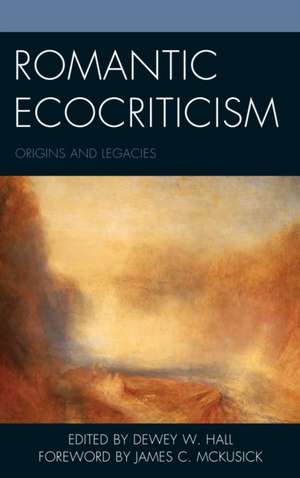
Romantic Ecocriticism: Origins and Legacies: Ecocritical Theory and Practice
Editat de Dewey W. Hall Cuvânt înainte de James C. McKusick Contribuţii de Colin Carman, Alicia Carroll, Judyta Frodyma, Gary Harrison, J. Andrew Hubbell, Ryan David Leack, Kaitlin Mondello, Shalon Noble, Lisa Ottum, Marcus Tomalin, Bryon Williamsen Limba Engleză Paperback – 11 sep 2017
| Toate formatele și edițiile | Preț | Express |
|---|---|---|
| Paperback (1) | 337.24 lei 6-8 săpt. | |
| Bloomsbury Publishing – 11 sep 2017 | 337.24 lei 6-8 săpt. | |
| Hardback (1) | 648.58 lei 6-8 săpt. | |
| Bloomsbury Publishing – 15 mar 2016 | 648.58 lei 6-8 săpt. |
Din seria Ecocritical Theory and Practice
- 31%
 Preț: 492.09 lei
 - 25%
 Preț: 249.33 lei
 - nou
 Preț: 511.78 lei
 - nou
 Preț: 159.96 lei
 -
 Preț: 221.58 lei
 - 34%
 Preț: 523.78 lei
 - 22%
 Preț: 305.87 lei
 - 34%
 Preț: 648.33 lei
 - 22%
 Preț: 328.98 lei
 - 23%
 Preț: 659.91 lei
 - 22%
 Preț: 327.71 lei
 - 34%
 Preț: 585.54 lei
 - 18%
 Preț: 771.87 lei
 - 22%
 Preț: 346.01 lei
 - 34%
 Preț: 610.36 lei
 - 34%
 Preț: 542.50 lei
 - 15%
 Preț: 658.41 lei
 - 34%
 Preț: 587.31 lei
 - 34%
 Preț: 627.75 lei
 - 34%
 Preț: 555.38 lei
 - 34%
 Preț: 534.89 lei
 - 15%
 Preț: 654.79 lei
 - 22%
 Preț: 336.09 lei
 - 34%
 Preț: 542.73 lei
 - 34%
 Preț: 543.93 lei
 - 34%
 Preț: 572.76 lei
 - 34%
 Preț: 524.52 lei
 - 34%
 Preț: 555.46 lei
 - 34%
 Preț: 647.49 lei
 - 23%
 Preț: 712.50 lei
 - 15%
 Preț: 652.61 lei
 - 34%
 Preț: 554.36 lei
 - 22%
 Preț: 331.63 lei
 - 22%
 Preț: 314.02 lei
 - 34%
 Preț: 554.18 lei
 - 34%
 Preț: 573.60 lei
 - 34%
 Preț: 525.12 lei
 - 26%
 Preț: 708.22 lei
 - 31%
 Preț: 505.82 lei
 - 31%
 Preț: 504.85 lei
 - 31%
 Preț: 505.64 lei
 - 30%
 Preț: 572.49 lei
 - 34%
 Preț: 610.78 lei
Preț: 337.24 lei
Preț vechi: 432.92 lei
-22%
Puncte Express: 506
Preț estimativ în valută:
59.68€ • 69.75$ • 51.82£
59.68€ • 69.75$ • 51.82£
Carte tipărită la comandă
Livrare economică 20 februarie-06 martie
Preluare comenzi: 021 569.72.76
Specificații
ISBN-13: 9781498518031
ISBN-10: 1498518036
Pagini: 336
Ilustrații: 4 b/w photos;
Dimensiuni: 151 x 229 x 23 mm
Greutate: 0.46 kg
Editura: Bloomsbury Publishing
Colecția Lexington Books
Seria Ecocritical Theory and Practice
Locul publicării:New York, United States
ISBN-10: 1498518036
Pagini: 336
Ilustrații: 4 b/w photos;
Dimensiuni: 151 x 229 x 23 mm
Greutate: 0.46 kg
Editura: Bloomsbury Publishing
Colecția Lexington Books
Seria Ecocritical Theory and Practice
Locul publicării:New York, United States
Cuprins
Introduction - Dewey W. Hall
Chapter 1. Ecological Horology: The Nature of Time during the Romantic Period - Marcus Tomalin
Chapter 2. Naturalists' Interpretations: Daffodils, Swallows, and a Floating Island - Dewey W. Hall
Chapter 3. 'It cannot be a sin to seek to save an earth-born being': Radical Ecotheology in
Byron's Heaven and Earth - J. Andrew Hubbell
Chapter 4. Process and Presence: Geological Influence and Innovation in Shelley's 'Mont Blanc' - Bryon Williams
Chapter 5. 'Perpetual Analogies' and 'Occult Harmonies': Ralph Waldo Emerson's Ecological Selves - Kaitlin Mondello
Chapter 6. An Uncertain Spirit of an Unstable Place: Frankenstein in the Anthropocene - Shalon Noble
Chapter 7. Wild West and Western Wildness: A Transatlantic Perspective - Jude Frodyma
Chapter 8. Ecocentering the Self: William Howitt, Thoreau, and the Environmental Imagination - Ryan David Leack
Chapter 9. Toward a Romantic Poetics of Acknowledgement: Wordsworth, Clare, and Aldo Leopold's 'Land Ethi
Chapter 1. Ecological Horology: The Nature of Time during the Romantic Period - Marcus Tomalin
Chapter 2. Naturalists' Interpretations: Daffodils, Swallows, and a Floating Island - Dewey W. Hall
Chapter 3. 'It cannot be a sin to seek to save an earth-born being': Radical Ecotheology in
Byron's Heaven and Earth - J. Andrew Hubbell
Chapter 4. Process and Presence: Geological Influence and Innovation in Shelley's 'Mont Blanc' - Bryon Williams
Chapter 5. 'Perpetual Analogies' and 'Occult Harmonies': Ralph Waldo Emerson's Ecological Selves - Kaitlin Mondello
Chapter 6. An Uncertain Spirit of an Unstable Place: Frankenstein in the Anthropocene - Shalon Noble
Chapter 7. Wild West and Western Wildness: A Transatlantic Perspective - Jude Frodyma
Chapter 8. Ecocentering the Self: William Howitt, Thoreau, and the Environmental Imagination - Ryan David Leack
Chapter 9. Toward a Romantic Poetics of Acknowledgement: Wordsworth, Clare, and Aldo Leopold's 'Land Ethi
Recenzii
Romantic Ecocriticism considers how natural philosophy and science informed, and sometimes influenced, 19th-century English and American Romantic writing. The essays tend to dwell on canonical figures; Wordsworth, Byron, the Shelleys, Emerson, and Thoreau play important roles in most of the essays, although the final contributions connect the Romantic movement to 20th-century environmentalism. In putting the collection together, Hall intends to erode the assumption that these Romantic writers were mere idealists by demonstrating the extent to which they drew on contemporaneous theories from the natural sciences. The essays broaden the critical context of Romantic study by traversing national boundaries to highlight thematic connections between US and English Romantic writers. The contributors range from full professors to graduate students, but essays are consistently insightful-sometimes, perhaps, more intriguing for the 19th-century scientific theories that are unveiled than for the critical insights those theories make available. Summing Up: Recommended. Graduate students; researchers/faculty.
This volume provides a good range of essays exploring the importance of British Romanticism--and...early nineteenth-century American literature--to contemporary ecological literary criticism.
The volume will be of great interest to Romanticists and ecocritics alike.
Romantic Ecocriticsm is a welcome addition to the fertile and ever-expanding critical terrain shared by Romanticists and Ecocritics. Hall weaves a rich and important story.... The relationship and intersections between Romantic science and Romantic ecocriticism, surprisingly not brought together more in scholarship, was to me one of the volume's most interesting and exciting aspects, as it illuminates not only texts and interrelations in new-modern, ecological, mesh-like-ways, but also potential new environmental 'legacies' and directions.
With his edited collection, Romantic Ecocriticism, Dewey Hall launches a much-needed "new wave" of eco-historical scholarship of Romanticism, one that explores ecocriticism's own historical roots in transatlantic writing of the late Georgian period. Representing a great diversity of theoretical concerns, these essays are united in two vital objectives: to break down the 'two culture' divide between ecocriticism and ecological science, and to move beyond the narrow presentism of our ecological anxieties, toward multiple encounters with geological and biological 'deep time,' the formulae for which first emerged around 1800. Romantic Ecocriticism takes us deep into the Anthropocene, and beyond.
Romantic Ecocriticism is a forceful reminder that literature and science do not exist in isolation. These essays further establish the engagement of literary Romanticism with the major scientific and socio-theoretical debates of the period.
This volume provides a good range of essays exploring the importance of British Romanticism--and...early nineteenth-century American literature--to contemporary ecological literary criticism.
The volume will be of great interest to Romanticists and ecocritics alike.
Romantic Ecocriticsm is a welcome addition to the fertile and ever-expanding critical terrain shared by Romanticists and Ecocritics. Hall weaves a rich and important story.... The relationship and intersections between Romantic science and Romantic ecocriticism, surprisingly not brought together more in scholarship, was to me one of the volume's most interesting and exciting aspects, as it illuminates not only texts and interrelations in new-modern, ecological, mesh-like-ways, but also potential new environmental 'legacies' and directions.
With his edited collection, Romantic Ecocriticism, Dewey Hall launches a much-needed "new wave" of eco-historical scholarship of Romanticism, one that explores ecocriticism's own historical roots in transatlantic writing of the late Georgian period. Representing a great diversity of theoretical concerns, these essays are united in two vital objectives: to break down the 'two culture' divide between ecocriticism and ecological science, and to move beyond the narrow presentism of our ecological anxieties, toward multiple encounters with geological and biological 'deep time,' the formulae for which first emerged around 1800. Romantic Ecocriticism takes us deep into the Anthropocene, and beyond.
Romantic Ecocriticism is a forceful reminder that literature and science do not exist in isolation. These essays further establish the engagement of literary Romanticism with the major scientific and socio-theoretical debates of the period.