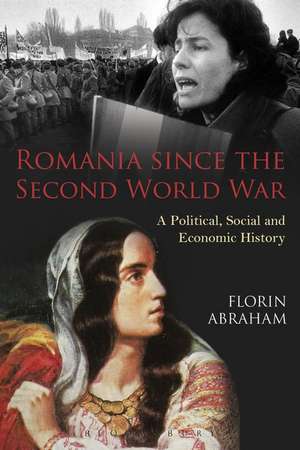
Romania since the Second World War: A Political, Social and Economic History
Autor Florin Abrahamen Limba Engleză Hardback – 17 noi 2016
Recomandăm Romania since the Second World War ca pe un instrument academic esențial, fiind primul volum conceput special pentru studenți care cartografiază progresul națiunii de la instaurarea regimului comunist până la complexa perioadă de tranziție. Suntem de părere că rigoarea autorului, Florin Abraham, oferă o perspectivă integrată asupra istoriei recente, depășind simpla cronologie politică prin includerea unor analize economice și sociale detaliate. Structura cărții este extrem de logică, fiind împărțită în trei secțiuni majore: analiza aprofundată a regimului comunist (sub lideri precum Gheorghiu-Dej și Ceaușescu), revenirea la democrație și tendințele socio-demografice postbelice. Merită menționat că volumul nu se limitează la evenimente, ci explorează mecanismele „violenței legitime” și modul în care societatea a fost modelată de tiranie. Ca alternativă la Romania since 1989 de Henry F. Carey, care se concentrează preponderent pe era post-revoluționară, lucrarea de față are avantajul unei viziuni de ansamblu care explică prezentul prin continuitatea și rupturile față de trecutul comunist. De asemenea, spre deosebire de Romania under Communism de Dennis Deletant, care rămâne un reper pentru perioada totalitară, volumul publicat de Bloomsbury Academic extinde analiza până la eforturile contemporane de integrare în NATO și UE, oferind un tablou complet al modernizării românești. Tonul este unul academic, dar accesibil, susținut de casete biografice și liste de lecturi suplimentare care facilitează aprofundarea subiectului.
Preț: 839.29 lei
Preț vechi: 1109.32 lei
-24%
Carte tipărită la comandă
Livrare economică 08-22 decembrie
Specificații
ISBN-10: 147253218X
Pagini: 360
Dimensiuni: 156 x 236 x 24 mm
Greutate: 0.68 kg
Editura: Bloomsbury Publishing
Colecția Bloomsbury Academic
Locul publicării:London, United Kingdom
V-ar putea interesa
-
 A History of the Soviet Union 1945-1991: Last of the EmpiresJohn L. H. Keep-16%Preț: 217.64 lei258.69 lei
 -
 French History Since NapoleonMartin AlexanderPreț: 192.24 lei
 -
 The Nazi Germany Sourcebook: An Anthology of TextsRoderick StackelbergPreț: 461.50 lei
 -
 The Annals & The HistoriesTacitusPreț: 132.02 lei
 -
 German Essays on FilmRichard McCormickPreț: 278.68 lei
 -
 Preț: 264.27 lei
 -
 The Great Famine: Ireland's Agony 1845-1852Dr Ciarán Ó MurchadhaPreț: 174.77 lei
 -
 After Oriental Despotism: Eurasian Growth in a Global PerspectiveAlessandro Stanziani-14%Preț: 234.13 lei273.35 lei
 -
 An Introduction to Antonio Gramsci: His Life, Thought and LegacyDr George Hoare-16%Preț: 189.48 lei224.66 lei
 -
 Cold War DiplomacyMircea MalitzaPreț: 187.48 lei
 -
 1066Andrew BridgefordPreț: 77.16 lei
 -
 SUBALTERN ON THE SOMMEMax PlowmanPreț: 107.57 lei
 -
 GERMAN AIR RAIDS ON GREAT BRITAIN 1914-1918Joseph MorrisPreț: 172.64 lei
 -
 History of the First Seven BattalionsFormerly Captain Cyril FallsPreț: 206.58 lei
 -
 History of the Lincolnshire Regiment 1914-1918C. R. SimpsonPreț: 248.24 lei
 -
 Border Regiment in the Great WarCol H. C. WyllyPreț: 239.79 lei
 -
 Preț: 290.04 lei
 -
 Education and Society in GermanyH. J. Hahn-16%Preț: 249.42 lei295.82 lei
 -
 Merchants and RevolutionRobert BrennerPreț: 276.19 lei
De ce să citești această carte
Această lucrare este ideală pentru studenții la istorie, științe politice sau sociologie, precum și pentru profesioniștii care au nevoie de o resursă documentată despre evoluția României moderne. Cititorul câștigă o înțelegere clară a modului în care s-au transformat instituțiile statului și economia de la dictatură la democrație, beneficiind de expertiza unui istoric recunoscut în studiul totalitarismului.
Despre autor
Florin Abraham este un istoric român de prestigiu, cercetător științific gradul I la Institutul Național pentru Studiul Totalitarismului din cadrul Academiei Române. De asemenea, acesta este lector la Școala Națională de Studii Politice și Administrative (SNSPA) din București. Expertiza sa se concentrează pe istoria contemporană a Europei Centrale și de Est, cu un accent deosebit pe regimurile totalitare, procesele de tranziție și evoluția instituțiilor politice în spațiul românesc. Activitatea sa academică și de cercetare este recunoscută internațional, volumul de față fiind publicat de prestigioasa editură Bloomsbury Publishing.
Descriere
The first part of the book looks at the communist regime in depth. It examines how communism took hold and how the elimination of traditional elites took place before discussing the impact of Gheorghiu-Dej and Nicolae Ceausescu, the two most important leaders of the communist era. A further chapter will also be given to the main economic and social changes that took place under the rule of communism. The second part of the book goes on to explore the transition period that followed the fall of the Berlin Wall and the end of communism in 1989, with special attention being given to international relations and Romania's drive for inclusion in NATO and the EU. Romania since the Second World War goes on to assess socio-demographic trends across the postwar period using a range of data before concluding with some final thoughts on the nation's development during this time. The book also includes useful biographical boxes for key figures in Romania's recent history, an extensive bibliography and further reading lists throughout.
This is an essential text for those interested in the modern history of Eastern Europe.
Cuprins
Part I - The Communist Regime
1. Renewing the Communist Regime (1945-1948)
2. The Gheorghe Gheorghiu-Dej Era (1948-1965)
3. Ceausescu's Dictatorship (1965-1989)
4. The Fall of Communism
5. Society and the Economy during the Communist Regime
Part II - Return to Democracy: Lost in Transition
6. The Party System
7. The Political Institutions
8. European and Foreign Affairs
9. The Rule of Law and the Evolution of Society
10. The New Capitalists
11. Mass Media
12. Political Culture
13. Ethnic Minorities
Part III - Socio-Demographic Trends
14. Main Trends
15. Wealth and Poverty
Conclusions
Bibliography
Index