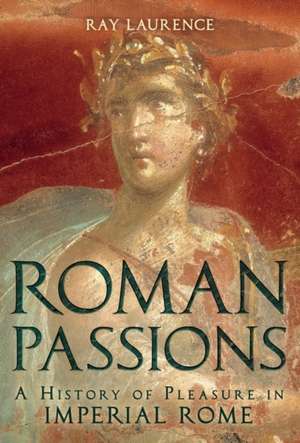
Roman Passions: A History of Pleasure in Imperial Rome
Autor Professor Ray Laurenceen Limba Engleză Paperback – 30 sep 2010
Preț: 118.34 lei
Preț vechi: 198.42 lei
-40%
Puncte Express: 178
Carte tipărită la comandă
Livrare economică 07-21 decembrie
Livrare prin curier în România Termenul estimat este afișat lângă disponibilitate.
Transport gratuit de la 400.00 lei Plată online sau ramburs, în funcție de opțiunile comenzii.
Retur gratuit în 14 zile Comandă securizată și suport în română.
Specificații
ISBN-13: 9781441134851
ISBN-10: 1441134859
Pagini: 262
Ilustrații: 12
Dimensiuni: 156 x 234 x 14 mm
Greutate: 0.41 kg
Editura: Bloomsbury Publishing
Colecția Continuum
Locul publicării:London, United Kingdom
ISBN-10: 1441134859
Pagini: 262
Ilustrații: 12
Dimensiuni: 156 x 234 x 14 mm
Greutate: 0.41 kg
Editura: Bloomsbury Publishing
Colecția Continuum
Locul publicării:London, United Kingdom
V-ar putea interesa
-
 Writing and Reading Byzantine Secular Poetry, 1025-1081Floris Bernard-31%Preț: 695.46 lei1008.20 lei
 -
 Alexander the Great: A Very Short IntroductionHugh Bowden-20%Preț: 56.97 lei70.82 lei
 -
 -31%Preț: 691.03 lei1005.52 lei
 -
 Explaining the Cosmos: Creation and Cultural Interaction in Late-Antique GazaMichael W. Champion-30%Preț: 683.58 lei977.30 lei
 -
 Rome, Polybius, and the EastThe late Peter Derow-31%Preț: 678.20 lei984.13 lei
 -
 Poetic Autonomy in Ancient RomeLuke Roman-31%Preț: 777.12 lei1125.57 lei
 -
 The Rise of the Greek Aristocratic BanquetMarek Wecowski-31%Preț: 823.98 lei1194.75 lei
 -
 Roman Archaeology for HistoriansRay LaurencePreț: 394.56 lei
 -
 Preț: 467.10 lei
 -
 Travel and Geography in the Roman EmpireColin Adams-15%Preț: 459.55 lei540.65 lei
 -
 The City in the Roman West, c.250 BC-c.AD 250Ray LaurencePreț: 346.33 lei
 -
 Preț: 87.49 lei
 -
 A Companion to LivyBernard Mineo-9%Preț: 1275.96 lei1402.15 lei
 -
 -18%Preț: 76.51 lei93.80 lei
 -
 Veni, Vidi, ViciPeter Jones-16%Preț: 68.12 lei81.33 lei
 -
 Life in Ancient Rome: People & PlacesNigel RodgersPreț: 83.18 lei
 -
 Blood in the Forum: The Struggle for the Roman RepublicDr Pamela Marin-47%Preț: 283.65 lei536.40 lei
Descriere
By the time of the emperors, the Romans had created the world's first global empire stretching from Morocco in the West to Iraq in the East, and from Britain in the North to Egypt in the South. It was an empire delineated by rivers - the Euphrates, the Danube and the Rhine - the Atlantic Ocean, and the deserts of North Africa.
Within this territory was the Mediterranean, a liquid continent that facilitated trade and into which flowed a treasure trove of goods from far-flung lands: slaves, spices, precious stones and coloured marble, not to mention an exotic array of foods and wine, from the novelty of British oysters to garum, a fish-sauce, from southern Spain.
At the same time, the aesthetics of the city of Rome were being embraced in the provinces with the establishment of towns with public buildings and baths, and the adoption of the Latin language. And with these attributes of civilisation came other trappings of Roman culture: lavish entertainments, elaborate dinner parties and vice. A world of pleasure had arrived. Passions for food, refi ned taste, drink, sex and excess, collecting unusual objects (human, animal or mineral), and a desire for the display of excess rebuilt Roman culture. This book charts how pleasure shaped Roman society and argues the case for pleasure being regarded as a potent historical force.
Within this territory was the Mediterranean, a liquid continent that facilitated trade and into which flowed a treasure trove of goods from far-flung lands: slaves, spices, precious stones and coloured marble, not to mention an exotic array of foods and wine, from the novelty of British oysters to garum, a fish-sauce, from southern Spain.
At the same time, the aesthetics of the city of Rome were being embraced in the provinces with the establishment of towns with public buildings and baths, and the adoption of the Latin language. And with these attributes of civilisation came other trappings of Roman culture: lavish entertainments, elaborate dinner parties and vice. A world of pleasure had arrived. Passions for food, refi ned taste, drink, sex and excess, collecting unusual objects (human, animal or mineral), and a desire for the display of excess rebuilt Roman culture. This book charts how pleasure shaped Roman society and argues the case for pleasure being regarded as a potent historical force.
Cuprins
1: Introduction - Roman Passions 2: Into the World of Roman Pleasure 3: The Emperor's Pleasures 4: The Aesthetics of the City 5: A Little Place in the Country 6: The Roman Body at the Baths 7: Roman Erotics 8: Dining 9: Food and Wine 10: A Great Song and Dance 11: Violence 12: Collectors and Collections 13: Pleasure transforms Roman culture \ Timeline \ Glossary of terms \ Further Reading \ Bibliography \ Index
Recenzii
"What's not to like about a guidebook through the consumerist wonderland of ancient Rome, a breezy tour of conspicuous living, lavish dining, mass spectacle, and, of course, sex? ... The book provides general readers with an engaging introduction to early Roman social history. Summing up: Highly recommended." - CHOICE
'Really quite rude, quite often - I'm enjoying that hugely! ... Just what you need really to help you drift peacefully off to sleep' - Lindsey Davis's 'Bedtime Read', The Book Show, Sky Arts
'It is all here: emperors' luxurious lifestyles, magnificent urban architecture, grand country villas, baths, sex, food, drink, the theatre, games (especially violent ones) and collecting and displaying rarities ... Commendably detailed.' - Peter Jones, BBC History Magazine
'A detailed exposition of the world of late Roman culture.'
'Really quite rude, quite often - I'm enjoying that hugely! ... Just what you need really to help you drift peacefully off to sleep' - Lindsey Davis's 'Bedtime Read', The Book Show, Sky Arts
'It is all here: emperors' luxurious lifestyles, magnificent urban architecture, grand country villas, baths, sex, food, drink, the theatre, games (especially violent ones) and collecting and displaying rarities ... Commendably detailed.' - Peter Jones, BBC History Magazine
'A detailed exposition of the world of late Roman culture.'
Notă biografică
Ray Laurence is Professor of Ancient History at Macquarie University (Sydney, Australia). He has been instrumental in re-thinking and re-conceptualising key areas of Roman history, including urbanism, roads and communications, as well as childhood and the family. His work engages with other disciplines and seeks to move Roman historical research into new areas, such as the cultural history of shopping.