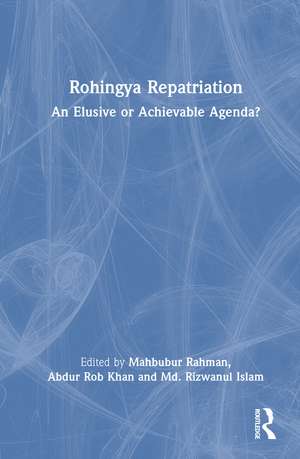
Rohingya Repatriation: An Elusive or Achievable Agenda?
Editat de Mahbubur Rahman, Abdur Rob Khan, Md. Rizwanul Islamen Limba Engleză Hardback – 11 sep 2026
Preț: 1349.60 lei
Preț vechi: 1645.85 lei
-18% Nou
Puncte Express: 2024
Carte tipărită la comandă
Livrare economică 05-19 decembrie
Livrare prin curier în România Termenul estimat este afișat lângă disponibilitate.
Transport gratuit pentru acest produs Plată online sau ramburs, în funcție de opțiunile comenzii.
Retur gratuit în 14 zile Comandă securizată și suport în română.
Specificații
ISBN-13: 9781041299172
ISBN-10: 1041299176
Pagini: 264
Ilustrații: 4
Dimensiuni: 156 x 234 mm
Greutate: 0.65 kg
Ediția:1
Editura: Taylor & Francis
Colecția Routledge
Locul publicării:Oxford, United Kingdom
ISBN-10: 1041299176
Pagini: 264
Ilustrații: 4
Dimensiuni: 156 x 234 mm
Greutate: 0.65 kg
Ediția:1
Editura: Taylor & Francis
Colecția Routledge
Locul publicării:Oxford, United Kingdom
Public țintă
AcademicCuprins
Chapter 1 Introduction, Chapter 2 Contested Identity and Historical Truth: The Rohingya as an “Indigenous” yet “Stateless” People, Chapter 3 The Rohingya Repatriation Discourse: What Repatriation Mean for the Rohingya Living in the Refugee Camps in Bangladesh, Chapter 4 The Wanton Stripping of Nationality and the Violation of International Law: Exploring the Genesis of Atrocities on the Rohingyas, Chapter 5 From Statelessness to Systematic Denial: A Critical Assessment of Myanmar’s Multi-layered Predicaments to Sustainable Rohingya Repatriation Process, Chapter 6 Dealing with China over the Rohingya Issue: Bangladesh’s Predicaments and Leverages, Chapter 7 Rethinking India’s Approach to the Rohingya Crisis, Chapter 8 The Rohingya Quagmire: US Policy, Myanmar’s Resistance, and the International Response, Chapter 9 "Roadblocks to Rohingya repatriation: Can the R2P help remove them?", Chapter 10 Uniting for “Peace”: The (Missing) Role of the United Nations General Assembly in the Rohingya Crisis, Chapter 11 Rohingya Repatriation Beyond the Courtroom: Geopolitics and the Limits of International Adjudication, Chapter 12 Citizenship Law and Practice of Bangladesh: A Hurdle in the Way of Local Integration of the Rohingya Refugees, Chapter 13 Inclusive Repatriation and Rohingya Women: A Critical Analysis, Chapter 14 The quest for Rohingya repatriation: What happened and what’s next?
Recenzii
Rohingya Repatriation: Elusive or Achievable? is a "must read" for scholars and students alike on the plight of the Rohingya. Its authors insightfully address the tragedy of Rohingya refugees, victims of decades of persecution and rendered stateless by the authoritarian government of Myanmar, their life in exile in Bangladesh and the problems and challenges of repatriation.
- John L. Esposito, Distinguished University Professor & Founding Director of the Alwaleed Center for Muslim-Christian Understanding. Georgetown University, Washington, DC.
The editors and contributors to this indispensable volume comprehensively examine the confounding multi-dimensionality of the Rohingyas’ tragedy. Caught between contested sovereignties and identities as well as geopolitical rivalries, those in Bangladesh are in a kind of limbo, neither settled nor repatriated, able to rely on neither international law and institutions nor the cooperation of state actors. Compellingly argued is that any amelioration must lie in the seemingly intractable political and diplomatic realm. To do nothing would be to signal unacceptably that authoritarian policies of displacement can erase minority rights. This volume dispassionately as well as sensitively sets out, rather, the parameters for a reasoned way forward.
- James Piscatori, Emeritus Professor, Australian National University
In this unique volume, a diverse group of scholars systematically and cogently analyze the legal difficulties faced by the Rohingya and what it would take to solve the quagmire that has stranded 1.3 million Rohingya in the world's largest refugee camp. The book examines the roles key stakeholders (international institutions, states, and regional organizations) could play in solving the crisis. It also draws broader warning lessons about the dangers of authoritarian or majoritarian states denationalizing minority groups, depriving them of key political and economic rights protections. The book is mandatory reading for any scholar who cares about the plight of the Rohingya, or the problems of statelessness or refugees more broadly.
- Jennifer Trahan, Clinical Professor at the Center for Global Affairs, New York University
- John L. Esposito, Distinguished University Professor & Founding Director of the Alwaleed Center for Muslim-Christian Understanding. Georgetown University, Washington, DC.
The editors and contributors to this indispensable volume comprehensively examine the confounding multi-dimensionality of the Rohingyas’ tragedy. Caught between contested sovereignties and identities as well as geopolitical rivalries, those in Bangladesh are in a kind of limbo, neither settled nor repatriated, able to rely on neither international law and institutions nor the cooperation of state actors. Compellingly argued is that any amelioration must lie in the seemingly intractable political and diplomatic realm. To do nothing would be to signal unacceptably that authoritarian policies of displacement can erase minority rights. This volume dispassionately as well as sensitively sets out, rather, the parameters for a reasoned way forward.
- James Piscatori, Emeritus Professor, Australian National University
In this unique volume, a diverse group of scholars systematically and cogently analyze the legal difficulties faced by the Rohingya and what it would take to solve the quagmire that has stranded 1.3 million Rohingya in the world's largest refugee camp. The book examines the roles key stakeholders (international institutions, states, and regional organizations) could play in solving the crisis. It also draws broader warning lessons about the dangers of authoritarian or majoritarian states denationalizing minority groups, depriving them of key political and economic rights protections. The book is mandatory reading for any scholar who cares about the plight of the Rohingya, or the problems of statelessness or refugees more broadly.
- Jennifer Trahan, Clinical Professor at the Center for Global Affairs, New York University
Notă biografică
Mahbubur Rahman is Professor of Political Science and Chair of the Department of History and Philosophy at North South University (NSU). He was Founding Director of the Liberation War Research Center at NSU. Prior to joining NSU, he taught at York College of the City University of New York (CUNY) and Jahangirnagar University, Bangladesh, and worked as a Research Associate at the Bangladesh Institute of International and Strategic Studies (BIISS). Rahman’s research and teaching interests focus on Electoral Governance, Democratization, Refugee Repatriation, Responsibility to Protect (R2P), Islamic Activism, and Countering Violent Extremism (CVE). He has authored/edited many publications, including journal articles, books, book chapters, and encyclopedia entries with reputed international publishers. He serves as a country expert (Bangladesh) for the Varieties of Democracy (V-Dem) Institute, Sweden, and sits on the editorial board of several journals. He received several scholarships/fellowships, including the J. William Fulbright Scholarship.
Abdur Rob Khan is Treasurer of North South University (NSU). Previously, he served as Dean of the School of Humanities and Social Sciences (SHSS) at NSU for seven years. Before joining North South University as a faculty member in 2009, Dr Khan spent 15 years as Research Director at the Bangladesh Institute of International and Strategic Studies (BIISS), a think tank under the Ministry of Foreign Affairs. With a graduation in Economics from the University of Dhaka, Dr Khan earned his Ph.D. in International Relations from the University of Kent at Canterbury in 1994, specializing in Conflict Studies. He did post-doctoral work in South Asian politics at UPenn as a Senior Fulbright Fellow in 2007. His book-length works include Globalization and South Asian Security, Human Security in South Asia, and the Human Security Index for South Asia. Dr Khan has widely participated in seminars and conferences across Asia, Europe, and the Americas.
Md. Rizwanul Islam is Professor of Law and Dean of the School of Humanities and Social Sciences at North South University. He has earned his Bachelor of Laws from the University of Dhaka, Master of Laws from the National University of Singapore, and his Doctoral degree from Macquarie University. He has earned several awards for his research work. Rizwan has worked as a consultant or fellow in projects funded by the International Labour Organization, the United Nations Development Programme, and the World Bank. Rizwan sits on the editorial board of several journals.
Abdur Rob Khan is Treasurer of North South University (NSU). Previously, he served as Dean of the School of Humanities and Social Sciences (SHSS) at NSU for seven years. Before joining North South University as a faculty member in 2009, Dr Khan spent 15 years as Research Director at the Bangladesh Institute of International and Strategic Studies (BIISS), a think tank under the Ministry of Foreign Affairs. With a graduation in Economics from the University of Dhaka, Dr Khan earned his Ph.D. in International Relations from the University of Kent at Canterbury in 1994, specializing in Conflict Studies. He did post-doctoral work in South Asian politics at UPenn as a Senior Fulbright Fellow in 2007. His book-length works include Globalization and South Asian Security, Human Security in South Asia, and the Human Security Index for South Asia. Dr Khan has widely participated in seminars and conferences across Asia, Europe, and the Americas.
Md. Rizwanul Islam is Professor of Law and Dean of the School of Humanities and Social Sciences at North South University. He has earned his Bachelor of Laws from the University of Dhaka, Master of Laws from the National University of Singapore, and his Doctoral degree from Macquarie University. He has earned several awards for his research work. Rizwan has worked as a consultant or fellow in projects funded by the International Labour Organization, the United Nations Development Programme, and the World Bank. Rizwan sits on the editorial board of several journals.
Descriere
This volume provides a comprehensive analysis of the Rohingya refugee crisis, examining it as a critical 'time bomb' with implications extending far beyond Bangladesh to affect South Asia and the global community.