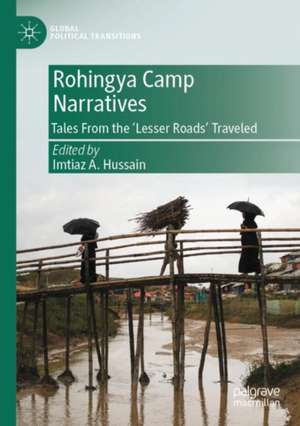
Rohingya Camp Narratives: Global Political Transitions
Editat de Imtiaz A. Hussainen Limba Engleză Paperback – 2 iun 2023
This book presents thirteen chapters which probe the “tales less told” and “pathways less traveled” in refugee camp living. Rohingya camps in Bangladesh since August 2017 supply these “tales” and “pathways”. They dwell upon/reflect camp violence, sexual/gender discrimination, intersectionality, justice, the sudden COVID camp entry, human security, children education, innovation, and relocation plans. Built largely upon field trips, these narratives interestingly interweave with both theoretical threads (hypotheses) and tapestries (net-effects), feeding into the security-driven pulls of political realism, or disseminating from humanitarian-driven socioeconomic pushes, but mostly combining them. Post-ethnic cleansing and post-exodus windows open up a murky future for Rohingya and global refugees. We learn of positive offshoots (of camp innovations exposing civil society relevance) and negative (like human and sex trafficking beyond Bangladeshi and Myanmar borders), as of navigating (a) local–global linkages of every dynamic and (b) fast-moving current circumstances against stoic historical leftovers.
Din seria Global Political Transitions
- 15%
 Preț: 604.87 lei
 - 15%
 Preț: 663.49 lei
 - 15%
 Preț: 607.11 lei
 - 15%
 Preț: 666.02 lei
 - 15%
 Preț: 509.83 lei
 - 18%
 Preț: 897.38 lei
 - 18%
 Preț: 913.69 lei
 - 18%
 Preț: 894.45 lei
 - 15%
 Preț: 613.83 lei
 -
 Preț: 305.43 lei
 - 18%
 Preț: 746.99 lei
 - 18%
 Preț: 807.64 lei
 - 18%
 Preț: 812.51 lei
 - 9%
 Preț: 974.89 lei
 - 9%
 Preț: 855.06 lei
Preț: 457.09 lei
Puncte Express: 686
Carte tipărită la comandă
Livrare economică 04-18 decembrie
Livrare prin curier în România Termenul estimat este afișat lângă disponibilitate.
Transport gratuit pentru acest produs Plată online sau ramburs, în funcție de opțiunile comenzii.
Retur gratuit în 14 zile Comandă securizată și suport în română.
Specificații
ISBN-13: 9789811911996
ISBN-10: 9811911991
Pagini: 340
Ilustrații: XXIII, 314 p. 19 illus., 8 illus. in color.
Dimensiuni: 148 x 210 x 19 mm
Greutate: 0.44 kg
Ediția:1st ed. 2022
Editura: Springer
Colecția Global Political Transitions
Seria Global Political Transitions
Locul publicării:Singapore, Singapore
ISBN-10: 9811911991
Pagini: 340
Ilustrații: XXIII, 314 p. 19 illus., 8 illus. in color.
Dimensiuni: 148 x 210 x 19 mm
Greutate: 0.44 kg
Ediția:1st ed. 2022
Editura: Springer
Colecția Global Political Transitions
Seria Global Political Transitions
Locul publicării:Singapore, Singapore
Cuprins
1.Introduction: Forget-me-nots From Rohingya Camps: Dark Experiences & Tales not Told.- 2.Ethnicity, Identity, & Rohingya Security: At the ‘Olive-tree’-‘Lexus’ Crossroads.- 3.Rohingya Conundrum: Cutting the Gordian Knot.- 4.The Political Economy of Religion & Security: Tracing Rohingya Camp Violence.- 5.From Disorganized Hypocrisy to Political Neo-medievalism? Rohingya Crises in Bangladesh.- 6.Identity ‘Intersectionality’ & Cox’s Bazaar Refugees: Remaking Rohingyas.- 7.Sexual/Gender Camp Violence & Institutional Response Limits: Rohingyas in Bangladesh.- 8.Return, Citizenship, & Justice in the Eye of Rohingya Women: Imagined Terrain?.- 9.Vulnerability & Humanitarian Emergencies: Fate of Rohingya Women amid COVID—19.- 10.Rohingya Refugees & Human Security: Foreign Policy Reform Needs.- 11.Rohingya Refugee-camp Innovations: Reinvigorating Humanitarianism.- 12.Rohingya Refugee & Classroom Children: Cultivating A LostGeneration.- 13.Rohingya Refugee Future: History, Memory, & Relocation.- 14.Conclusion: Squaring the Circle.
Textul de pe ultima copertă
Although international attention on the Rohingya refugees in Bangladesh has waned, the challenges have not. This theoretically informed and empirically rich volume explores the social, economic, political, environmental, and security implications of nearly one million refugees. Policymakers, advocates, and researchers should read this book.
-Geoffrey Macdonald, Ph.D., Bangladesh Country Director, International Republican Institute, Bangladesh
This book presents thirteen chapters which probe the “tales less told” and “pathways less traveled” in refugee camp living. Rohingya camps in Bangladesh since August 2017 supply these “tales” and “pathways”. They dwell upon/reflect camp violence, sexual/gender discrimination, intersectionality, justice, the sudden COVID camp entry, human security, children education, innovation, and relocation plans. Built largely upon field trips, these narratives interestingly interweave with both theoretical threads (hypotheses) and tapestries (net-effects), feeding into the security-driven pulls of political realism, or disseminating from humanitarian-driven socioeconomic pushes, but mostly combining them. Post-ethnic cleansing and post-exodus windows open up a murky future for Rohingya and global refugees. We learn of positive offshoots (of camp innovations exposing civil society relevance) and negative (like human and sex trafficking beyond Bangladeshi and Myanmar borders), as of navigating (a) local–global linkages of every dynamic and (b) fast-moving current circumstances against stoic historical leftovers. -Geoffrey Macdonald, Ph.D., Bangladesh Country Director, International Republican Institute, Bangladesh
Imtiaz A. Hussain founded the Global Studies & Governance Department at Independent University, Bangladesh (2016), after creating/teaching International Relations/Global Studies/Governance courses in Philadelphia University/ Universidad Iberoamericana (1990–2014). He has published over 20 books (South Asia in Global Power Rivalry, Transatlantic Transactions; North American Regionalism; Evaluating NAFTA; Border Governance and the ‘Unruly’ South, and Afghanistan-Iraq and Post-conflict Governance), articles (Encyclopedia of U.S.-Latin American Relations, Handbook of Global Security and Intelligence, South Asian Survey, Politics & Policy, Journal of the Asiatic Society of Bangladesh, Norteamérica, & Journal of International Relations), and has contributed to Bangladesh’s newspapers such as Daily Star and Financial Express. He received his Ph.D. in Political Science from the University of Pennsylvania (1989).
Caracteristici
Covers camp violence, sexual/gender discrimination, the sudden COVID situation, children education, among other issues Focuses on Rohingya camps across Bangladesh’s south-east since August 2017 Built largely upon field-trips, and thereby first-hand experiences of refugees.