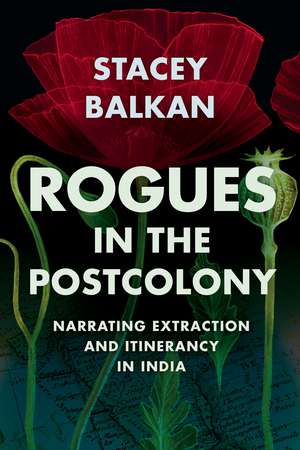
Rogues in the Postcolony
Autor Stacey Balkanen Limba Engleză Paperback – feb 2022
Rogues in the Postcolony is a study of Anglophone Indian picaresque novels that dramatize the impacts of extractive capitalism and colonial occupation on local communities in several Indian states. In this materialist history of development on the subcontinent, Stacey Balkan considers works by Amitav Ghosh, Indra Sinha, and Aravind Adiga that critique violent campaigns of enclosure and dispossession at the hands of corporate entities like the English East India Company and its many legatees. By foregrounding the intersections among landscape ideology, agricultural improvement, extractive capitalism, and aesthetic expression, Rogues in the Postcolony also attends to the complicity of popular aesthetic forms with political and economic policy, as well as the colonial and extractivist logics that often frame discussions around the so-called Anthropocene epoch.
Bringing together questions about settler-colonial practices and environmental injustice, Rogues in the Postcolony concludes with an investigation of new extractivist frontiers, including solar capitalism, and considers the possibility of imagining life after extraction on the Indian subcontinent and beyond.
Preț: 191.64 lei
Puncte Express: 287
Carte tipărită la comandă
Livrare economică 07-21 decembrie
Livrare prin curier în România Termenul estimat este afișat lângă disponibilitate.
Transport gratuit de la 400.00 lei Plată online sau ramburs, în funcție de opțiunile comenzii.
Retur gratuit în 14 zile Comandă securizată și suport în română.
Specificații
ISBN-13: 9781952271366
ISBN-10: 1952271363
Pagini: 224
Ilustrații: 3 b-w images
Dimensiuni: 152 x 229 x 13 mm
Greutate: 0.3 kg
Ediția:First Edition
Editura: West Virginia University Press
ISBN-10: 1952271363
Pagini: 224
Ilustrații: 3 b-w images
Dimensiuni: 152 x 229 x 13 mm
Greutate: 0.3 kg
Ediția:First Edition
Editura: West Virginia University Press
Notă biografică
Stacey Balkan is assistant professor of English and environmental humanities at Florida Atlantic University. She is coeditor of Oil Fictions: World Literature and Our Contemporary Petrosphere.
Textul de pe ultima copertă
Rogues in the Postcolony is a study of Anglophone Indian picaresque novels that dramatize the impacts of extractive capitalism and colonial occupation on local communities in several Indian states. In this materialist history of development on the subcontinent, Stacey Balkan considers works by Amitav Ghosh, Indra Sinha, and Aravind Adiga that critique violent campaigns of enclosure and dispossession at the hands of corporate entities like the English East India Company and its many legatees. By foregrounding the intersections among landscape ideology, agricultural improvement, extractive capitalism, and aesthetic expression, Rogues in the Postcolony also attends to the complicity of popular aesthetic forms with political and economic policy, as well as the colonial and extractivist logics that often frame discussions around the so-called Anthropocene epoch.
Bringing together questions about settler-colonial practices and environmental injustice, Rogues in the Postcolony concludes with an investigation of new extractivist frontiers, including solar capitalism, and considers the possibility of imagining life after extraction on the Indian subcontinent and beyond.
Bringing together questions about settler-colonial practices and environmental injustice, Rogues in the Postcolony concludes with an investigation of new extractivist frontiers, including solar capitalism, and considers the possibility of imagining life after extraction on the Indian subcontinent and beyond.
Recenzii
“Rogues in the Postcolony is a marvelous study of how picaresque novels refract the violent dispossessions and rogue freedoms of extractive capitalism in India and beyond. In dialogue with cutting-edge conversations in environmental and energy humanities, Balkan argues convincingly that extraction is a pervasive dynamic within post/colonial modernity.”
Dominic Boyer, author of Energopolitics: Wind and Power in the Anthropocene
Dominic Boyer, author of Energopolitics: Wind and Power in the Anthropocene
Cuprins
Acknowledgments
Abbreviations
Introduction: Why Can’t a Rogue Be a Hero?
1. Revisiting the Environmental Picaresque: Plantationocene Aesthetics and the Origins of Cheap Nature in Amitav Ghosh’s Ibis Trilogy
2. A Memento Mori Tale: Indra Sinha’s Animal’s People and the Politics of Global Toxicity
3. Slum Ecologies: Figuring (Energy) Waste in Aravind Adiga’s The White Tiger
Conclusion: Beyond Extraction: Imagining Solarity in India's Mineral Belt
Notes
Bibliography
Index
Abbreviations
Introduction: Why Can’t a Rogue Be a Hero?
1. Revisiting the Environmental Picaresque: Plantationocene Aesthetics and the Origins of Cheap Nature in Amitav Ghosh’s Ibis Trilogy
2. A Memento Mori Tale: Indra Sinha’s Animal’s People and the Politics of Global Toxicity
3. Slum Ecologies: Figuring (Energy) Waste in Aravind Adiga’s The White Tiger
Conclusion: Beyond Extraction: Imagining Solarity in India's Mineral Belt
Notes
Bibliography
Index