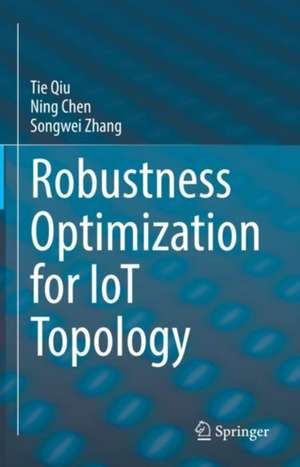
Robustness Optimization for IoT Topology
Autor Tie Qiu, Ning Chen, Songwei Zhangen Limba Engleză Paperback – 12 iun 2023
The book provides the relevant theoretical framework and the latest empirical research on robustness optimization of IoT topology. Starting with the self-organization of networks, it gradually moves to genetic evolution. It also discusses the application of neural networks and reinforcement learning to endow the node with self-learning ability to allow intelligent networking.
This book is intended for students, practitioners, industry professionals, and researchers who are eager to comprehend the vulnerabilities of IoT topology. It helps them to master the research framework for IoT topology robustness optimization and to build more efficient and reliable IoT topologies in their industry.
Preț: 987.61 lei
Preț vechi: 1234.51 lei
-20%
Puncte Express: 1481
Carte tipărită la comandă
Livrare economică 26 noiembrie-10 decembrie
Livrare prin curier în România Termenul estimat este afișat lângă disponibilitate.
Transport gratuit pentru acest produs Plată online sau ramburs, în funcție de opțiunile comenzii.
Retur gratuit în 14 zile Comandă securizată și suport în română.
Specificații
ISBN-13: 9789811696114
ISBN-10: 981169611X
Pagini: 228
Ilustrații: XIV, 214 p. 1 illus.
Dimensiuni: 155 x 235 x 13 mm
Greutate: 0.33 kg
Ediția:1st ed. 2022
Editura: Palgrave MacMillan
Locul publicării:Singapore, Singapore
ISBN-10: 981169611X
Pagini: 228
Ilustrații: XIV, 214 p. 1 illus.
Dimensiuni: 155 x 235 x 13 mm
Greutate: 0.33 kg
Ediția:1st ed. 2022
Editura: Palgrave MacMillan
Locul publicării:Singapore, Singapore
V-ar putea interesa
-
 Computer Networks: A Systems ApproachLarry L. Peterson-41%Preț: 558.53 lei941.05 lei
 -
 -31%Preț: 441.34 lei639.30 lei
 -
 -15%Preț: 436.67 lei513.73 lei
 -
 Deep Learning Crash CourseGiovanni Volpe-35%Preț: 290.84 lei445.88 lei
 -
 Advances in AI for Cloud, Edge, and Mobile Computing ApplicationsShrikaant Kulkarni-20%Preț: 1296.62 lei1620.78 lei
 -
 Intelligent Computing and OptimizationPandian Vasant-20%Preț: 1282.88 lei1603.61 lei
 -
 Concise Guide to the Internet of ThingsMichael Mccarthy-20%Preț: 421.74 lei527.18 lei
 -
 -18%Preț: 1368.94 lei1669.44 lei
 -
 Advances in Smart Medical, IoT & Artificial IntelligenceMohammed Serrhini-20%Preț: 1394.25 lei1742.81 lei
 -
 -20%Preț: 531.38 lei664.22 lei
 -
 -20%Preț: 558.53 lei698.17 lei
 -
 Intelligent Water Monitoring IoT SystemAna Cristina Faria RibeiroPreț: 426.48 lei
 -
 Design Frameworks for Wireless NetworksSantosh Kumar Das-24%Preț: 969.75 lei1275.99 lei
 -
 -18%Preț: 1239.08 lei1511.08 lei
 -
 Applied Soft Computing and Communication NetworksSabu M. Thampi-20%Preț: 1448.49 lei1810.62 lei
 -
 Intelligent Networked ThingsLin Zhang-20%Preț: 898.45 lei1123.05 lei
 -
 -18%Preț: 1350.37 lei1646.80 lei
 -
 -18%Preț: 1184.25 lei1444.21 lei
Cuprins
Chapter 1 Introduction 1.1 Context and motivation
1.2 Characteristics of IoT topology
1.3 Attack modes against network topology
1.4 Book organization
Chapter 2 Preliminaries of robustness optimization
2.1 Metrics of topology robustness
2.2 Related work
2.3 Existing challanges
Chapter 3 Robustness optimization based on self-organization 3.1 Path planning based on the greedy principle
3.2 Construction of highly robust topology
3.3 Robust time synchronization scheme
Chapter 4 Evolution-based robustness optimization 4.1 Robustness optimization scheme with multi-population co-evolution
4.2 An adaptive robustness evolution algorithm with self-competition
Chapter 5 Robustness optimization based on swarm intelligence
5.1 Topology optimization strategy with ant colony algorithm
5.2 Topology optimization strategy with particle swarm algorithm
Chapter 6 Robustness optimization based on multi-objective cooperation
6.1 Multi-objective optimization based on layered-cooperation
Chapter 7 Robustness optimization based on self-learning
7.1 Malicious node identification scheme based on gaussian mixture model
7.2 Highly robust topology learning model based on neural network
7.3 Highly robust topology generation strategy based on time series convolutional network
Chapter 8 Robustness optimization based on node self-learning
8.1 Node self-learning mechanism based on reinforcement learning
Chapter 9 Future research directions
9.1 Homogeneous networks
9.2 Heterogeneous networks
9.3 Smart IoT
1.2 Characteristics of IoT topology
1.3 Attack modes against network topology
1.4 Book organization
Chapter 2 Preliminaries of robustness optimization
2.1 Metrics of topology robustness
2.2 Related work
2.3 Existing challanges
Chapter 3 Robustness optimization based on self-organization 3.1 Path planning based on the greedy principle
3.2 Construction of highly robust topology
3.3 Robust time synchronization scheme
Chapter 4 Evolution-based robustness optimization 4.1 Robustness optimization scheme with multi-population co-evolution
4.2 An adaptive robustness evolution algorithm with self-competition
Chapter 5 Robustness optimization based on swarm intelligence
5.1 Topology optimization strategy with ant colony algorithm
5.2 Topology optimization strategy with particle swarm algorithm
Chapter 6 Robustness optimization based on multi-objective cooperation
6.1 Multi-objective optimization based on layered-cooperation
Chapter 7 Robustness optimization based on self-learning
7.1 Malicious node identification scheme based on gaussian mixture model
7.2 Highly robust topology learning model based on neural network
7.3 Highly robust topology generation strategy based on time series convolutional network
Chapter 8 Robustness optimization based on node self-learning
8.1 Node self-learning mechanism based on reinforcement learning
Chapter 9 Future research directions
9.1 Homogeneous networks
9.2 Heterogeneous networks
9.3 Smart IoT
Notă biografică
Xiaobo Zhou is a professor in the College of Intelligence and Computing at Tianjin University, China. His research interests include Internet of Things, cloud computing, edge computing, and mobile computing. He has authored/coauthored over 100 in international journals and conference proceedings, including IEEE Transactions on Mobile Computing, IEEE Transactions on Cloud Computing, IEEE INFOCOM, etc. He has served as TPC Co-Chair, Publication Chair for server international conferences. He is a senior member of China Computer Federation (CCF) and IEEE.
Shuxin Ge is pursuing a doctoral degree of Computer Science and Technology at Tianjin University, China. His researches focus on the mobile edge computing, Internet of Things, vehicular fog computing, and ride-hailing platform management.
Jiancheng Chi is currently pursuing a PhD degree in Computer Science and Technology at Tianjin University, China. His research interests include industrial internet of things, industrial Big Data, edge computing, and machine learning.
Tie Qiu is a full professor at the School of Computer Science and Technology, Tianjin University, China. Prior to that, he held positions as an assistant professor in 2008 and associate professor in 2013 at the School of Software, Dalian University of Technology. He also served as a visiting professor at the Department of Electrical and Computer engineering, Iowa State University, U.S. (2014-2015). At present, he holds editorial roles in multiple international journals, including IEEE/ACM Transactions on Networking (ToN), IEEE Transactions on Network Science and Engineering (TNSE) and IEEE Transactions on Systems, Man, and Cybernetics: Systems, etc. Dr. Qiu has played significant roles, for example General Chair, Program Chair, in various international conferences. He has authored/coauthored 10 books, over 200 scientific papers in international journals and conference proceedings, such as IEEE/ACM Transactions on Networking, IEEE Transactions on Mobile Computing, IEEE Transactions on Knowledge and Data Engineering, IEEE Transactions on Industrial Informatics, IEEE Communications Surveys and Tutorials, IEEE Communications, INFOCOM, GLOBECOM, etc. He is a distinguished member of China Computer Federation (CCF) and a senior member of IEEE and ACM.
Textul de pe ultima copertă
The IoT topology defines the way various components communicate with each other within a network. Topologies can vary greatly in terms of security, power consumption, cost, and complexity. Optimizing the IoT topology for different applications and requirements can help to boost the network’s performance and save costs. More importantly, optimizing the topology robustness can ensure security and prevent network failure at the foundation level. In this context, this book examines the optimization schemes for topology robustness in the IoT, helping readers to construct a robustness optimization framework, from self-organizing to intelligent networking.
The book provides the relevant theoretical framework and the latest empirical research on robustness optimization of IoT topology. Starting with the self-organization of networks, it gradually moves to genetic evolution. It also discusses the application of neural networks and reinforcement learning to endow the node with self-learning ability to allow intelligent networking.
This book is intended for students, practitioners, industry professionals, and researchers who are eager to comprehend the vulnerabilities of IoT topology. It helps them to master the research framework for IoT topology robustness optimization and to build more efficient and reliable IoT topologies in their industry.
The book provides the relevant theoretical framework and the latest empirical research on robustness optimization of IoT topology. Starting with the self-organization of networks, it gradually moves to genetic evolution. It also discusses the application of neural networks and reinforcement learning to endow the node with self-learning ability to allow intelligent networking.
This book is intended for students, practitioners, industry professionals, and researchers who are eager to comprehend the vulnerabilities of IoT topology. It helps them to master the research framework for IoT topology robustness optimization and to build more efficient and reliable IoT topologies in their industry.
Caracteristici
Provides in-depth studies on the theory and hands-on practices of the IoT topology robustness
Discusses the robustness optimization framework, from self-organizing to intelligent networking
Explores intelligent networking technologies to improve topology robustness in 5G IoT
Discusses the robustness optimization framework, from self-organizing to intelligent networking
Explores intelligent networking technologies to improve topology robustness in 5G IoT