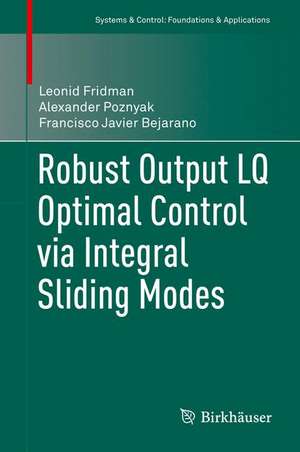
Robust Output LQ Optimal Control via Integral Sliding Modes: Systems & Control: Foundations & Applications
Autor Leonid Fridman, Alexander Poznyak, Francisco Javier Bejaranoen Limba Engleză Hardback – 6 mar 2014
In the theory of optimal control, the linear quadratic (LQ) optimal problem plays an important role due to its physical meaning, and its solution is easily given by an algebraic Riccati equation. This solution turns out to be restrictive, however, because of two assumptions: the system must be free from disturbances and the entire state vector must be known. A new technique, called output integral sliding modes, eliminates the effects of disturbances acting in the same subspace as the control. By using LQ-optimal control together with integral sliding modes, the former is made robust and based on output information only. Thus optimal control theory improves its applicability.
Din seria Systems & Control: Foundations & Applications
- 15%
 Preț: 611.27 lei
 -
 Preț: 374.54 lei
 - 18%
 Preț: 823.65 lei
 - 15%
 Preț: 661.83 lei
 -
 Preț: 408.64 lei
 - 15%
 Preț: 674.70 lei
 - 15%
 Preț: 670.12 lei
 - 15%
 Preț: 584.73 lei
 -
 Preț: 397.95 lei
 - 15%
 Preț: 651.27 lei
 - 15%
 Preț: 668.04 lei
 - 15%
 Preț: 675.82 lei
 - 15%
 Preț: 664.88 lei
 - 15%
 Preț: 657.71 lei
 -
 Preț: 399.93 lei
 - 15%
 Preț: 555.18 lei
 -
 Preț: 381.55 lei
 -
 Preț: 411.78 lei
 - 18%
 Preț: 1383.74 lei
 - 18%
 Preț: 995.59 lei
 -
 Preț: 411.23 lei
 -
 Preț: 406.37 lei
 - 18%
 Preț: 995.63 lei
 - 18%
 Preț: 966.51 lei
 - 18%
 Preț: 950.43 lei
 - 15%
 Preț: 643.87 lei
 - 18%
 Preț: 1005.14 lei
 - 15%
 Preț: 673.55 lei
 - 18%
 Preț: 987.18 lei
 - 15%
 Preț: 646.70 lei
 -
 Preț: 399.46 lei
 - 15%
 Preț: 669.86 lei
 -
 Preț: 396.88 lei
 - 18%
 Preț: 1014.46 lei
 - 15%
 Preț: 669.16 lei
Preț: 400.42 lei
Puncte Express: 601
Carte tipărită la comandă
Livrare economică 05-19 decembrie
Livrare prin curier în România Termenul estimat este afișat lângă disponibilitate.
Transport gratuit pentru acest produs Plată online sau ramburs, în funcție de opțiunile comenzii.
Retur gratuit în 14 zile Comandă securizată și suport în română.
Specificații
ISBN-13: 9780817649616
ISBN-10: 0817649611
Pagini: 164
Ilustrații: XII, 149 p. 42 illus., 30 illus. in color.
Dimensiuni: 160 x 241 x 15 mm
Greutate: 0.37 kg
Ediția:2014
Editura: birkhäuser
Colecția Systems & Control: Foundations & Applications
Seria Systems & Control: Foundations & Applications
Locul publicării:New York, NY, United States
ISBN-10: 0817649611
Pagini: 164
Ilustrații: XII, 149 p. 42 illus., 30 illus. in color.
Dimensiuni: 160 x 241 x 15 mm
Greutate: 0.37 kg
Ediția:2014
Editura: birkhäuser
Colecția Systems & Control: Foundations & Applications
Seria Systems & Control: Foundations & Applications
Locul publicării:New York, NY, United States
V-ar putea interesa
-
 Principles of Mathematical Analysis (Int'l Ed)Walter Rudin-27%Preț: 375.61 lei516.26 lei
 -
 Lattice Methods for Multiple IntegrationI. H. Sloan-32%Preț: 782.97 lei1144.70 lei
 -
 Matrix AnalysisRajendra Bhatia-15%Preț: 495.63 lei583.09 lei
 -
 A Course in Functional AnalysisJohn B. Conway-15%Preț: 498.70 lei586.70 lei
 -
 -27%Preț: 1396.87 lei1913.52 lei
 -
 First Course Mathematical AnalysisDavid Alexander Brannan-19%Preț: 517.37 lei638.73 lei
 -
 CalculusKen Binmore-19%Preț: 520.86 lei643.03 lei
 -
 Calculus of Variations and Optimal Control TheoryDaniel Liberzon-19%Preț: 601.35 lei742.41 lei
 -
 Sliding Mode Control and ObservationYuri Shtessel-54%Preț: 385.06 lei840.94 lei
 -
 Measure Theory and Fine Properties of FunctionsLawrenceCraig Evans-9%Preț: 1086.36 lei1193.79 lei
 -
 Optimization with PDE ConstraintsMichael Hinze-18%Preț: 924.87 lei1127.89 lei
 -
 Convex Analysis and Nonlinear OptimizationJonathan Borwein-15%Preț: 446.81 lei525.65 lei
 -
 Mathematical Control TheoryEduardo D. Sontag-15%Preț: 515.66 lei606.66 lei
 -
 Foundations of OptimizationOsman Güler-40%Preț: 239.42 lei399.03 lei
 -
 Geometric Optimal ControlHeinz Schättler-15%Preț: 606.28 lei713.27 lei
 -
 Optimal InvestmentL. C. G. Rogers-15%Preț: 467.08 lei549.51 lei
 -
 Nonlinear Solid MechanicsAdnan IbrahimbegovicPreț: 427.88 lei
Public țintă
Professional/practitionerCuprins
Introduction.- Part I OPTIMAL CONTROL AND SLIDING MODE.- 2 Integral Sliding Mode Control.- 3 Observer Based on ISM.- 4 Output Integral Sliding Mode Based Control.- Part II MINI-MAX OUTPUT ROBUST LQ CONTROL.- 5 The Robust Maximum Principle.- 6 Multimodel and ISM Control.- 7 Multiplant and ISM Output Control.- 8 Fault Detection.- 9 Stewart Platform.- 10 Magnetic Bearing.- Part IV APPENDIXES.- B Min-Max Multimodel LQ Control.- Notations.- References.- Index.
Textul de pe ultima copertă
Featuring original research from well-known experts in the field of sliding mode control, this monograph presents new design schemes for implementing LQ control solutions in situations where the output system is the only information provided about the state of the plant. This new design works under the restrictions of matched disturbances without losing its desirable features. On the cutting-edge of optimal control research, Robust Output LQ Optimal Control via Integral Sliding Modes is an excellent resource for both graduate students and professionals involved in linear systems, optimal control, observation of systems with unknown inputs, and automatization.
In the theory of optimal control, the linear quadratic (LQ) optimal problem plays an important role due to its physical meaning, and its solution is easily given by an algebraic Riccati equation. This solution turns out to be restrictive, however, because of two assumptions: the system must be free from disturbances and the entire state vector must be known. A new technique, called output integral sliding modes, eliminates the effects of disturbances acting in the same subspace as the control. By using LQ-optimal control together with integral sliding modes, the former is made robust and based on output information only. Thus optimal control theory improves its applicability.
In the theory of optimal control, the linear quadratic (LQ) optimal problem plays an important role due to its physical meaning, and its solution is easily given by an algebraic Riccati equation. This solution turns out to be restrictive, however, because of two assumptions: the system must be free from disturbances and the entire state vector must be known. A new technique, called output integral sliding modes, eliminates the effects of disturbances acting in the same subspace as the control. By using LQ-optimal control together with integral sliding modes, the former is made robust and based on output information only. Thus optimal control theory improves its applicability.
Caracteristici
New approach used, with many design techniques unique to this book Minimal prerequisites: only a basic course in linear systems theory is needed For a broad audience of graduate students, practitioners, and researchers in engineering, mathematics, and optimal control theory