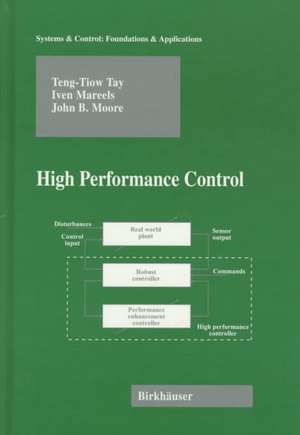
High Performance Control: Systems & Control: Foundations & Applications
Autor Teng-Tiow Tay, Iven Mareels, John B. Mooreen Limba Engleză Hardback – sep 1997
Din seria Systems & Control: Foundations & Applications
- 15%
 Preț: 611.27 lei
 -
 Preț: 374.54 lei
 - 18%
 Preț: 823.65 lei
 - 15%
 Preț: 661.83 lei
 -
 Preț: 408.64 lei
 - 15%
 Preț: 674.70 lei
 - 15%
 Preț: 670.12 lei
 - 15%
 Preț: 584.73 lei
 -
 Preț: 397.95 lei
 - 15%
 Preț: 651.27 lei
 - 15%
 Preț: 668.04 lei
 - 15%
 Preț: 675.82 lei
 - 15%
 Preț: 664.88 lei
 - 15%
 Preț: 657.71 lei
 -
 Preț: 399.93 lei
 - 15%
 Preț: 546.55 lei
 -
 Preț: 381.55 lei
 -
 Preț: 411.78 lei
 - 18%
 Preț: 1383.74 lei
 - 18%
 Preț: 995.59 lei
 -
 Preț: 411.23 lei
 -
 Preț: 395.19 lei
 - 18%
 Preț: 995.63 lei
 - 18%
 Preț: 966.51 lei
 - 18%
 Preț: 950.43 lei
 - 15%
 Preț: 643.87 lei
 - 18%
 Preț: 973.69 lei
 - 18%
 Preț: 987.18 lei
 - 15%
 Preț: 646.70 lei
 -
 Preț: 399.46 lei
 - 15%
 Preț: 669.86 lei
 -
 Preț: 396.88 lei
 - 18%
 Preț: 1014.46 lei
 - 15%
 Preț: 669.16 lei
Preț: 653.16 lei
Preț vechi: 768.42 lei
-15%
Puncte Express: 980
Carte tipărită la comandă
Livrare economică 26 noiembrie-10 decembrie
Livrare prin curier în România Termenul estimat este afișat lângă disponibilitate.
Transport gratuit pentru acest produs Plată online sau ramburs, în funcție de opțiunile comenzii.
Retur gratuit în 14 zile Comandă securizată și suport în română.
Specificații
ISBN-13: 9780817640040
ISBN-10: 0817640045
Pagini: 368
Ilustrații: XVII, 347 p.
Dimensiuni: 160 x 241 x 26 mm
Greutate: 0.72 kg
Ediția:1998
Editura: birkhäuser
Colecția Systems & Control: Foundations & Applications
Seria Systems & Control: Foundations & Applications
Locul publicării:Boston, MA, United States
ISBN-10: 0817640045
Pagini: 368
Ilustrații: XVII, 347 p.
Dimensiuni: 160 x 241 x 26 mm
Greutate: 0.72 kg
Ediția:1998
Editura: birkhäuser
Colecția Systems & Control: Foundations & Applications
Seria Systems & Control: Foundations & Applications
Locul publicării:Boston, MA, United States
V-ar putea interesa
-
 -41%Preț: 185.00 lei311.77 lei
 -
 Switching Power Supplies A - ZSanjaya Maniktala-27%Preț: 388.10 lei530.87 lei
 -
 Hidden Markov ModelsRobert J. Elliott-18%Preț: 990.21 lei1207.57 lei
 -
 Optimal FilteringBrian D O AndersonPreț: 154.16 lei
 -
 Optimal ControlBrian D O AndersonPreț: 148.57 lei
 -
 Preț: 172.42 lei
 -
 Impulse Time-Domain Electromagnetics of Continuous MediaAlex ShvartsburgPreț: 399.93 lei
 -
 Partial Stability and ControlV. I. VorotnikovPreț: 416.48 lei
 -
 Intelligent Methods in Signal Processing and CommunicationsDomingo DocampoPreț: 409.69 lei
 -
 Stability and Oscillations of Nonlinear Pulse-Modulated SystemsAlexander N. Churilov-18%Preț: 1040.67 lei1269.11 lei
 -
 Computer Intensive Methods in Control and Signal ProcessingMiroslav Karny-15%Preț: 667.74 lei785.58 lei
 -
 Signal Analysis and PredictionAles Prochazka-15%Preț: 688.79 lei810.34 lei
 -
 Signal Detection TheoryVyacheslav Tuzlukov-15%Preț: 630.04 lei741.22 lei
 -
 -9%Preț: 844.50 lei928.03 lei
 -
 -23%Preț: 723.54 lei939.66 lei
 -
 Electrochemical Power SourcesBagotsky-8%Preț: 640.87 lei696.59 lei
 -
 Power System Transient AnalysisEiichi Haginomori-9%Preț: 737.97 lei810.95 lei
 -
 -9%Preț: 812.48 lei892.83 lei
 -
 Fuel Cell FundamentalsRyan O'Hayre-23%Preț: 915.53 lei1189.00 lei
 -
 Optimization and Dynamical SystemsUwe Helmke-18%Preț: 741.79 lei904.63 lei
 -
 Feedback and Control for EveryonePedro AlbertosPreț: 335.05 lei
Public țintă
ResearchCuprins
1 Performance Enhancement.- 1.1 Introduction.- 1.2 Beyond Classical Control.- 1.3 Robustness and Performance.- 1.4 Implementation Aspects and Case Studies.- 1.5 Book Outline.- 1.6 Study Guide.- 1.7 Main Points of Chapter.- 1.8 Notes and References.- 2 Stabilizing Controllers.- 2.1 Introduction.- 2.2 The Nominal Plant Model.- 2.3 The Stabilizing Controller.- 2.4 Coprime Factorization.- 2.5 All Stabilizing Feedback Controllers.- 2.6 All Stabilizing Regulators.- 2.7 Notes and References.- 3 Design Environment.- 3.1 Introduction.- 3.2 Signals and Disturbances.- 3.3 Plant Uncertainties.- 3.4 Plants Stabilized by a Controller.- 3.5 State Space Representation.- 3.6 Notes and References.- 4 Off-line Controller Design.- 4.1 Introduction.- 4.2 Selection of Performance Index.- 4.3 An LQG/LTR Design.- 4.4 H? Optimal Design.- 4.5 An ?1 Design Approach.- 4.6 Notes and References.- 5 Iterated and Nested (Q, S) Design.- 5.1 Introduction.- 5.2 Iterated (Q, S) Design.- 5.3 Nested (Q, S) Design.- 5.4 Notes and References.- 6 Direct Adaptive- Q Control.- 6.1 Introduction.- 6.2 Q-Augmented Controller Structure: Ideal Model Case.- 6.3 Adaptive-Q Algorithm.- 6.4 Analysis of the Adaptive-Q Algorithm. Ideal Case.- 6.5 Q-augmented Controller Structure: Plant-model Mismatch.- 6.6 Adaptive Algorithm.- 6.7 Analysis of the Adaptive-Q Algorithm: Unmodeled Dynamics Situation.- 6.8 Notes and References.- 7 Indirect (Q, S) Adaptive Control.- 7.1 Introduction.- 7.2 System Description and Control Problem Formulation.- 7.3 Adaptive Algorithms.- 7.4 Adaptive Algorithm Analysis: Ideal case.- 7.5 Adaptive Algorithm Analysis: Nonideal Case.- 7.6 Notes and References.- 8 Adaptive-Q Application to Nonlinear Systems.- 8.1 Introduction.- 8.2 Adaptive-Q Method for Nonlinear Control.- 8.3 Stability Properties.-8.4 Learning-Q Schemes.- 8.5 Notes and References.- 9 Real-time Implementation.- 9.1 Introduction.- 9.2 Algorithms for Continuous-time Plant.- 9.3 Hardware Platform.- 9.4 Software Platform.- 9.5 Other Issues.- 9.6 Notes and References.- 10 Laboratory Case Studies.- 10.1 Introduction.- 10.2 Control of Hard-disk Drives.- 10.3 Control of a Heat Exchanger.- 10.4 Aerospace Resonance Suppression.- 10.5 Notes and References.- A Linear Algebra.- A.1 Matrices and Vectors.- A.2 Addition and Multiplication of Matrices.- A.3 Determinant and Rank of a Matrix.- A.4 Range Space, Kernel and Inverses.- A.5 Eigenvalues, Eigenvectors and Trace.- A.6 Similar Matrices.- A.7 Positive Definite Matrices and Matrix Decompositions.- A.8 Norms of Vectors and Matrices.- A.9 Differentiation and Integration.- A.10 Lemma of Lyapunov.- A.11 Vector Spaces and Subspaces.- A.12 Basis and Dimension.- A.13 Mappings and Linear Mappings.- B Dynamical Systems.- B.1 Linear Dynamical Systems.- B.2 Norms, Spaces and Stability Concepts.- B.3 Nonlinear Systems Stability.- C Averaging Analysis For Adaptive Systems.- C.1 Introduction.- C.2 Averaging.- C.3 Transforming an adaptive system into standard form.- C.4 Averaging Approximation.- References.
Recenzii
"Examples...include control of a hard disk drive, control of a heat exchanger, and aerospace resonance suppression. ...Three appendices...make the text basically self-contained... Most chapters also contain short problem sections. ...Throughout the book, the authors maintain their focus on real-world application issues while presenting theoretically rigorous mathematical developments. ...Other useful features of the book are a list of figures, an eight-page bibliography, an author index, and a ten-page subject index." —Computing Reviews