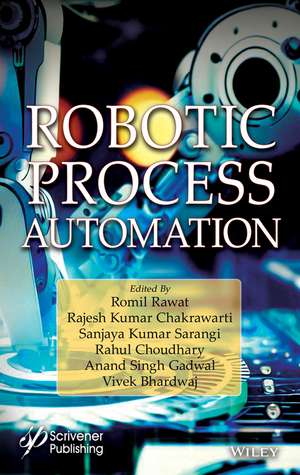
Robotic Process Automation
Editat de Romil Rawat, Rajesh Kumar Chakrawarti, Sanjaya Kumar Sarangi, Rahul Choudhary, Anand Singh Gadwal, Vivek Bhardwajen Limba Engleză Hardback – 6 sep 2023
ABORDAREA PRACTICĂ: Robotic Process Automation se distinge prin echilibrul riguros între fundamentele teoretice și implementarea soluțiilor software în diverse industrii. Reținem că acest volum, publicat sub egida Wiley, nu se limitează la o descriere conceptuală, ci analizează modul în care tehnologia RPA poate fi desfășurată pentru a gestiona roboți software capabili să execute sarcini repetitive, precum extragerea datelor sau navigarea în sisteme digitale complexe. Notăm cu interes modul în care autorii integrează cunoștințe din domenii vaste — de la mecatronică și electronică la bioinginerie — pentru a oferi o imagine de ansamblu asupra automatizării moderne. Ca și Tom Taulli în The Robotic Process Automation Handbook, echipa de editori condusă de Romil Rawat distilează experiență reală în principii acționabile, punând un accent deosebit pe eficiența operativă: roboții software pot procesa informația fără erori umane și fără necesitatea pauzelor fiziologice. Totodată, volumul abordează utilizarea roboticii în scenarii critice, precum deactivarea dispozitivelor explozibile sau misiunile subacvatice, oferind o perspectivă tehnică asupra sistemelor de comandă și control. În contextul operei editorilor, această lucrare completează temele explorate în Conversational Artificial Intelligence, unde accentul era pus pe securitatea cloud și aplicații conversaționale. Dacă lucrarea anterioară se concentra pe interfața dintre om și mașină prin limbaj, volumul de față extinde analiza către automatizarea proceselor de back-office și intervenția robotizată în medii ostile. Putem afirma că lucrarea reprezintă o resursă tehnică esențială pentru înțelegerea modului în care algoritmii software și structurile mecanice converg în industria 4.0.
Preț: 1131.92 lei
Preț vechi: 1470.03 lei
-23%
Carte disponibilă
Livrare economică 18 august-01 septembrie
Specificații
ISBN-10: 1394166184
Pagini: 464
Dimensiuni: 152 x 231 x 30 mm
Greutate: 0.77 kg
Ediția:1
Editura: Wiley
Locul publicării:Hoboken, United States
V-ar putea interesa
-
 Robotics: A Very Short IntroductionAlan Winfield-21%Preț: 54.90 lei69.90 lei
 -
 -25%Preț: 93.65 lei125.53 lei
 -
 Soft RoboticsCecilia Laschi-14%Preț: 446.92 lei519.68 lei
 -
 Robotics in Physical Medicine and RehabilitationDouglas P. Murphy-29%Preț: 833.29 lei1181.44 lei
 -
 So That's How It Works! Robots and AITom Jackson-40%Preț: 57.36 lei95.22 lei
 -
 Robotic Process and Cognitive Automation: The Next PhaseLeslie Willcocks-20%Preț: 226.05 lei282.56 lei
 -
 Robotic Process Automation and Risk MitigationLeslie P. WillcocksPreț: 138.93 lei
 -
 The Big Book of RobotsCampbell BooksPreț: 82.86 lei
 -
 MechatronicsW. Bolton-11%Preț: 657.18 lei738.39 lei
 -
 The Heart and the ChipDaniela RusPreț: 163.39 lei
 -
 Python Automation For DummiesAlan Simpson-20%Preț: 144.23 lei180.29 lei
 -
 The LEGO MINDSTORMS EV3 LaboratoryDaniele Benedettelli-20%Preț: 209.46 lei260.46 lei
 -
 -35%Preț: 286.72 lei440.91 lei
 -
 Racing RobotsElizabeth DalePreț: 48.81 lei
 -
 First Sticker Book RobotsAlice BeechamPreț: 46.63 lei
 -
 Robotics Software Design and EngineeringAlejandro Rafael Garcia Ramirez-23%Preț: 784.45 lei1018.77 lei
 -
 RoboticsKathy CeceriPreț: 90.59 lei
 -
 -20%Preț: 311.36 lei389.19 lei
 -
 Raising Robots to be GoodRebecca RaperPreț: 194.01 lei
 -
 Robotics Goes MOOCBruno SicilianoPreț: 404.01 lei
De ce să citești această carte
Această carte este indispensabilă profesioniștilor din IT și inginerie care doresc să implementeze soluții de automatizare scalabile. Cititorul câștigă o înțelegere profundă a tehnologiei RPA, învățând cum să înlocuiască procesele manuale predispuse la erori cu fluxuri de lucru automatizate. Este un ghid tehnic solid pentru cei care proiectează sisteme capabile să opereze în medii unde prezența umană este riscantă sau ineficientă.
Despre autor
Echipa editorială, condusă de Romil Rawat și Rajesh Kumar Chakrawarti, reunește experți în securitate cibernetică, inteligență artificială și sisteme computaționale. Romil Rawat are o experiență vastă în cercetarea tehnologiilor emergente, fiind cunoscut și pentru contribuțiile sale în domeniul AI conversațional și al securității în cloud. Expertiza colectivă a autorilor se reflectă în abordarea multidisciplinară a cărții, aceștia reușind să conecteze teoria matematică abstractă cu aplicațiile practice din ingineria software și electronică, adaptând conceptele complexe la nevoile actuale ale industriei tehnologice.
Notă biografică
Rajesh Kumar Chakrawarti, PhD, is a professor and the Dean of the Department of Computer Science & Engineering, Sushila Devi Bansal College, Bansal Group of Institutions, India. He has over 20 years of industry and academic experience and has published over 100 research papers and chapters in books.
Sanjaya Kumar Sarangi, PhD, is an adjunct professor and coordinator at Utkal University, Coordinator and Adjunct Professor, Utkal University, Bhubaneswar, India. He has over 23 years of academic experience and has authored textbooks, book chapters, and papers for journals and conferences. He has been a visiting doctoral fellow at the University of California, USA, and he has more than 30 patents to his credit.
Rahul Choudhary, PhD, is an assistant professor at the Shri Vaishnav Institute of Information Technology, Indore, India. He has over nine years of academic experience.
Anand Singh Gadwal, is an assistant professor at the Shri Vaishnav Institute of Information Technology, Indore, India, has a masters of engineering degree in computer engineering, and is pursuing a PhD in this area.
Vivek Bhardwaj, PhD, is an assistant professor at Manipal University Jaipur, Jaipur, India. He has over eight years of teaching and research experience, has filed five patents, and has published many articles in scientific journals and conferences.
Descriere scurtă
Robotics is the study of creating devices that can take the place of people and mimic their behaviors. Mechanical engineering, electrical engineering, information engineering, mechatronics, electronics, bioengineering, computer engineering, control engineering, software engineering, mathematics, and other subjects are all included in robotics. Robots can be employed in a variety of scenarios and for a variety of objectives, but many are now being used in hazardous areas (such as radioactive material inspection, bomb detection, and deactivation), manufacturing operations, or in conditions where humans are unable to live (e.g. in space, underwater, in high heat, and clean up and containment of hazardous materials and radiation). Walking, lifting, speaking, cognition, and any other human activity are all attempted by robots. Many of today's robots are influenced by nature, making bio-inspired robotics a growing area. Defusing explosives, seeking survivors in unstable ruins, and investigating mines and shipwrecks are just a few of the activities that robots are designed to undertake.
This groundbreaking new volume presents a Robotic Process Automation (RPA) software technique that makes it simple to create, deploy, and manage software robots that mimic human movements while dealing with digital systems and software. Software robots can interpret what's on a screen, type the correct keystrokes, traverse systems, locate and extract data, and do a wide variety of predetermined operations, much like people. Software robots can do it quicker and more reliably than humans, without having to stand up and stretch or take a coffee break.