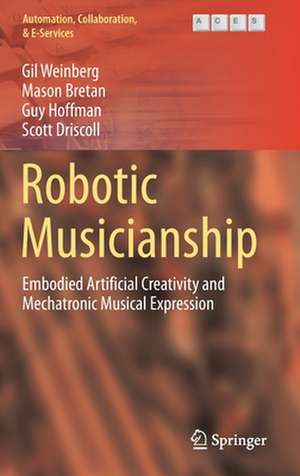
Robotic Musicianship: Automation, Collaboration, & E-Services, cartea 8
Autor Gil Weinberg, Mason Bretan, Guy Hoffman, Scott Driscollen Limba Engleză Hardback – 8 feb 2020
The book provides an in-depth view of the robotic platforms designed at the GTCMT Robotic Musicianship Group, including the improvisational robotic percussionists Haile and Shimon, the personal robotic companion Shimi, and a number of wearable robots, such as the Robotic Drumming Prosthesis, The Third Drumming Arm, and the Skywalker Piano Hand. The book discusses numerous research studies based on these platforms in the context of five main principles: Listen like a Human, Play Like a Machine, Be Social, Watch and Learn, and Wear It.
Din seria Automation, Collaboration, & E-Services
- 20%
 Preț: 1106.44 lei
 - 20%
 Preț: 1124.29 lei
 - 18%
 Preț: 910.19 lei
 - 20%
 Preț: 1011.05 lei
 - 20%
 Preț: 943.96 lei
 - 24%
 Preț: 1354.21 lei
 - 18%
 Preț: 702.12 lei
 - 18%
 Preț: 919.70 lei
 - 24%
 Preț: 877.57 lei
 - 15%
 Preț: 677.73 lei
 - 18%
 Preț: 926.05 lei
 - 15%
 Preț: 666.11 lei
 - 20%
 Preț: 667.61 lei
 - 20%
 Preț: 615.98 lei
 - 15%
 Preț: 612.18 lei
 - 18%
 Preț: 964.09 lei
 - 18%
 Preț: 746.75 lei
 - nou
 Preț: 785.36 lei
Preț: 969.44 lei
Preț vechi: 1182.24 lei
-18%
Puncte Express: 1454
Carte tipărită la comandă
Livrare economică 23 noiembrie-07 decembrie
Livrare prin curier în România Termenul estimat este afișat lângă disponibilitate.
Transport gratuit pentru acest produs Plată online sau ramburs, în funcție de opțiunile comenzii.
Retur gratuit în 14 zile Comandă securizată și suport în română.
Specificații
ISBN-13: 9783030389291
ISBN-10: 3030389294
Pagini: 276
Ilustrații: XVII, 256 p. 161 illus., 98 illus. in color.
Dimensiuni: 160 x 241 x 21 mm
Greutate: 0.58 kg
Ediția:1st ed. 2020
Editura: Springer
Colecția Automation, Collaboration, & E-Services
Seria Automation, Collaboration, & E-Services
Locul publicării:Cham, Switzerland
ISBN-10: 3030389294
Pagini: 276
Ilustrații: XVII, 256 p. 161 illus., 98 illus. in color.
Dimensiuni: 160 x 241 x 21 mm
Greutate: 0.58 kg
Ediția:1st ed. 2020
Editura: Springer
Colecția Automation, Collaboration, & E-Services
Seria Automation, Collaboration, & E-Services
Locul publicării:Cham, Switzerland
V-ar putea interesa
-
 The Musician's Way: A Guide to Practice, Performance, and WellnessGerald Klickstein-15%Preț: 222.22 lei262.94 lei
 -
 -21%Preț: 166.03 lei210.74 lei
 -
 Two Beats AheadPanos A. Panay-39%Preț: 86.49 lei140.73 lei
 -
 Sound ActionsAlexander Refsum JenseniusPreț: 363.59 lei
 -
 Living with RobotsRuth AylettPreț: 157.79 lei
 -
 FuturomaniaSimon ReynoldsPreț: 124.69 lei
 -
 Preț: 273.94 lei
 -
 Preț: 113.35 lei
 -
 Preț: 384.83 leiRecomandat
 -
 Preț: 383.51 lei
 -
 The Heart and the ChipDaniela RusPreț: 163.70 lei
 -
 Creative MachinesMaya AckermanPreț: 205.21 lei
 -
 The Madman's OrchestraEdward Brooke-HitchingPreț: 197.06 leiRecomandat
 -
 Listening to the Music the Machines MakeRichard Evans-17%Preț: 92.33 lei110.63 lei
 -
 The Guitar CircleRobert FrippPreț: 383.37 lei
 -
 -18%Preț: 1119.50 lei1365.24 lei
 -
 Robotics Goes MOOCBruno SicilianoPreț: 404.01 lei
 -
 Mind the Music: On Improvisation, Music and the BrainArtur C. Jaschke-19%Preț: 98.33 lei121.90 lei
 -
 Beat the BotsJane K. Cleland-22%Preț: 122.04 lei156.67 lei
Cuprins
Introduction.- Georgia Tech’s Robotic Musicianship Platforms.- Listen Like A Human.- Play Like A Machine.- Social Interaction through Gestures.- Watch and Learn.- Wearable Robotic Musicians.
Textul de pe ultima copertă
This book discusses the principles, methodologies, and challenges of robotic musicianship through an in-depth review of the work conducted at the Georgia Tech Center for Music Technology (GTCMT), where the concept was first developed. Robotic musicianship is a relatively new research field that focuses on the design and development of intelligent music-making machines. The motivation behind the field is to develop robots that not only generate music, but also collaborate with humans by listening and responding in an expressive and creative manner. This combination of human and machine creativity has the potential to surprise and inspire us to play, listen, compose, and think about music in new ways.
The book provides an in-depth view of the robotic platforms designed at the GTCMT Robotic Musicianship Group, including the improvisational robotic percussionists Haile and Shimon, the personal robotic companion Shimi, and a number of wearable robots, such as the Robotic Drumming Prosthesis, The Third Drumming Arm, and the Skywalker Piano Hand. The book discusses numerous research studies based on these platforms in the context of five main principles: Listen like a Human, Play Like a Machine, Be Social, Watch and Learn, and Wear It.
The book provides an in-depth view of the robotic platforms designed at the GTCMT Robotic Musicianship Group, including the improvisational robotic percussionists Haile and Shimon, the personal robotic companion Shimi, and a number of wearable robots, such as the Robotic Drumming Prosthesis, The Third Drumming Arm, and the Skywalker Piano Hand. The book discusses numerous research studies based on these platforms in the context of five main principles: Listen like a Human, Play Like a Machine, Be Social, Watch and Learn, and Wear It.
Caracteristici
Explores the exciting novel opportunities that emerge at the cusp of the intersection between 1. Musical Mechatronics, which is the study and construction of physical systems that generate sound through mechanical means; and 2. Machine Musicianship, which focuses on developing algorithms and cognitive models representative of various aspects of music perception, composition, performance, and theory Presents state-of-the-art research and developments Interesting to musicians, scientists, engineers, and artists who are interested in the interdisciplinary intersections of their respective fields and in exploring the inherent challenges involved in making a machine artistically expressive The book ends with a fictional chapter exploring the potential impact of creative robotics on society