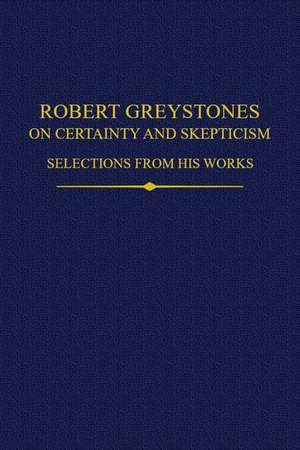
Robert Greystones on Certainty and Skepticism: Selections from His Works: Auctores Britannici Medii Aevi
Editat de Robert Andrews, Jennifer Ottman, Mark Henningeren Limba Engleză Hardback – 28 mar 2020
Această ediție critică, publicată în prestigioasa serie Auctores Britannici Medii Aevi, aduce în prim-plan o figură aproape uitată a gîndirii medievale, a cărei relevanță pentru istoria filozofiei este recalibrată prin documente inedite. Subliniem faptul că Robert Greystones on Certainty and Skepticism nu este doar o culegere de texte, ci o dovadă documentară care obligă la o revizuire a cronologiei scepticismului occidental. Deși cercetători recenți au susținut că resursele teoretice pentru scepticismul de tip cartezian nu existau în secolul al XIV-lea, textul de față demonstrează contrariul: Greystones a formulat îndoieli radicale cu mult înaintea lui Descartes.
Ne-a atras atenția modul în care editorii Robert Andrews, Jennifer Ottman și Mark Henninger au structurat cele cinci întrebări fundamentale extrase din comentariul lui Greystones la „Sentențe”. Autorul pornește de la premisa puterii absolute a lui Dumnezeu pentru a concluziona că nu putem avea certitudini despre existența obiectelor externe, despre cauzalitate sau chiar despre propriul corp. Singura certitudine rămâne „ego sum”, însă, spre deosebire de Descartes, Greystones avertizează că încrederea în simțuri este o formă de auto-amăgire, dat fiind că intervenția divină poate surveni în orice moment.
Ca alternativă la Skepticism de G. Anthony Bruno pentru cursurile de epistemologie sau istoria filozofiei medievale, lucrarea de față are avantajul de a oferi acces direct la surse primare traduse și comentate, care prefigurează dezbaterile moderne. Volumul continuă direcția începută în Robert Greystones on the Freedom of the Will, unde Henninger explora teoria libertății umane la același autor, oferind acum o imagine completă a sistemului său de gîndire.
Din seria Auctores Britannici Medii Aevi
- 23%
 Preț: 704.46 lei
 - 23%
 Preț: 846.75 lei
 - 23%
 Preț: 725.70 lei
 - 19%
 Preț: 683.80 lei
 - 23%
 Preț: 735.10 lei
 - 23%
 Preț: 809.19 lei
 - 19%
 Preț: 680.07 lei
 - 19%
 Preț: 520.23 lei
 - 23%
 Preț: 703.34 lei
 - 23%
 Preț: 918.03 lei
 - 23%
 Preț: 811.60 lei
 - 23%
 Preț: 1012.03 lei
 - 23%
 Preț: 1089.12 lei
 - 23%
 Preț: 891.96 lei
 - 37%
 Preț: 809.62 lei
 - 37%
 Preț: 838.84 lei
 - 37%
 Preț: 992.61 lei
 - 37%
 Preț: 620.49 lei
 - 36%
 Preț: 649.92 lei
 - 36%
 Preț: 748.60 lei
 -
 Preț: 468.19 lei
 - 34%
 Preț: 421.88 lei
 - 34%
 Preț: 454.97 lei
 - 37%
 Preț: 643.62 lei
Preț: 1020.89 lei
Preț vechi: 1325.83 lei
-23%
Carte disponibilă
Livrare economică 31 octombrie-14 noiembrie
Specificații
ISBN-10: 0197266592
Pagini: 587
Dimensiuni: 161 x 230 x 36 mm
Greutate: 1 kg
Editura: OUP OXFORD
Colecția OUP Oxford
Seria Auctores Britannici Medii Aevi
Locul publicării:Oxford, United Kingdom
V-ar putea interesa
-
 The New Penguin Dictionary of Modern QuoRobert AndrewsPreț: 313.19 lei
 -
 -23%Preț: 735.10 lei954.68 lei
 -
 -37%Preț: 809.62 lei1278.33 lei
 -
 -37%Preț: 992.61 lei1570.35 lei
 -
 Famous Lines – A Columbia Dictionary of Familiar QuotationsRobert AndrewsPreț: 507.18 lei
 -
 Aquinas on the Beginning and End of Human LifeFabrizio AmeriniPreț: 310.59 lei
 -
 Gadamer's Ethics of Play: Hermeneutics and the OtherMonica Vilhauer-35%Preț: 594.56 lei910.58 lei
 -
 Augustine and PhilosophyPhillip Cary-33%Preț: 705.22 lei1054.62 lei
 -
 The A to Z of Medieval Philosophy and TheologyStephen F. Brown-28%Preț: 350.33 lei486.48 lei
 -
 Good and Evil Actions A Journey through Saint Thomas AquinasSteven J JensenPreț: 267.00 lei
 -
 Headed UpstreamJack LoefflerPreț: 119.26 lei
 -
 1308David Wirmer-9%Preț: 2133.30 lei2344.29 lei
 -
 Schriften zur Anthropologie I, Geschichtsphilosophie, Politik und PädagogikWilhelm WeischedelPreț: 144.44 lei
 -
 Montaigne und die LebenskunstMario StenzPreț: 126.14 lei
 -
 Die BergpredigtAurelius AugustinusPreț: 82.88 lei
De ce să citești această carte
Recomandăm această lucrare cercetătorilor și studenților la filozofie care doresc să descopere rădăcinile medievale ale scepticismului modern. Cititorul va obține o perspectivă rară asupra modului în care teologia scolastică a generat, paradoxal, premisele îndoielii radicale. Este o piesă esențială pentru înțelegerea tranziției de la certitudinea dogmatică la interogația critică asupra capacităților cognitive umane.
Despre autor
Robert Andrews este un cercetător și editor specializat în filozofia medievală, colaborând frecvent cu Mark Henninger și Jennifer Ottman pentru recuperarea manuscriselor scolastice. Deși biografia sa publică include și o carieră diversificată în securitate națională și literatură de ficțiune, activitatea sa academică în cadrul seriei Auctores Britannici Medii Aevi este recunoscută pentru rigoarea filologică. În acest volum, el contribuie la editarea și traducerea textelor lui Robert Greystones, un călugăr benedictin și teolog de la Oxford din secolul al XIV-lea, a cărui operă a rămas mult timp în manuscris.