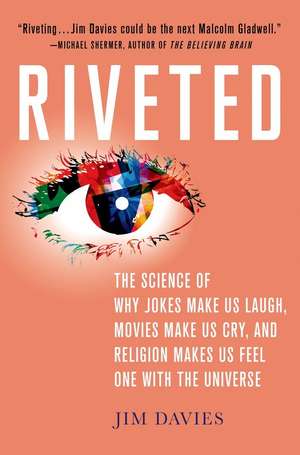
Riveted
Autor Jim Daviesen Limba Engleză Hardback – 4 aug 2014
Notăm cu interes apariția volumului Riveted, o lucrare esențială pentru studenții și profesioniștii din sfera științelor cognitive și sociale care doresc să înțeleagă arhitectura atenției umane. Jim Davies propune un model teoretic integrat pentru a explica de ce anumite concepte — de la știri alarmante la narațiuni religioase — reușesc să ne „ancoreze” mintea, în timp ce altele trec neobservate. Relevanța acestei analize pentru curriculumul de psihologie cognitivă rezidă în capacitatea autorului de a demonstra că preferințele noastre, adesea considerate subiective sau arbitrare, sunt de fapt rezultatul unor presiuni evolutive precise și al unor mecanisme neuronale de recompensă.
Remarcăm structura riguroasă a argumentației: Davies investighează modul în care creierul caută instinctiv tipare și informații vitale pentru supraviețuire, transformând curiozitatea într-un instrument biologic. Putem afirma că volumul reușește să sintetizeze cercetări complexe din ultimii 20 de ani într-un format accesibil, fără a sacrifica rigoarea științifică. Riveted completează perspectiva oferită de Mystery de Jonah Lehrer, adăugând o bază solidă de psihologie evoluționistă și antropologie acolo unde Lehrer se concentrează mai mult pe neuroștiința suspansului și a marketingului. În timp ce alte lucrări analizează doar nișe specifice ale interesului uman, Jim Davies oferă o „teorie a tot ceea ce ne captivează”, explicând de ce suntem programați să fim atenți la bârfele despre structura socială sau la accidentele de pe marginea drumului.
Experiența lecturii este una de clarificare; autorul demonstrează prin studii de caz, precum cel al întâlnirilor rapide (speed dating), că predicțiile noastre conștiente despre propriile dorințe sunt frecvent infirmate de alegerile subconștiente. Este un instrument valoros pentru oricine activează în comunicare, educație sau cercetare comportamentală.
Preț: 192.56 lei
Carte disponibilă
Livrare economică 28 mai-11 iunie
Specificații
ISBN-10: 113727901X
Pagini: 282
Ilustrații: illustrations
Dimensiuni: 162 x 247 x 26 mm
Greutate: 0.48 kg
Ediția:1
Editura: Palgrave MacMillan Trade
V-ar putea interesa
-
 -25%Preț: 363.98 lei487.16 lei
 -
 Time Will Tell: A Theory of Dynamic AttendingMari Riess Jones-33%Preț: 609.00 lei907.08 lei
 -
 The First Minds: Caterpillars, Karyotes, and ConsciousnessArthur S. Reber-23%Preț: 269.90 lei349.91 lei
 -
 The Aesthetic AnimalHenrik Hogh-Olesen-13%Preț: 271.36 lei313.25 lei
 -
 Art, Aesthetics, and the BrainJoseph P. Huston-29%Preț: 401.64 lei569.09 lei
 -
 -24%Preț: 514.26 lei680.39 lei
 -
 The Origins of Morality: An Evolutionary AccountDennis Krebs-32%Preț: 464.50 lei680.39 lei
 -
 Preț: 101.89 lei
 -
 Preț: 444.18 lei
 -
 Specification and Proof in Real Time CSPJim Davies-20%Preț: 363.26 lei454.07 lei
 -
 Psychology of Language: Theory and ApplicationsShelia M. Kennison-21%Preț: 347.77 lei441.69 lei
 -
 Found Footage Horror Films: A Cognitive ApproachPeter Turner-18%Preț: 1069.15 lei1303.85 lei
 -
 Artificial Believers: The Ascription of BeliefAfzal BallimPreț: 423.91 lei
 -
 Preț: 238.04 lei
 -
 Levels of Cognitive DevelopmentTracy S. KendlerPreț: 222.56 lei
 -
 Perception of the Visual EnvironmentRonald G. BoothePreț: 385.99 lei
 -
 Past, Present, and Future Contributions of Cognitive Writing Research to Cognitive PsychologyVirginia Wise Berninger-9%Preț: 1276.82 lei1403.11 lei
 -
 Formal Methods and Software EngineeringJim Davies-20%Preț: 635.14 lei793.93 lei
 -
 -20%Preț: 652.07 lei815.08 lei
 -
 Integrated Formal MethodsJim Davies-20%Preț: 642.92 lei803.65 lei
 -
 -20%Preț: 321.03 lei401.30 lei
 -
 Engineering Agile Big-Data SystemsKevin Feeney-20%Preț: 724.37 lei905.47 lei
 -
 The Sphere of AttentionP. Sven Arvidson-15%Preț: 616.03 lei724.74 lei
De ce să citești această carte
Recomandăm această carte oricărui cititor interesat de mecanismele invizibile care ne ghidează atenția și deciziile. Veți câștiga o înțelegere profundă a motivelor pentru care anumite povești sau idei „prind” la public, descoperind legătura dintre instinctele de supraviețuire și consumul modern de media. Este o resursă excelentă pentru a înțelege de ce mintea umană prioritizează anumite tipuri de informații în detrimentul altora, oferind un avantaj teoretic în orice domeniu ce implică persuasiunea.
Despre autor
Jim Davies este profesor universitar și cercetător în cadrul Institutului de Științe Cognitive de la Universitatea Carleton din Ottawa, Canada. Specializat în modelare computațională și psihologia imaginației, Davies conduce „Science of Imagination Laboratory”, unde explorează procesele mentale din spatele creativității și al credințelor umane. Expertiza sa interdisciplinară este reflectată în modul în care combină în Riveted date din inteligență artificială, biologie și filozofie pentru a oferi o imagine de ansamblu asupra funcționării minții umane în context cultural.
Recenzii
"Moments that jolt or delight us punctuate our lives. But whereas shock might be salutary in an art gallery, it can trigger blind belief in other contexts, points out cognitive scientist Jim Davies. Expounding his theory of 'compellingness foundations', Davies synthesizes research on what makes us susceptible to gripping stimuli, such as our drives to discover patterns and to find incongruity, and our attraction to hope and fear. Scepticism, he argues, can help us to build resistance to riveting ideas that turn out to be duds."--"Nature"
""
"Davies's book is not meant to be a "how-to" manual for artists. He's not sure it's even possible to engineer a work of art based on these principles of compellingness. What the book may do, he says, is help creatives "understand the basis of their intuitions." Riveted...presents a unified theory of compellingness."--"Fast Company"
"In the battle to grab attention, you should heed the musings of Jim Davies in "Riveted."..Davies attempts a grand unified theory of compellingness...What ["Riveted"] show[s] is that while media culture can be overwhelming, it also provides a great platform from which to observe the endless mysteries and absurdities of human nature."--"New Scientist"
"To describe Riveted as riveting sounds cliche, but I predict that Jim Davies could be the next Malcolm Gladwell. Integrating scientific findings with compelling stories across the wide spectrum of the human experience--art, music, literature, comedy, magic, quotes, sports, conspiracy theories, gossip, religion, and science itself--Davies weaves a central theme throughout to explain what makes them all so compelling. You can read Riveted for five minutes or five hours and be enriched at multiple levels, and the book itself explains why. How recursive." --Michael Shermer is the Publisher of "Skeptic" magazine, a monthly columnist for "Scientific American," and the author of "The Believing Brain," "Why Darwin Matters," and "The Science of Good and Evil"
"What makes a song, a piece of art, a tabloid or even a silly romantic comedy film trailer so enthralling? What is it about these things that draw us in, even when we may (or at least should) know better? In "Riveted," Jim Davies tackles this complex question by proposing a thoughtful, interdisciplinary framework to illuminate the qualities of 'compellingness, ' the very attributes of riveting things that have the power to sway our beliefs and attention. By tying together psychological, anthropological, cognitive science, and evolutionary biological studies, he provides a thorough and persuasive context to help us understand how the compelling can fascinate (and sometimes manipulate) the human mind." --Kayt Sukel, author of "Dirty Minds: How Our Brains Influence Love, Sex, and Relationships"
" "
"My life's work as an experience designer has been to rivet audiences for Universal, Disney, Sanrio, Broadway as well as to train soldiers, surgeons, and other high-risk job holders for life and death situations. So I know how and what makes an audience 'riveted, ' but not until reading Jim Davies' book did I understand WHY audiences are RIVETED. This book is a delightful read through the many diverse and nuanced drivers of human experience, influences, and choices. It is a must read for anyone who is looking to influence these strange beasts we call humans and keep them captivated."--Christopher Stapleton, Experience Designer and Creative Venture Catalyst, Simiosys
"Accessible and entertaining. Davies draws fascinating insights from a wealth of diverse material." --Jeanette Bicknell, Ph.D., author of "Why Music Moves Us"
""
""Riveted" lives up to its title as a compelling investigation into the properties of our lives, the origins of which can be traced to the kind of species we are: why we plan, imagine, invent imaginary worlds, weep and laugh in chorus, delight in puzzles and incongruities, respond to patterns, rhythms, and repetitions, cluster in groups and create outsiders, seek attractive partners, and crave status. To a better understanding of human nature, this book is a brilliant guide."--Donald Beecher, Chancellor's Professor, Carleton University, Ottawa
"A fascinating analysis of what we find fascinating."--"Kirkus Reviews"
"Moments that jolt or delight us punctuate our lives. But whereas shock might be salutary in an art gallery, it can trigger blind belief in other contexts, points out cognitive scientist Jim Davies. Expounding his theory of 'compellingness foundations', Davies synthesizes research on what makes us susceptible to gripping stimuli, such as our drives to discover patterns and to find incongruity, and our attraction to hope and fear. Scepticism, he argues, can help us to build resistance to riveting ideas that turn out to be duds."--"Nature"
""
"Davies's book is not meant to be a "how-to" manual for artists. He's not sure it's even possible to engineer a work of art based on these principles of compellingness. What the book may do, he says, is help creatives "understand the basis of their intuitions." Riveted...presents a unified theory of compellingness."--"Fast Company"
"In the battle to grab attention, you should heed the musings of Jim Davies in "Riveted."..Davies attempts a grand unified theory of compellingness...What ["Riveted"] show[s] is that while media culture can be overwhelming, it also provides a great platform from which to observe the endless mysteries and absurdities of human nature."--"New Scientist"
"To describe Riveted as riveting sounds cliche, but I predict that Jim Davies could be the next Malcolm Gladwell. Integrating scientific findings with compelling stories across the wide spectrum of the human experience--art, music, literature, comedy, magic, quotes, sports, conspiracy theories, gossip, religion, and science itself--Davies weaves a central theme throughout to explain what makes them all so compelling. You can read Riveted for five minutes or five hours and be enriched at multiple levels, and the book itself explains why. How recursive." --Michael Shermer is the Publisher of "Skeptic" magazine, a monthly columnist for "Scientific American," and the author of "The Believing Brain," "Why Darwin Matters," and "The Science of Good and Evil"
"What makes a song, a piece of art, a tabloid or even a silly romantic comedy film trailer so enthralling? What is it about these things that draw us in, even when we may (or at least should) know better? In "Riveted," Jim Davies tackles this complex question by proposing a thoughtful, interdisciplinary framework to illuminate the qualities of 'compellingness, ' the very attributes of riveting things that have the power to sway our beliefs and attention. By tying together psychological, anthropological, cognitive science, and evolutionary biological studies, he provides a thorough and persuasive context to help us understand how the compelling can fascinate (and sometimes manipulate) the human mind." --Kayt Sukel, author of "Dirty Minds: How Our Brains Influence Love, Sex, and Relationships"
" "
"My life's work as an experience designer has been to rivet audiences for Universal, Disney, Sanrio, Broadway as well as to train soldiers, surgeons, and other high-risk job holders for life and death situations. So I know how and what makes an audience 'riveted, ' but not until reading Jim Davies' book did I understand WHY audiences are RIVETED. This book is a delightful read through the many diverse and nuanced drivers of human experience, influences, and choices. It is a must read for anyone who is looking to influence these strange beasts we call humans and keep them captivated."--Christopher Stapleton, Experience Designer and Creative Venture Catalyst, Simiosys
"Accessible and entertaining. Davies draws fascinating insights from a wealth of diverse material." --Jeanette Bicknell, Ph.D., author of "Why Music Moves Us"
""
""Riveted" lives up to its title as a compelling investigation into the properties of our lives, the origins of which can be traced to the kind of species we are: why we plan, imagine, invent imaginary worlds, weep and laugh in chorus, delight in puzzles and incongruities, respond to patterns, rhythms, and repetitions, cluster in groups and create outsiders, seek attractive partners, and crave status. To a better understanding of human nature, this book is a brilliant guide."--Donald Beecher, Chancellor's Professor, Carleton University, Ottawa