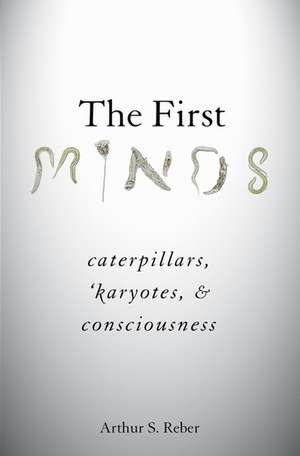
The First Minds: Caterpillars, Karyotes, and Consciousness
Autor Arthur S. Reberen Limba Engleză Hardback – 17 ian 2019
Preț: 298.77 lei
Preț vechi: 378.55 lei
-21%
Puncte Express: 448
Comandă specială
Livrare economică 12-17 noiembrie
Livrare express 23-29 octombrie pentru 120.09 lei
Livrare prin curier în România Termenul estimat este afișat lângă disponibilitate.
Transport gratuit de la 400.00 lei Plată online sau ramburs, în funcție de opțiunile comenzii.
Retur gratuit în 14 zile Comandă securizată și suport în română.
Specificații
ISBN-13: 9780190854157
ISBN-10: 0190854154
Pagini: 296
Dimensiuni: 236 x 160 x 20 mm
Greutate: 0.57 kg
Editura: Oxford University Press
Colecția OUP USA
Locul publicării:New York, United States
ISBN-10: 0190854154
Pagini: 296
Dimensiuni: 236 x 160 x 20 mm
Greutate: 0.57 kg
Editura: Oxford University Press
Colecția OUP USA
Locul publicării:New York, United States
Recenzii
In The First Minds, Reber masterfully organizes and presents this challenging theory in book form, which introduces readers to his reasons for positing the early origin of consciousness. He begins with the question of whether robots can be conscious, contrasting weak AI with strong AI and concluding that computers will not have minds because they do not have self-awareness and agency. He then gives a historical review of the resistance to Donald Griffin's ideas of animal awareness and Brian Key's rejection of fish pain, offering a few approaches to his viewpoint. This is a well-constructed book, worth reading even for those who do not believe the premise.
Notă biografică
Arthur S. Reber earned his Ph.D. from Brown University (1967). He was in the Psychology Department of the University of British Columbia from 1966 to 1970 when he moved to Brooklyn College and the Graduate Center of the City University of New York. After retiring in 2005, he returned to UBC as a Visiting Professor. Reber is a Fellow of the Association for Psychological Science and the American Association for the Advancement of Science, and was a Fulbright Professor 1977-1978 in Innsbruck, Austria. He is also a lexicographer (Dictionary of Psychology - Penguin), a novelist (Xero to Sixty - Create Space), and an authority on poker and gambling (Poker, Life and Other Confusing Things -- Conjelco, The New Gambler's Bible -- Three Rivers, and Gambling for Dummies -- Wiley, with L. Krieger and R. Harroch).
Cuprins
- Table of Contents
- Preface
- Where the Voyage Began: A Personal Note
- A Quick Overview
- An Aside on Terminology
- An Aside on the Nature of Philosophic Argument
- Distinguishing between Evolutionary Biology and Evolutionary Psychology
- A Note on Citations
- Summary
- Chapter I : Can Robots be Conscious?
- Functionalism or the Possibility of "Hardware-Independent" Consciousness
- What Do I/You Know about Minds? Yours and/or Mine?
- Is there Something It Is Like To Be a Robot?
- John Searle's Chinese Room
- The Anthropomorphic "Tug"
- Summary
- Chapter II: Why Has A CBC-Type Model Not Been Proposed Before?
- My Propaedeutic Caterpillar
- Three Reasons for Hesitating
- In Defense of Anthropomorphism
- A Short Aside on Fish Pain? An Object Lesson
- Those Who Are, Might Be, or Perhaps Should be Comfortable with Sentient cells
- Summary
- Chapter III. Bio-centric Views of the Origin of Consciousness: The Search for the Solution to the Hard Problem
- General Theories of the Origins of Consciousness
- Phylogenetic Searching for the First Appearance of Consciousness
- Some Thoughts on These Efforts
- Stumbling into a Category Error
- The Emergentist's Dilemma
- Anticipating Criticism: Some Prophylactic Arguments
- Summary
- Chapter IV: Where we Get Serious: The Cellular Basis of Consciousness
- Common Threads with Other Areas of Research
- A Short Aside on a Personal Bewilderment
- A Short Aside on which Unicellular Species We're Talking About
- The Cellular Basis of Consciousness Framework
- A Closer Look at Unicellular Life
- Summary
- Coda: Anticipating Criticism (once more) and Defending Against it
- Chapter V: Entailments of the Cellular Basis of Consciousness Stance
- On Evolution's Hierarchical Structure
- Reductionism
- Avoiding Mysterianism
- Empirical Problems Searching for Solutions
- Plants
- Ethical Considerations
- A Short Aside on Altruism and Cooperation
- Secondary Gains
- Summary
- Appendix A: An Exercise in Lexicography: Defining (?) Consciousness
- Appendix B: The Cambridge Declaration on Consciousness, with Commentary
- References