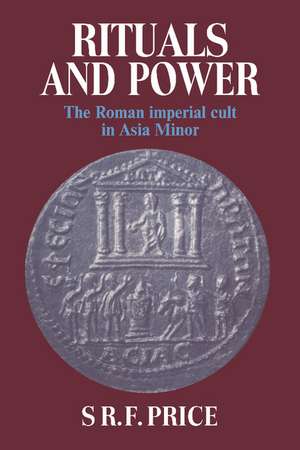
Rituals and Power: The Roman Imperial Cult in Asia Minor
Autor S. R. F. Priceen Limba Engleză Paperback – 26 sep 1985
În lucrarea Rituals and Power, S. R. F. Price propune o reevaluare riguroasă a cultului imperial în Asia Mică, pornind de la premisa că interpretările tradiționale au fost mult timp distorsionate de o perspectivă anacronică, de influență creștină. Remarcăm argumentul central al autorului: separarea modernă între sferă religioasă și cea politică este inadecvată pentru a înțelege de ce supușii greci îl tratau pe împăratul roman ca pe o divinitate. Autorul demonstrează că acest cult nu era doar o formă de flatare politică, ci un sistem religios vital și flexibil care ajuta orașele grecești să conceptualizeze puterea externă a Romei.
Structura volumului este echilibrată între teorie și analiză materială. Prima parte investighează rădăcinile sociale și culturale ale cultului, în timp ce a doua parte se concentrează pe aspectele concrete ale ritualului — de la arhitectura templelor și semnificația statuilor de cult, până la rolul sacrificiilor. Ediția de față, publicată de Cambridge University Press, include 24 de ilustrații alb-negru și 6 hărți care sprijină argumentația arheologică și numismatică.
Această cercetare extinde cadrul propus de Cult, Ritual, Divinity and Belief in the Roman World de Duncan Fishwick prin concentrarea specifică pe spațiul elenistic și prin utilizarea metodelor antropologice pentru a descifra simbolismul puterii. Dacă în The Religious History of the Roman Empire autorul oferea o perspectivă de ansamblu asupra peisajului religios, aici el plonjează în mecanismele intime ale reprezentării imperiale. Lucrarea rămâne un punct de referință fundamental, influențând direct studii precum Paul and the Roman Imperial Order, care analizează contextul misiunilor pauline prin prisma structurilor de putere descrise de Price.
Preț: 326.55 lei
Carte tipărită la comandă
Livrare economică 08-22 iunie
Specificații
ISBN-10: 052131268X
Pagini: 320
Ilustrații: 24 b/w illus. 6 maps
Dimensiuni: 152 x 233 x 20 mm
Greutate: 0.49 kg
Ediția:Revised
Editura: Cambridge University Press
Colecția Cambridge University Press
Locul publicării:Cambridge, United Kingdom
V-ar putea interesa
-
 The Fall of the Roman RepublicPlutarch-20%Preț: 72.21 lei89.74 lei
 -
 The Greeks: A Portrait of Self and OthersPaul Cartledge-22%Preț: 105.89 lei134.95 lei
 -
 The Oxford Illustrated History of Prehistoric EuropeBarry Cunliffe-20%Preț: 218.86 lei272.13 lei
 -
 -18%Preț: 505.57 lei617.93 lei
 -
 She-Wolf: The Story of a Roman IconCristina MazzoniPreț: 187.38 lei
 -
 Roman WarfareJonathan P RothPreț: 215.80 lei
 -
 Egypt and the EgyptiansDouglas J. BrewerPreț: 388.93 lei
 -
 The Ancient Languages of Asia MinorRoger D. Woodard-19%Preț: 429.05 lei529.69 lei
 -
 The Ancient Languages of Mesopotamia, Egypt and AksumRoger D. Woodard-19%Preț: 434.29 lei536.16 lei
 -
 The World of Athens: An Introduction to Classical Athenian CultureJoint Association of Classical TeachersPreț: 254.36 lei
 -
 Preț: 344.32 lei
 -
 The Horse in Human HistoryPita KeleknaPreț: 284.53 lei
 -
 Seven Wonders of the Ancient WorldPaul Jordan-18%Preț: 1070.77 lei1305.83 lei
 -
 Thucydides and the Shaping of HistoryProfessor Emily Greenwood-17%Preț: 243.76 lei294.63 lei
 -
 The Mystery of the Crystal SkullsChris MortonPreț: 116.24 lei
 -
 Archaeological Resource Management in the UKIan RalstonPreț: 183.52 lei
 -
 Nero Caesar Augustus: Emperor of RomeDavid ShotterPreț: 457.13 lei
De ce să citești această carte
Recomandăm această carte cercetătorilor și studenților de istorie veche care doresc să înțeleagă mecanismele puterii în Antichitate fără filtrele interpretative moderne. Cititorul câștigă o perspectivă interdisciplinară, unde arheologia și antropologia explică cum ritualul religios a devenit limbajul universal al politicii imperiale. Este o resursă esențială pentru a înțelege contextul în care a apărut creștinismul timpuriu în orașele grecești.
Descriere scurtă
Cuprins
Recenzii
'While the book is based upon a meticulous study of the surviving evidence for the cult in Asia Minor … likely to satisfy the most demanding empirical researcher, the real excitement and challenge of the book for me lies in its conceptual sophistication and the sustained nature of the argumentatiob … Not a little of its bite comes from Price's effective command of recent anthropological writing.' C. E. V. Nixon, The Liverpool Classical Monthly
'The combination of detailed scholarship in a particular area with insights which will assist anyone's understanding of religion, and of power, in the ancient world, make this an extremely important book.' T. E. J. Wiedemann, The JACT Review