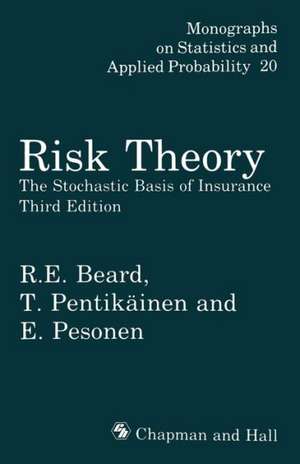
Risk Theory: The Stochastic Basis of Insurance: Monographs on Statistics and Applied Probability, cartea 20
Autor R. Bearden Limba Engleză Paperback – 3 ian 2013






Preț: 376.55 lei
Puncte Express: 565
Carte tipărită la comandă
Livrare economică 01-15 decembrie
Livrare prin curier în România Termenul estimat este afișat lângă disponibilitate.
Transport gratuit de la 400.00 lei Plată online sau ramburs, în funcție de opțiunile comenzii.
Retur gratuit în 14 zile Comandă securizată și suport în română.
Specificații
ISBN-13: 9789401176828
ISBN-10: 9401176825
Pagini: 428
Ilustrații: XVII, 408 p.
Dimensiuni: 140 x 216 x 22 mm
Greutate: 0.49 kg
Ediția:1984
Editura: SPRINGER NETHERLANDS
Colecția Springer
Seria Monographs on Statistics and Applied Probability
Locul publicării:Dordrecht, Netherlands
ISBN-10: 9401176825
Pagini: 428
Ilustrații: XVII, 408 p.
Dimensiuni: 140 x 216 x 22 mm
Greutate: 0.49 kg
Ediția:1984
Editura: SPRINGER NETHERLANDS
Colecția Springer
Seria Monographs on Statistics and Applied Probability
Locul publicării:Dordrecht, Netherlands
V-ar putea interesa
-
 -29%Preț: 450.72 lei630.61 lei
 -
 Periodicity and Stochastic Trends in Economic Time SeriesPhilip Hans Franses-19%Preț: 329.61 lei408.04 lei
 -
 Stochastic Integration TheoryPeter Medvegyev-32%Preț: 783.18 lei1158.76 lei
 -
 Stochastic Processes in Physics and ChemistryN.G. Van Kampen-30%Preț: 589.81 lei842.09 lei
 -
 Stochastic Dynamic ProgrammingSennott-9%Preț: 1180.33 lei1297.07 lei
 -
 Levy Processes and Stochastic CalculusDavid Applebaum-11%Preț: 698.53 lei784.87 lei
 -
 Diffusions, Markov Processes and MartingalesL. C. G. Rogers-5%Preț: 595.27 lei626.61 lei
 -
 Diffusions, Markov Processes, and MartingalesL. C. G. Rogers-11%Preț: 585.82 lei658.23 lei
 -
 -23%Preț: 762.83 lei990.69 lei
 -
 -18%Preț: 1231.99 lei1502.43 lei
 -
 Probability and StochasticsErhan Ç¿nlar-40%Preț: 211.27 lei352.10 lei
 -
 Brownian Dynamics at Boundaries and InterfacesZeev SchussPreț: 412.04 lei
 -
 Stochastic Models, Statistics and Their ApplicationsAnsgar Steland-18%Preț: 996.28 lei1214.97 lei
 -
 Stochastic MethodsCrispin Gardiner-15%Preț: 560.31 lei659.18 lei
 -
 The Malliavin Calculus and Related TopicsDavid Nualart-15%Preț: 705.76 lei830.30 lei
 -
 -15%Preț: 626.66 lei737.25 lei
Public țintă
ResearchCuprins
1 Definitions and notation.- 1.1 The purpose of the theory of risk.- 1.2 Stochastic processes in general.- 1.3 Positive and negative risk sums.- 1.4 Main problems.- 1.5 On the notation.- 1.6 The moment generating function, the characteristic function, and the Laplace transform.- 2 Claim number process.- 2.1 Introduction.- 2.2 The Poisson process.- 2.3 Discussion of conditions.- 2.4 Some basic formulae.- 2.5 Numerical values of Poisson probabilities.- 2.6 The additivity of Poisson variables.- 2.7 Time-dependent variation of risk exposure.- 2.8 Formulae concerning the mixed Poisson distribution.- 2.9 The Polya process.- 2.10 Risk exposure variation inside the portfolio.- 3 Compound Poisson process.- 3.1 The distribution of claim size.- 3.2 Compound distribution of the aggregate claim.- 3.3 Basic characteristics of F.- 3.4 The moment generating function.- 3.5 Estimation of S.- 3.6 The dependence of the S function on reinsurance.- 3.7 Decomposition of the portfolio into sections.- 3.8 Recursion formula for F.- 3.9 The normal approximation.- 3.10 Edgeworth series.- 3.11 Normal power approximation.- 3.12 Gamma approximation.- 3.13 Approximations by means of functions belonging to the Pearson family.- 3.14 Inversion of the characteristic function.- 3.15 Mixed methods.- 4 Applications related to one-year time-span.- 4.1 The basic equation.- 4.2 Evaluation of the fluctuation range of the annual underwriting profits and losses.- 4.3 Some approximate formulae.- 4.4 Reserve funds.- 4.5 Rules for the greatest retention.- 4.6 The case of several Ms.- 4.7 Excess of loss reinsurance premium.- 4.8 Application to stop loss reinsurance.- 4.9 An application to insurance statistics.- 4.10 Experience rating, credibility theory.- 5 Variance as a measure of stability.- 5.1 Optimum form of reinsurance.- 5.2 Reciprocity of two companies.- 5.3 Equitability of safety loadings: a link to theory of multiplayer games.- 6 Risk processes with a time-span of several years.- 6.1 Claims.- 6.2 Premium income P(1, t).- 6.3 Yield of investments.- 6.4 Portfolio divided in sections.- 6.5 Trading result.- 6.6 Distribution of the solvency ratio u.- 6.7 Ruin probability ?T(u), truncated convolution.- 6.8 Monte Carlo method.- 6.9 Limits for the finite time ruin probability ?T.- 7 Applications related to finite time-span T.- 7.1 General features of finite time risk processes.- 7.2 The size of the portfolio.- 7.3 Evaluation of net retention M.- 7.4 Effect of cycles.- 7.5 Effect of the time-span T.- 7.6 Effect of inflation.- 7.7 Dynamic control rules.- 7.8 Solvency profile.- 7.9 Evaluation of the variation range of u(t).- 7.10 Safety loading.- 8 Risk theory analysis of life insurance.- 8.1 Cohort analysis.- 8.2 Link to classic individual risk theory.- 8.3 Extensions of the cohort approach.- 8.4 General system.- 9 Ruin probability during an infinite time period.- 9.1 Introduction.- 9.2 The infinite time ruin probability.- 9.3 Discussion of the different methods.- 10 Application of risk theory to business planning.- 10.1 General features of the models.- 10.2 An example of risk theory models.- 10.3 Stochastic dynamic programming.- 10.4 Business objectives.- 10.5 Competition models.- Appendixes.- A Derivation of the Poisson and mixed Poisson processes.- B Edgeworth expansion.- C Infinite time ruin probability.- D Computation of the limits for the finite time ruin probability according to method of Section 6.9.- E Random numbers.- F Solutions to the exercises.- Author index.