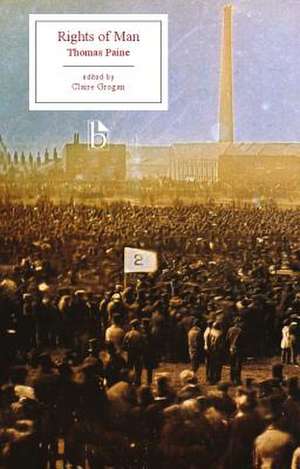
Rights of Man
Autor Thomas Paine Editat de Claire Groganen Limba Engleză Paperback – 29 mar 2011
This edition situates Rights of Man within the discussion of the French Revolution in Britain and enables readers to understand the broader political debates of the 1790s. Appendices include responses to the French Revolution, Paine’s response to the Proclamation that declared his writing seditious, contemporary political philosophy by Richard Price and Edmund Burke, and cartoons satirizing Paine and his views.
Preț: 143.61 lei
Preț vechi: 161.06 lei
-11%
Puncte Express: 215
Carte disponibilă
Livrare economică 18 mai-01 iunie
Livrare express 02-08 mai pentru 49.73 lei
Specificații
ISBN-13: 9781551115849
ISBN-10: 1551115840
Pagini: 400
Dimensiuni: 140 x 216 x 20 mm
Greutate: 0.5 kg
Editura: BROADVIEW PR
Colecția Broadview Press
Locul publicării:Peterborough, Canada
ISBN-10: 1551115840
Pagini: 400
Dimensiuni: 140 x 216 x 20 mm
Greutate: 0.5 kg
Editura: BROADVIEW PR
Colecția Broadview Press
Locul publicării:Peterborough, Canada
V-ar putea interesa
-
 A Vindication of the Rights of WomanMary Wollstonecraft-24%Preț: 23.02 lei30.14 lei
 -
 Thomas Paine ReaderThomas Paine-30%Preț: 72.57 lei103.19 lei
 -
 Common SenseThomas Paine-22%Preț: 41.99 lei53.75 lei
 -
 -16%Preț: 47.86 lei57.30 lei
 -
 -18%Preț: 57.15 lei70.01 lei
 -
 Thomas Paine and the Clarion Call for American IndependenceHarlow Giles Unger-31%Preț: 125.04 lei181.95 lei
 -
 Songs of Innocence and Songs of ExperienceWilliam BlakePreț: 23.78 lei
 -
 The Age of the Democratic RevolutionR. R. PalmerPreț: 213.35 lei
 -
 -11%Preț: 104.84 lei118.36 lei
 -
 Locke: Political WritingsJohn Locke-11%Preț: 133.22 lei150.15 lei
 -
 Two Treatises of GovernmentJohn LockePreț: 47.31 lei
 -
 The Age of ReasonThomas PainePreț: 40.29 lei
 -
 Thomas PaineThomas PainePreț: 68.02 lei
 -
 Common SenseThomas PainePreț: 25.92 lei
 -
 Thomas Paine's Rights of ManChristopher Hitchens-22%Preț: 52.76 lei67.45 lei
 -
 The Rights Of Man And Common SenseThomas PainePreț: 92.24 lei
 -
 UtopiaThomas MorePreț: 31.89 lei
 -
 The Social ContractJean-Jacques RousseauPreț: 40.05 lei
Recenzii
Advocating equality, meritocracy, and social responsibility in plain language, Thomas Paine galvanized tens of thousands of readers and changed the framework of political discourse with this text. He was tried and convicted for sedition by the British government for publishing Rights of Man, Part Two but his direct style and provocative ideas were hugely influential.
This edition situates Rights of Man within the discussion of the French Revolution in Britain and enables readers to understand the broader political debates of the 1790s. Appendices include responses to the French Revolution, Paine’s response to the Proclamation that declared his writing seditious, contemporary political philosophy by Richard Price and Edmund Burke, and cartoons satirizing Paine and his views.
“Perhaps no political treatise is more important to the development of modern political thought and yet so often misread than Thomas Paine’s Rights of Man. Claire Grogan’s comprehensively annotated edition of this classic text corrects the problem of decontextualized readings by not only reviving the tumultuous political debates with which Paine engaged, but also by distinguishing the unique style, argument, and overall significance of this revolutionary tract. With a critical yet lively introduction, this edition of Rights of Man is indispensable to anyone interested in understanding the development of 1790s radical thought and its relevance today.” — Juan Luís Sánchez, University of California, Los Angeles
This edition situates Rights of Man within the discussion of the French Revolution in Britain and enables readers to understand the broader political debates of the 1790s. Appendices include responses to the French Revolution, Paine’s response to the Proclamation that declared his writing seditious, contemporary political philosophy by Richard Price and Edmund Burke, and cartoons satirizing Paine and his views.
“Perhaps no political treatise is more important to the development of modern political thought and yet so often misread than Thomas Paine’s Rights of Man. Claire Grogan’s comprehensively annotated edition of this classic text corrects the problem of decontextualized readings by not only reviving the tumultuous political debates with which Paine engaged, but also by distinguishing the unique style, argument, and overall significance of this revolutionary tract. With a critical yet lively introduction, this edition of Rights of Man is indispensable to anyone interested in understanding the development of 1790s radical thought and its relevance today.” — Juan Luís Sánchez, University of California, Los Angeles
Cuprins
Acknowledgements
Introduction
Thomas Paine: A Brief Chronology
A Note on the Text
Rights of Man
Part One
Part Two
Appendix A: Monarchs of Great Britain
Appendix B: Price and Burke
Appendix D: Five Versions of the Versailles Incident
Select Bibliography
Introduction
Thomas Paine: A Brief Chronology
A Note on the Text
Rights of Man
Part One
Part Two
Appendix A: Monarchs of Great Britain
Appendix B: Price and Burke
- From Richard Price, A Discourse on the Love of our Country (1789)
- From Edmund Burke, Reflections on the Revolution in France (1790)
Appendix D: Five Versions of the Versailles Incident
- From Edmund Burke, Reflections on the Revolution in France (1790)
- From Mary Wollstonecraft, A Vindication of the Rights of Men (1790)
- From Helen Maria Williams, Letters Written in France (1790)
- From Correspondance de Madame Élisabeth de France, Soeur de Louis XVI (1868 [1789])
- Stanislas Maillard describes the Women’s March to Versailles, 5 October 1789 (1790)
- From Analytical Review (Jan–Apr 1791)
- From Analytical Review (Jan–Apr 1792)
- From The Monthly Review (May 1791)
- From The English Freeholder (1 June 1791)
- From Rights of Englishmen, An Antidote To the Poison Now Vending by the Transatlantic Republican Thomas Paine (1791)
- A Letter from a Magistrate (1791)
- From A Defence of the Constitution of England (1791)
- From Letter to Thomas Paine, In answer to his late publicationOn the Rights of Man (1791)
- From A British Freeholder’s Address to his Countrymen(1791)
- From A Plain Address to the Common Sense of thePeople of England (1792)
- From Hannah More, Village Politics (1793)
- Daniel Isaac Eaton, “A New Song: God Save Great ThomasPaine.” Hog’s Wash, or a Salmagundy for Swine (1794)
- James Gillray, “The Rights of Man; or Tommy Paine, the little American Taylor” (23 May 1791)
- W. Locke, “Mad Tom, or the Man of Rights” (1 September 1791)
- James Sayers, “Loyalty against Levelling” (15 December 1792)
- James Gillray, “Fashion before Ease; or, A good Constitutionsacrificed, for a Fantastick Form” (2 January 1793)
Select Bibliography
Textul de pe ultima copertă
One of the most influential writers and reformers of his age, Thomas Paine successfully publicized the issues of his time in pamphlets that clearly and persuasively argued for political independence and social reform. "Rights of Man," his greatest and most widely read work, is considered a classic statement of faith in democracy and egalitarianism.
The first part of this document, dedicated to George Washington, appeared in 1791. Defending the early events of the French Revolution, it spoke on behalf of democracy, equality, and a new European order. Part Two, which appeared the following year, is perhaps Paine's finest example of political pamphleteering and an exemplary work that supported social security for workers, public employment for those in need of work, abolition of laws limiting wages, and other social reforms.
Written in the language of common speech, "Rights of Man" was a sensation in the United States, defended by many who agreed with Paine's defense of republican government; but in Britain, it was labeled by Parliament as highly seditious, causing the government to suppress it and prosecute the British-born Paine for treason.
Regarded by historian E. P. Thompson as the "foundation-text for the English working-class movement," this much-read and much-studied book remains an inspiring, rational work that paved the way for the growth and development of radical traditions in American and British society.
The first part of this document, dedicated to George Washington, appeared in 1791. Defending the early events of the French Revolution, it spoke on behalf of democracy, equality, and a new European order. Part Two, which appeared the following year, is perhaps Paine's finest example of political pamphleteering and an exemplary work that supported social security for workers, public employment for those in need of work, abolition of laws limiting wages, and other social reforms.
Written in the language of common speech, "Rights of Man" was a sensation in the United States, defended by many who agreed with Paine's defense of republican government; but in Britain, it was labeled by Parliament as highly seditious, causing the government to suppress it and prosecute the British-born Paine for treason.
Regarded by historian E. P. Thompson as the "foundation-text for the English working-class movement," this much-read and much-studied book remains an inspiring, rational work that paved the way for the growth and development of radical traditions in American and British society.
Notă biografică
Thomas Paine (born Thomas Pain[1]) (February 9, 1737 [O.S. January 29, 1736]- June 8, 1809) was an English-born American political activist, philosopher, political theorist, and revolutionary. He authored the two most influential pamphlets at the start of the American Revolution and inspired the patriots in 1776 to declare independence from Great Britain.[2] His ideas reflected Enlightenment-era ideals of transnational human rights.[3] Historian Saul K. Padover described him as "a corsetmaker by trade, a journalist by profession, and a propagandist by inclination".[4] Born in Thetford in the English county of Norfolk, Paine migrated to the British American colonies in 1774 with the help of Benjamin Franklin, arriving just in time to participate in the American Revolution. Virtually every rebel read (or listened to a reading of) his powerful pamphlet Common Sense (1776), proportionally the all-time best-selling[5][6] American title, which catalysed the rebellious demand for independence from Great Britain. His The American Crisis (1776-1783) was a pro-revolutionary pamphlet series. Common Sense was so influential that John Adams said: "Without the pen of the author of Common Sense, the sword of Washington would have been raised in vain".[7] Paine lived in France for most of the 1790s, becoming deeply involved in the French Revolution. He wrote Rights of Man (1791), in part a defense of the French Revolution against its critics. His attacks on Anglo-Irish conservative writer Edmund Burke led to a trial and conviction in absentia in England in 1792 for the crime of seditious libel. The British government of William Pitt the Younger, worried by the possibility that the French Revolution might spread to England, had begun suppressing works that espoused radical philosophies. Paine's work, which advocated the right of the people to overthrow their government, was duly targeted, with a writ for his arrest issued in early 1792. Paine fled to France in September where, despite not being able to speak French, he was quickly elected to the French National Convention. The Girondists regarded him as an ally. Consequently, the Montagnards, especially Maximilien Robespierre, regarded him as an enemy. In December 1793, he was arrested and was taken to Luxembourg Prison in Paris. While in prison, he continued to work on The Age of Reason (1793-1794). James Monroe, a future President of the United States, used his diplomatic connections to get Paine released in November 1794. Paine became notorious because of his pamphlets. The Age of Reason, in which he advocated deism, promoted reason and free thought and argued against institutionalized religion in general and Christian doctrine in particular. He published the pamphlet Agrarian Justice (1797), discussing the origins of property and introduced the concept of a guaranteed minimum income through a one-time inheritance tax on landowners. In 1802, he returned to the U.S. When he died on June 8, 1809 only six people attended his funeral as he had been ostracized for his ridicule of Christianity