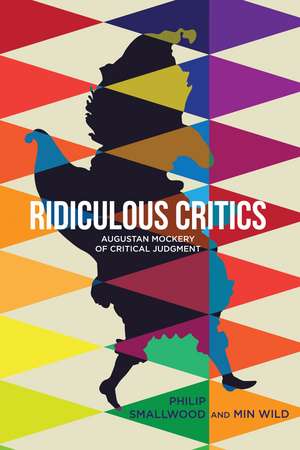
Ridiculous Critics: Augustan Mockery of Critical Judgment
Editat de Philip Smallwood, Min Wilden Limba Engleză Hardback – 16 sep 2014
The anthology also includes two original essays discussing and illustrating the irrepressible spirit of critical ridicule in the period, and commending its value and effect. The first offers an evaluation of the merciless and sometimes shockingly venomous satirical attacks on critical habits and personalities of the eighteenth century. The editors argue that such attacks are reflexive, in the sense that criticism becomes increasingly supple and able to observe and examine its own irresponsible ingenuities from within. The volume's concluding essay supplies an analysis of modern modes of criticism and critical history, and suggests applications across time. We propose that humor's vital force was once an important part of living criticism.
The eighteenth-century mockery of critics casts light on a neglected common thread in the history of criticism and its recent manifestations; it prompts questions about the relative absence of comedy from the stories we presently tell about critics dead or alive. The passages invite laughter, both with the critics and at their expense, and suggest the place that ridicule might have had since the eighteenth century in the making of judgments, and in the pricking of critical pretension. For this reason, they indicate the role that laughter may still have in criticism today and provide an encouraging precedent for its future.
Preț: 719.04 lei
Preț vechi: 876.88 lei
-18%
Puncte Express: 1079
Carte tipărită la comandă
Livrare economică 08-22 septembrie
Livrare prin curier în România Termenul estimat este afișat lângă disponibilitate.
Transport gratuit pentru acest produs Plată online sau ramburs, în funcție de opțiunile comenzii.
Retur gratuit în 14 zile Comandă securizată și suport în română.
Specificații
ISBN-13: 9781611486148
ISBN-10: 1611486149
Pagini: 266
Ilustrații: 8 BW Photos
Dimensiuni: 154 x 232 x 28 mm
Greutate: 0.56 kg
Editura: Bloomsbury Publishing
Colecția Bucknell University Press
Locul publicării:New York, United States
ISBN-10: 1611486149
Pagini: 266
Ilustrații: 8 BW Photos
Dimensiuni: 154 x 232 x 28 mm
Greutate: 0.56 kg
Editura: Bloomsbury Publishing
Colecția Bucknell University Press
Locul publicării:New York, United States
Cuprins
Illustrations
Preface
Acknowledgments
Abbreviations
Part I: Laughing with Reason: Seriousness and Un-seriousness in English Critical HistoryClassical Origins and Sources
Writing the Laughing History of Criticism
Self-Ridicule
Overdoing It
A Note on Texts and Images
Part II: The Language and Appearance of Ridicule: A Selection
"Critiques, Do Your Worst": Buckingham's Rehearsal
Lord Rochester's Disdain: "An Allusion to Horace"
Jonathan Swift and my Good Lords the Critics: A Tale of a Tub
Swift's Goddess Criticism: the Battle of the Books
William Wycherley's Anti-Critical Rampagings
Addison and the Art of Critical Tittling and Tattling
How Not to Write Literary Criticism: the Cautions of Pope's Essay
Tyrants in Wit and Pretenders to Criticism: The Guardian
The Critical Insect of Thomas Parnell: "The Bookworm"
A Life in Criticism: Parnell's Remarks on Zoilus
Steele and the Big Beast of Criticism: The Theatre
Damning with Faint Praise: Pope's Epistle to Arbuthnot
Pope's Big Sleep of Criticism: The Dunciad
Henry Fielding's Guesswork: The Champion
Sarah Fielding on Critical Cackling and Gobbling: David Simple
Henry Fielding's Critical Reptiles and Slanderers: Tom Jones
Thomas Edwards' "Airy Petulance": The Canons of Criticism
Critical Puffery and Scrapping: Smollett's Peregrine Pickle
Smart's Practical Critic: The Student
Smart's Semicolonic Ramblings: The Midwife (I)
Mrs. Midnight's Art of Close Reading: The Midwife(II)
Smart's Critical Dogs and Spiders: The Midwife (III)
Microscopic and Telescopic Critics: Johnson's Rambler
George Stevens' Pedasculus: Distress upon Distress
Critical Fishiness: Smart, Rolt, and The Universal Visitor
Garrick's Witches' Brew: "A Recipe for a Modern Critic"
Critical Rodents and The Universal Visitor
Oliver Goldsmith's Specious Idlers: Polite Learning in Europe
Goldsmith's Critical Spiders and Blockheads: The Critical Review
Johnson's Critical Minim: The Idler
Alexander Mackenzie's The Hungry Mob of Scriblers and Etchers
Sterne's Bobs and Trinkets of Criticism: Tristram Shandy
The Reviewers' Cave
Evan Lloyd and the Critic's Catacomb of Words: The Powers of the Pen
A Connoisseur Admiring a Dark Night Piece
An Old Macaroni Critic at a New Play
Gibbon's Critical Overcast: The Decline and Fall
Gillray's Critical Owl
Dr. Pomposo
The Critics: A Poem
The Critic at Home
A Connoisseur in Brokers Alley
Part III: Legacies of Ridicule: the Close of Critical History
Uncertainties Yet More Uncertain
Being Serious with Theory
Comedy and Contextualization
Stasis and Change
Dignity, Indignity and the Function of Criticism
Laughing When Reason Fails
Of Dogs and Monkeys: an Afterword
Bibliography
Index
Preface
Acknowledgments
Abbreviations
Part I: Laughing with Reason: Seriousness and Un-seriousness in English Critical HistoryClassical Origins and Sources
Writing the Laughing History of Criticism
Self-Ridicule
Overdoing It
A Note on Texts and Images
Part II: The Language and Appearance of Ridicule: A Selection
"Critiques, Do Your Worst": Buckingham's Rehearsal
Lord Rochester's Disdain: "An Allusion to Horace"
Jonathan Swift and my Good Lords the Critics: A Tale of a Tub
Swift's Goddess Criticism: the Battle of the Books
William Wycherley's Anti-Critical Rampagings
Addison and the Art of Critical Tittling and Tattling
How Not to Write Literary Criticism: the Cautions of Pope's Essay
Tyrants in Wit and Pretenders to Criticism: The Guardian
The Critical Insect of Thomas Parnell: "The Bookworm"
A Life in Criticism: Parnell's Remarks on Zoilus
Steele and the Big Beast of Criticism: The Theatre
Damning with Faint Praise: Pope's Epistle to Arbuthnot
Pope's Big Sleep of Criticism: The Dunciad
Henry Fielding's Guesswork: The Champion
Sarah Fielding on Critical Cackling and Gobbling: David Simple
Henry Fielding's Critical Reptiles and Slanderers: Tom Jones
Thomas Edwards' "Airy Petulance": The Canons of Criticism
Critical Puffery and Scrapping: Smollett's Peregrine Pickle
Smart's Practical Critic: The Student
Smart's Semicolonic Ramblings: The Midwife (I)
Mrs. Midnight's Art of Close Reading: The Midwife(II)
Smart's Critical Dogs and Spiders: The Midwife (III)
Microscopic and Telescopic Critics: Johnson's Rambler
George Stevens' Pedasculus: Distress upon Distress
Critical Fishiness: Smart, Rolt, and The Universal Visitor
Garrick's Witches' Brew: "A Recipe for a Modern Critic"
Critical Rodents and The Universal Visitor
Oliver Goldsmith's Specious Idlers: Polite Learning in Europe
Goldsmith's Critical Spiders and Blockheads: The Critical Review
Johnson's Critical Minim: The Idler
Alexander Mackenzie's The Hungry Mob of Scriblers and Etchers
Sterne's Bobs and Trinkets of Criticism: Tristram Shandy
The Reviewers' Cave
Evan Lloyd and the Critic's Catacomb of Words: The Powers of the Pen
A Connoisseur Admiring a Dark Night Piece
An Old Macaroni Critic at a New Play
Gibbon's Critical Overcast: The Decline and Fall
Gillray's Critical Owl
Dr. Pomposo
The Critics: A Poem
The Critic at Home
A Connoisseur in Brokers Alley
Part III: Legacies of Ridicule: the Close of Critical History
Uncertainties Yet More Uncertain
Being Serious with Theory
Comedy and Contextualization
Stasis and Change
Dignity, Indignity and the Function of Criticism
Laughing When Reason Fails
Of Dogs and Monkeys: an Afterword
Bibliography
Index
Recenzii
[The authors] provide a fascinating hybrid collection/anthology on the role of ridicule in criticism produced during the long 18th century. They focus on ridicule of critics/criticism rather than by critics (though sometimes the boundary blurs). In both the critical commentary it offers and the primary texts by the period's 'ridiculous critics' it includes, the volume stands as a history of a body of criticism that has been largely ignored, and which has implications for today's critical practices. In part 1, the editors consider the balance of serious and unserious in English criticism and 'suggest that a corpus of comic and satirical writings with its own genealogy' reveals 'what criticism was, and should be.' In part 2, they provide examples of such writings (and some satirical prints), beginning with Buckingham's Rehearsal and proceeding to satirical jabs by Rochester, Swift, Wycherley, Pope, Parnell, Fielding, Smart, Johnson, Goldsmith, Mackenzie, Sterne, Gibbon, et al. In part 3, the editors suggest that bringing together the 'laughter of critics [and] their own laughable vices . . . offers a way of being serious about things . . . that serious expression renders trivial, obscure, or ineffective.' All who profess themselves literary critics should take a serious look at this book. Summing Up: Essential. All readers.
There are more books on Augustan satire and Augustan criticism than I can count, but no one has ever bothered to bring the two scholarly discourses together. Smallwood and Wild are the first to explore mockery as a serious critical mode, and their innovative approach brings unfamiliar text to light and lets us see familiar ones from new angles. Ridiculous Critics is essential reading for any student of eighteenth-century criticism or satire-which is to say any student of eighteenth-century literature.
There are more books on Augustan satire and Augustan criticism than I can count, but no one has ever bothered to bring the two scholarly discourses together. Smallwood and Wild are the first to explore mockery as a serious critical mode, and their innovative approach brings unfamiliar text to light and lets us see familiar ones from new angles. Ridiculous Critics is essential reading for any student of eighteenth-century criticism or satire-which is to say any student of eighteenth-century literature.