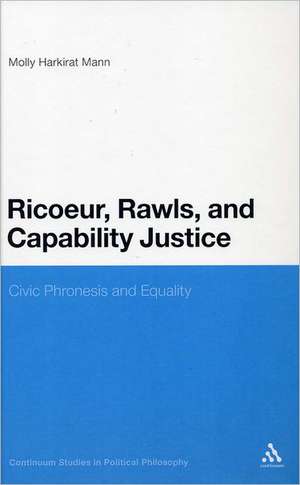
Ricoeur, Rawls, and Capability Justice: Civic Phronesis and Equality : Continuum Studies in Political Philosophy
Autor Professor Molly Harkirat Mannen Limba Engleză Hardback – 9 feb 2012
In order to prevent this danger of legitimizing the growing stratification between rich and poor, or between capability and vulnerability in modern neo-liberal societies, Molly Harkirat Mann turns to the work of Paul Ricoeur. In so doing she develops the argument that our historical and institutionalized practices of sharing, articulated by the lexicographical configuration of the Rawlisan principles of justice, represent a method for public deliberation or civic Phronesis, the ethical aim of which is the non-exclusion of our most vulnerable citizens from public institutions of care. By developing his political philosophy in relation to class politics in modern liberal societies, this book shows how Ricoeur's political thought is more closely aligned to that of John Rawls than has previously been acknowledged.
Preț: 977.68 lei
Preț vechi: 1455.37 lei
-33%
Puncte Express: 1467
Carte tipărită la comandă
Livrare economică 20 noiembrie-04 decembrie
Livrare prin curier în România Termenul estimat este afișat lângă disponibilitate.
Transport gratuit pentru acest produs Plată online sau ramburs, în funcție de opțiunile comenzii.
Retur gratuit în 14 zile Comandă securizată și suport în română.
Specificații
ISBN-13: 9781441198501
ISBN-10: 1441198504
Pagini: 240
Dimensiuni: 156 x 234 x 23 mm
Greutate: 0.52 kg
Ediția:New.
Editura: Bloomsbury Publishing
Colecția Continuum
Seria Continuum Studies in Political Philosophy
Locul publicării:London, United Kingdom
ISBN-10: 1441198504
Pagini: 240
Dimensiuni: 156 x 234 x 23 mm
Greutate: 0.52 kg
Ediția:New.
Editura: Bloomsbury Publishing
Colecția Continuum
Seria Continuum Studies in Political Philosophy
Locul publicării:London, United Kingdom
V-ar putea interesa
-
 Is God Happy?Leszek Kolakowski-26%Preț: 58.44 lei78.57 lei
 -
 Russell's Idealist ApprenticeshipNicholas Griffin-32%Preț: 793.56 lei1174.94 lei
 -
 -31%Preț: 937.52 lei1358.58 lei
 -
 Wittgenstein's Tractatus: History and InterpretationPeter Sullivan-31%Preț: 634.89 lei919.85 lei
 -
 John Stuart Mill and the Art of LifeBen Eggleston-17%Preț: 259.85 lei313.87 lei
 -
 Wittgenstein's Philosophical DevelopmentM. Engelmann-15%Preț: 609.90 lei717.53 lei
 -
 Gilles DeleuzeClaire ColebrookPreț: 276.62 lei
 -
 Althusser and His ContemporariesWarren MontagPreț: 249.71 lei
 -
 Adorno: A Guide for the PerplexedDr Alex Thomson-25%Preț: 1021.32 lei1356.18 lei
 -
 The Lost Thread: The Democracy of Modern FictionSteven Corcoran-21%Preț: 159.22 lei200.77 lei
 -
 Lectures on the Will to KnowM. FoucaultPreț: 323.14 lei
 -
 R. G. Collingwood: A Research CompanionProfessor James Connelly-33%Preț: 1026.68 lei1527.78 lei
 -
 Living CurrencyPierre Klossowski-45%Preț: 99.10 lei179.78 lei
 -
 Heidegger and the Place of EthicsDr Michael Lewis-16%Preț: 277.29 lei329.16 lei
 -
 -34%Preț: 220.68 lei333.04 lei
 -
 Topophobia: A Phenomenology of AnxietyDylan Trigg-17%Preț: 192.23 lei231.73 lei
 -
 -21%Preț: 136.74 lei173.18 lei
 -
 -21%Preț: 136.74 lei174.10 lei
Cuprins
Acknowledgments\ Introduction: The Course of Recognitive Phronesis: Ricoeur's Response to the Moralization of Inequality \ 1.An Introduction to Ricoeur's Theory of Capability Justice \ 2. The Redistribution-Recognition Debate Revisited: The Ethical Intention in Redistributive Justice \ 3. The Sacrificial Ethics of Constitutive Communitarianism \ 4. Civic Phronesis: Rawls's Anti-Sacrificial Ethics for Capability Justice \ 5. Hegel's Philosophical-Historical Account of the Modern Interventionist State:The Social Figuration of Right \ 6. The De-Penalization of Responsibility: A Genealogy of Enfranchisement in the Modern Welfare State \ Notes \ Bibliography\ Index
Recenzii
We begin with we are, not I am. We are who we are because of what we do through our daily practices. At a time when the United States has led the return to the gilded age when 1% of the population own one-third of its wealth, when those in the financial services who contribute least to the production of that wealth join the .com innovators to predominate among the super rich, when protesters claiming to represent the other 99% seek to reverse the direction of the narrative of greed that began in the 1980s to rise to its current pre-eminence, when protests that started on Wall Street have spread worldwide,when the principles to counteract the moralization of greed and inequality are in greatest need, this book's superb philosophical examination of that moral struggle could not be more timely.
Ricoeur, Rawls and Capability Justice will surely deserve its place among first-rate scholarly works on social justice, compassion and welfare. Its close reading of Rawls through Aristotle and Ricoeur on the inclusion of the least advantaged citizen is admirably patient and persuasive. Readers will be especially intrigued by the concluding argument on the reduction of poverty and crime as civic rather than police policy.
In this incisive work, Molly Harkirat Mann builds upon and deepens the work of Paul Ricoeur to argue that Rawls' theory of distributive justice, typically considered anti-communitarian, in fact supports a defense of the mutual society. This is a vital book in its response to our increasingly individualistic times.
Ricoeur, Rawls and Capability Justice will surely deserve its place among first-rate scholarly works on social justice, compassion and welfare. Its close reading of Rawls through Aristotle and Ricoeur on the inclusion of the least advantaged citizen is admirably patient and persuasive. Readers will be especially intrigued by the concluding argument on the reduction of poverty and crime as civic rather than police policy.
In this incisive work, Molly Harkirat Mann builds upon and deepens the work of Paul Ricoeur to argue that Rawls' theory of distributive justice, typically considered anti-communitarian, in fact supports a defense of the mutual society. This is a vital book in its response to our increasingly individualistic times.