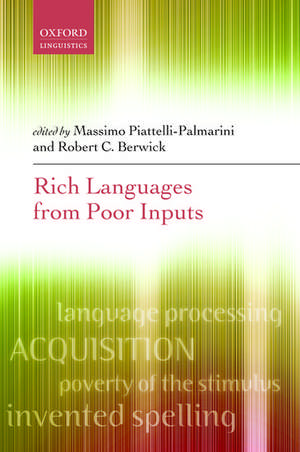
Rich Languages From Poor Inputs
Editat de Massimo Piattelli-Palmarini, Robert C. Berwicken Limba Engleză Paperback – 30 apr 2015
Preț: 339.77 lei
Preț vechi: 381.72 lei
-11%
Puncte Express: 510
Carte tipărită la comandă
Livrare economică 03-09 decembrie
Livrare prin curier în România Termenul estimat este afișat lângă disponibilitate.
Transport gratuit de la 400.00 lei Plată online sau ramburs, în funcție de opțiunile comenzii.
Retur gratuit în 14 zile Comandă securizată și suport în română.
Specificații
ISBN-13: 9780198736714
ISBN-10: 0198736711
Pagini: 328
Dimensiuni: 151 x 231 x 18 mm
Greutate: 0.5 kg
Editura: OUP OXFORD
Colecția OUP Oxford
Locul publicării:Oxford, United Kingdom
ISBN-10: 0198736711
Pagini: 328
Dimensiuni: 151 x 231 x 18 mm
Greutate: 0.5 kg
Editura: OUP OXFORD
Colecția OUP Oxford
Locul publicării:Oxford, United Kingdom
V-ar putea interesa
-
 Minimalist ParsingRobert C. BerwickPreț: 361.06 lei
-
 The Silent Child: Exploring the World of Children Who Do Not SpeakLaurent Danon-Boileau-18%Preț: 181.94 lei222.21 lei
-
 Of Minds and Language: A Dialogue with Noam Chomsky in the Basque CountryMassimo Piattelli-Palmarini-13%Preț: 176.17 lei203.52 lei
-
 Why Only UsRobert C Berwick-22%Preț: 152.01 lei195.22 lei
-
 What Darwin Got WrongJerry FodorPreț: 134.63 lei
-
 The Language and Thought of the ChildJean PiagetPreț: 172.44 lei
-
 Changing Language Education Through CALLRandall P. Donaldson-18%Preț: 1367.51 lei1667.70 lei
-
 English in Language ShiftRajend MesthriePreț: 325.49 lei
-
 Language AcquisitionPaul Fletcher-11%Preț: 496.38 lei557.73 lei
-
 The Lexicon in AcquisitionEve V. ClarkPreț: 366.14 lei
-
 -18%Preț: 1127.73 lei1375.28 lei
-
 Understanding Literacy Development: A Global ViewAnne McKeoughPreț: 391.31 lei
-
 -22%Preț: 536.95 lei684.38 lei
-
 Identity and Second Language LearningMiguel Mnatero-11%Preț: 456.83 lei513.30 lei
-
 Identity and Second Language LearningMiguel Mantero-19%Preț: 685.57 lei846.38 lei
-
 Developing Minority Language ResourcesGuadalupe ValdésPreț: 306.38 lei
-
 Input for Instructed L2 LearnersAnna Ni¿egorodcewPreț: 343.53 lei
-
 Linguistique contrastive, linguistique appliquée, sociolinguistiqueFlorentina Fredet-8%Preț: 617.80 lei671.53 lei
-
 -27%Preț: 786.28 lei1077.10 lei
-
 -27%Preț: 711.94 lei975.26 lei
Recenzii
Rich Languages is an unusual book, assembled as a homage to an unusual woman ... The various outstanding contributors to this volume ... are some of the leaders of the generative enterprise. They seamlessly converge on a rich narrative that is cohesive and engaging - a real page-turner. The convergence is itself a testament to the impact of her pioneering path.
Offers a very comprehensive and detailed overview of the state of current POS research and offers great insight into POS problems currently under investigation in the field of language acquisition.
Offers a very comprehensive and detailed overview of the state of current POS research and offers great insight into POS problems currently under investigation in the field of language acquisition.
Notă biografică
Massimo Piattelli-Palmarini is Professor Cognitive Science at the University of Arizona and a member of the Department of Linguistics, the Cognitive Science Program, and the Department of Psychology. In October 1975 he organized the encounter between Jean Piaget and Noam Chomsky and in 1980 edited the proceedings Language and Learning, now translated into 11 languages and the echoes of which still explictly resonate in the present volume. He is the editor, with Juan Uriagereka and Pello Salaburu, of Minds and Language: A Dialogue with Noam Chomsky in the Basque Country (OUP, 2009; paperback 2010), and author, with Jerrry Fodor, of What Darwin Got Wrong (Profile, 2010).Robert C. Berwick is Professor of Computer Science and Computational Linguistics at the Massachusetts Institute of Technology. He has published more than half a dozen books on the nature of language, language learnability, and computation, starting from his 1982 dissertation, The Acquisition of Syntactic Knowledge (MIT Press) to The Grammatical Basis of Linguistic Performance (MIT Press, 1986), Computational Complexity and Natural Language (MIT Press, 1987), and Principle-Based Parsing (Kluwer, 1999). Most recently, he has focused on the biology of language, particularly language evolution.
Cuprins
- 1: Massimo Piattelli-Palmarini and Robert C Berwick: Introduction
- Part 1 Poverty of the Stimulus and Modularity Revisited
- 2: Robert C. Berwick, Noam Chomsky, and Massimo Piattelli-Palmarini: Poverty of the Stimulus Stands: Why recent challenges fail
- 3: Xuan-Nga Cao Kam and Janet Dean Fodor: Children's Acquisition of Syntax: Simple models are too simple
- 4: Noam Chomsky: Poverty of the Stimulus: Willingness to be puzzled
- 5: Susan Curtiss: Revisiting Modularity: Using language as a window to the mind
- 6: Lila Gleitman and Barbara Landau: Every Child an Isolate: Nature's experiments in language learning
- Part 2: Discrepancies Between Child Grammar and Adult Grammar
- 7: Jean-Rémy Hochman and Jacques Mehler: Recent Findings About Language Acquisition
- 8: Adriana Belletti and Luigi Rizzi: Ways of Avoiding Intervention: Some thoughts on the development of object relatives, passive, and control
- 9: Itziar Laka: Merging From the Temporal Input: On subject-object asymmetries and an ergative language
- 10: Ken Wexler: Tough-Movement Developmental Delay: Another effect of phasal computation
- 11: Julie Anne Legate and Charles Yang: Assessing Child and Adult Grammar
- 12: Thomas G. Bever: Three Aspects of the Relation Between Lexical and Syntactic Knowledge
- Part 3: Broadening the Picture: Spelling andRreading
- 13: Charles Read and Rebecca Treiman: Children's Invented Spelling: What we have learned in forty years
- 14: Stephanie Gottwald and Maryane Wolf: How Insights into Child Language Changed the Development of Written Language
- 15: Wayne O'Neil: The Phonology of Invented Spelling
- 16: Merryl Goldberg: The Arts as Language: Invention, identity, and learning
- References
- Index