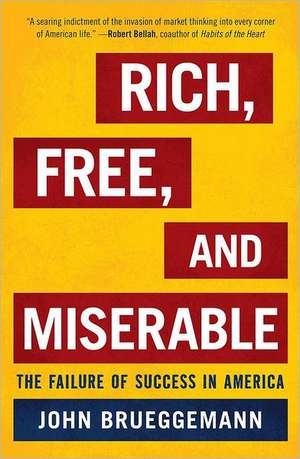
Rich, Free, and Miserable: The Failure of Success in America
Autor John Brueggemannen Limba Engleză Paperback – 12 apr 2012
From a hospital patient reduced to a balance sheet to a parent working such long hours that he misses dinner, Brueggemann argues that market thinking has permeated every corner of our lives. In the pursuit of more and better, relationships erode, to the detriment of individuals, communities, and the nation as a whole. Rich, Free, and Miserable not only outlines these pressing social problems, but also offers practical suggestions for people looking to make a positive change.
Preț: 255.13 lei
Preț vechi: 335.96 lei
-24%
Puncte Express: 383
Carte tipărită la comandă
Livrare economică 24 noiembrie-08 decembrie
Livrare prin curier în România Termenul estimat este afișat lângă disponibilitate.
Transport gratuit de la 400.00 lei Plată online sau ramburs, în funcție de opțiunile comenzii.
Retur gratuit în 14 zile Comandă securizată și suport în română.
Specificații
ISBN-13: 9781442200944
ISBN-10: 1442200944
Pagini: 233
Dimensiuni: 154 x 232 x 15 mm
Greutate: 0.39 kg
Editura: Bloomsbury Publishing
Colecția Rowman & Littlefield
Locul publicării:New York, United States
ISBN-10: 1442200944
Pagini: 233
Dimensiuni: 154 x 232 x 15 mm
Greutate: 0.39 kg
Editura: Bloomsbury Publishing
Colecția Rowman & Littlefield
Locul publicării:New York, United States
Cuprins
Acknowledgments
Chapter 1: Introduction
Chapter 2: Missing the Forest and Most of the Trees: What's Useful and What's Not in Current Conversations
Chapter 3: Social Change and Continuity in U.S. History
Chapter 4: Triumph of the Market
Chapter 5: Economic Life: Winning the Rat Race
Chapter 6: Civil Life: Cool iPods, Rolling Stops, and Fighting Dads
Chapter 7: Family Life: Frenzy and Atomization
Chapter 8: Resetting the Moral Compass
Notes
Bibliography
Index
About the Author
Chapter 1: Introduction
Chapter 2: Missing the Forest and Most of the Trees: What's Useful and What's Not in Current Conversations
Chapter 3: Social Change and Continuity in U.S. History
Chapter 4: Triumph of the Market
Chapter 5: Economic Life: Winning the Rat Race
Chapter 6: Civil Life: Cool iPods, Rolling Stops, and Fighting Dads
Chapter 7: Family Life: Frenzy and Atomization
Chapter 8: Resetting the Moral Compass
Notes
Bibliography
Index
About the Author
Recenzii
Rich, Free, and Miserable: The Failure of Success in America, examines why so many successful people are miserable, at work and at home, struggling emotionally and financially in the world's most prosperous nation. Brueggemann's book...is clearly written and easy to follow....[Brueggemann] drew upon existing research to try to diagnose what ails contemporary America. He cites numerous studies that show that Americans feel less connected to each other, that they have less time and that membership in civic organizations is declining.
Brueggemann's Rich, Free, and Miserable provides a concise and fairly comprehensive examination of the consequences of unregulated markets on the moral life of America. . . .[T]his book is insightful, well written, and comprehensive.
This book is a searing indictment of the invasion of market thinking into every corner of American life, including areas where market considerations should never be primary, as when we hear about 'the health industry' or 'the education industry.' Brueggemann points out that market pressures undermine moral commitments dear to liberals, such as social justice, and moral commitments dear to conservatives, such as personal loyalty and responsibility. He suggests the possibility of a civil discussion across our ideological divides to think about how we can resist long-standing pressures that undermine the moral life of all of us. It is a badly needed book and deserves a wide and diverse audience.
A highly accessible account of what Brueggemann calls the Death Zone-the grim moral universe of an America where markets have overwhelmed government and civil society. A Durkheimian critique that, despite the unsparing assessment of the moral crisis, points to the hopeful possibility of American renewal.
Cultural and political conservatives rail against the loss of civility, morality, and family values while simultaneously celebrating its principal cause-the individualist, materialist, and competitive free market. In Rich, Free, and Miserable, John Brueggemann sets the record straight, with prose that is powerful, engaging, and as contemporary as yesterday's newspaper. People who long for civility and community should turn off their iPods, their cell phones, and their laptops, and read this book.
Brueggemann's sociology of every-day experience shows how the power of the market is stealing our neighborhoods, our families, our time, our lives. I was reading it on the plane from Fargo to Los Angeles, and it was so fascinating that my seat partner surreptitiously read it as I did. And then he started talking about how it makes sense of his own life. This is a great conversation-starter.
The conversational and open-ended approach the author engages in is excellent. The biggest questions and conundrums of our day are tacked head-on. Grounded in important issues and questions, and up-to-date in current social science research, this book addresses the core questions of our time in a well-balanced, non-partisan tone.
Brueggemann's Rich, Free, and Miserable provides a concise and fairly comprehensive examination of the consequences of unregulated markets on the moral life of America. . . .[T]his book is insightful, well written, and comprehensive.
This book is a searing indictment of the invasion of market thinking into every corner of American life, including areas where market considerations should never be primary, as when we hear about 'the health industry' or 'the education industry.' Brueggemann points out that market pressures undermine moral commitments dear to liberals, such as social justice, and moral commitments dear to conservatives, such as personal loyalty and responsibility. He suggests the possibility of a civil discussion across our ideological divides to think about how we can resist long-standing pressures that undermine the moral life of all of us. It is a badly needed book and deserves a wide and diverse audience.
A highly accessible account of what Brueggemann calls the Death Zone-the grim moral universe of an America where markets have overwhelmed government and civil society. A Durkheimian critique that, despite the unsparing assessment of the moral crisis, points to the hopeful possibility of American renewal.
Cultural and political conservatives rail against the loss of civility, morality, and family values while simultaneously celebrating its principal cause-the individualist, materialist, and competitive free market. In Rich, Free, and Miserable, John Brueggemann sets the record straight, with prose that is powerful, engaging, and as contemporary as yesterday's newspaper. People who long for civility and community should turn off their iPods, their cell phones, and their laptops, and read this book.
Brueggemann's sociology of every-day experience shows how the power of the market is stealing our neighborhoods, our families, our time, our lives. I was reading it on the plane from Fargo to Los Angeles, and it was so fascinating that my seat partner surreptitiously read it as I did. And then he started talking about how it makes sense of his own life. This is a great conversation-starter.
The conversational and open-ended approach the author engages in is excellent. The biggest questions and conundrums of our day are tacked head-on. Grounded in important issues and questions, and up-to-date in current social science research, this book addresses the core questions of our time in a well-balanced, non-partisan tone.