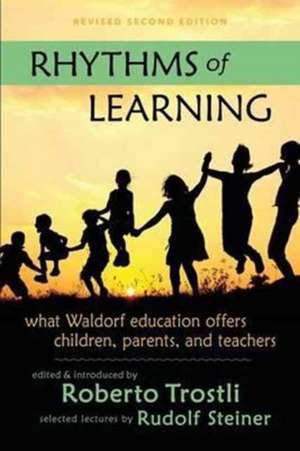
Rhythms of Learning
Autor Rudolf Steiner, Roberto Trostli Editat de Robert A McDermotten Limba Engleză Paperback – 15 feb 2017
In Rhythms of Learning, key lectures on children and education have been thoughtfully chosen from the vast amount of material by Steiner and presented in a context that makes them reader-friendly and accessible. In his many discussions and lectures, Steiner shared his vision of education that considers the spirit, soul, and physiology in children as they grow.
Roberto Trostli, a seasoned Waldorf teacher, has selected the works that best illustrate the fundamentals of this unique approach. In each chapter, Trostli explains Steiner's concepts and describes how they work in the contemporary Waldorf classroom. We learn how the teacher-child relationship and the Waldorf school curriculum changes as the students progress from kindergarten through high school.
Rhythms of Learning is an excellent resource for parents who want to understand how their child is learning. Parents will also be more prepared to discuss their child's education with teachers, and teachers will find it to be a valuable reference source and communication tool.
Preț: 179.13 lei
Nou
Puncte Express: 269
Preț estimativ în valută:
31.70€ • 37.17$ • 27.84£
31.70€ • 37.17$ • 27.84£
Carte disponibilă
Livrare economică 20 ianuarie-03 februarie 26
Preluare comenzi: 021 569.72.76
Specificații
ISBN-13: 9781621481799
ISBN-10: 1621481794
Pagini: 366
Dimensiuni: 154 x 228 x 25 mm
Greutate: 0.51 kg
Ediția:Revizuită
Editura: Steiner Books
ISBN-10: 1621481794
Pagini: 366
Dimensiuni: 154 x 228 x 25 mm
Greutate: 0.51 kg
Ediția:Revizuită
Editura: Steiner Books
V-ar putea interesa
-
 Mr Bunny's Chocolate FactoryElys Dolan-5%Preț: 52.95 lei55.59 lei
 -
 This Book is Out of Control!Richard Byrne-6%Preț: 51.69 lei54.83 lei
 -
 Nancy Parker's Spooky SpeculationsJulia Lee-5%Preț: 46.03 lei48.46 lei
 -
 The Dark ProphecyRick RiordanPreț: 194.18 lei
 -
 Dragon CaptivesLisa McMannPreț: 112.90 lei
 -
 The Unwanteds Collection (Boxed Set)Lisa McMannPreț: 456.94 lei
 -
 -8%Preț: 596.17 lei648.01 lei
 -
 The Little Book of Spooky JokesJoe KingPreț: 27.22 lei
 -
 Der elektronische DoppelgängerRudolf SteinerPreț: 85.81 lei
 -
 Preț: 89.80 lei
Notă biografică
Rudolf Steiner (1861-1925) was born in the small village of Kraljevec, Austro-Hungarian Empire (now in Croatia), where he grew up. As a young man, he lived in Weimar and Berlin, where he became a well-published scientific, literary, and philosophical scholar, known especially for his work with Goethe's scientific writings. At the beginning of the twentieth century, he began to develop his early philosophical principles into an approach to systematic research into psychological and spiritual phenomena. Formally beginning his spiritual teaching career under the auspices of the Theosophical Society, Steiner came to use the term Anthroposophy (and spiritual science) for his philosophy, spiritual research, and findings. The influence of Steiner's multifaceted genius has led to innovative and holistic approaches in medicine, various therapies, philosophy, religious renewal, Waldorf education, education for special needs, threefold economics, biodynamic agriculture, Goethean science, architecture, and the arts of drama, speech, and eurythmy. In 1924, Rudolf Steiner founded the General Anthroposophical Society, which today has branches throughout the world. He died in Dornach, Switzerland.