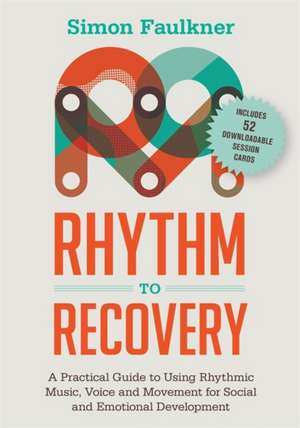
Rhythm to Recovery: A Practical Guide to Using Rhythmic Music, Voice and Movement for Social and Emotional Development
Autor Simon Faulkner Cuvânt înainte de James Oshinskyen Limba Engleză Paperback – 21 oct 2016
În Rhythm to Recovery, descoperim o metodologie clinică riguroasă care transformă utilizarea ritmului dintr-o simplă activitate recreativă într-un instrument terapeutic structurat. Simon Faulkner propune modelul R2R, o abordare care îmbină neuroștiința ritmului cu strategiile de reflecție cognitivă, oferind o punte sigură către introspecție pentru pacienții care pot găsi terapia verbală tradițională intimidantă. Lucrarea este organizată în două secțiuni complementare: prima fundamentează teoretic intervenția, explorând impactul muzicii asupra creierului și adaptările pentru populații specifice, în timp ce a doua secțiune funcționează ca un catalog practic de exerciții.
Spre deosebire de lucrarea sa anterioară, Drum Circles for Specific Population Groups, care se concentra pe logistica cercurilor de percuție, volumul de față extinde cadrul de lucru către consilierea familială și intervențiile în traume complexe. Clinicienii care utilizează Rhythm, Music, and the Brain de Michael Thaut ca referință pentru bazele neurobiologice vor găsi în textul lui Faulkner transpunerea acestor teorii în protocoale de lucru imediate. Autorul pune un accent deosebit pe utilizarea analogiilor ritmice pentru a facilita reglarea emoțională, oferind peste 100 de activități ce pot fi adaptate în școli sau centre de reabilitare. Structura progresivă a cărții, de la mecanismele de „entrainment” biologic până la exerciții de voce și mișcare, asigură o acoperire holistică a dezvoltării socio-emoționale, fiind susținută vizual de 30 de figuri și tabele care clarifică aplicarea tehnicilor în diverse contexte clinice.
Preț: 184.35 lei
Preț vechi: 262.35 lei
-30%
Carte disponibilă
Livrare economică 15-29 iunie
Livrare express 30 mai-05 iunie pentru 96.16 lei
Specificații
ISBN-10: 1785921320
Pagini: 256
Ilustrații: 30 black and white figures, tables and photographs
Dimensiuni: 173 x 245 x 9 mm
Greutate: 0.47 kg
Editura: JESSICA KINGSLEY PUBLISHERS
Colecția Jessica Kingsley Publishers
Locul publicării:London, United Kingdom
V-ar putea interesa
-
 Handbook of Neurologic Music TherapyMichael H. Thaut-29%Preț: 381.42 lei540.27 lei
 -
 Handbook of Neurologic Music TherapyMichael H. ThautPreț: 507.20 lei
 -
 -21%Preț: 202.66 lei257.33 lei
 -
 Using Music in Child and Adolescent PsychotherapyLaura E. Beer-5%Preț: 259.65 lei273.32 lei
 -
 Music Therapy Handbook, Second EditionMichael Viega-5%Preț: 441.65 lei464.89 lei
 -
 -25%Preț: 116.04 lei154.71 lei
 -
 -25%Preț: 149.63 lei199.86 lei
 -
 The Creative Dementia Practice Handbook: Arts for Health and WellbeingMaria Pasiecznik Parsons-25%Preț: 132.07 lei177.07 lei
 -
 Creative DBT Activities for Children Using MusicDeborah Spiegel-26%Preț: 154.77 lei207.90 lei
 -
 -29%Preț: 228.68 lei323.23 lei
 -
 -25%Preț: 143.87 lei192.62 lei
 -
 -20%Preț: 207.28 lei260.65 lei
 -
 -30%Preț: 197.30 lei280.94 lei
 -
 Voicework in Music Therapy: Research and PracticeJoost Hurkmans-26%Preț: 326.58 lei438.42 lei
 -
 -30%Preț: 200.92 lei288.61 lei
 -
 -30%Preț: 201.43 lei288.96 lei
 -
 -25%Preț: 150.90 lei201.74 lei
 -
 RhythmJulian GerstinPreț: 52.13 lei
De ce să citești această carte
Recomandăm această resursă profesioniștilor din terapia ocupațională și psihoterapeuților care caută metode non-verbale eficiente de conectare. Cititorul câștigă un set complet de instrumente pragmatice, de la carduri de sesiune la protocoale de evaluare, esențiale pentru lucrul cu trauma sau autismul. Este o achiziție valoroasă pentru cei care doresc să integreze muzica în practica clinică fără a necesita o formare muzicală avansată, bazându-se pe dovezi științifice solide.
Descriere
Incorporating the latest research on how rhythmic music impacts the brain, this book features over 100 different exercises spanning five key developmental areas: social and emotional learning; identity and culture; strengths and virtues; health and wellbeing; and families, teams and communities. It offers a safe entry to cognitive reflection through fun, experiential rhythmic exercises and is useful for working in settings such as school, child and adolescent counselling settings, mental health and drug and alcohol interventions, trauma counselling and relational counselling. Important sections on the use of metaphor and analogy show how to reinforce experiential outcomes. The book also contains helpful sections on working with specific populations, key facilitation skills and managing challenging behaviours. Downloadable resources such as evaluation forms, certificates and 52 session cards optimise the process of implementing this approach in practice.
Recenzii
In Rhythm 2 Recovery, Simon Faulkner has distilled years of successful, evidence-based practice into a comprehensive series of highly accessible rhythmic exercises and reflective starting points that will be a valuable addition to any therapeutic practitioner's toolkit. What's more, he has opened up the field of rhythm work in such a way that no prior musical expertise is needed to be able to use these exercises - making this accessible to therapists, educators and group leaders who may never have considered using rhythm in their work until now. Highly recommended!
If you are now working with, or ever planning to work with, any type of at risk population in schools, behavioral centres, hospitals, drug and alcohol rehabs, mental health rehabs, trauma services, prisons or child protection services, then you cannot afford to miss an opportunity to learn from the body of work Simon Faulkner provides in this new book.
Over the past several years Simon Faulkner has trained a large number of our school counsellors in using rhythmic based interventions. This model has been of great value for them in both individual and group work. The manual and the cards are easy to follow and very practical. My team have had great success working with children, adolescents, older people and residents in rehabilitation centres.
The versatility of the Rhythm2Recovery model makes it suitable for use with a variety of ages and presentations - from students who are very anxious and withdrawn to those that have difficulty with emotional regulation and substance abuse.
Everyone benefits from drumming - the participants are able to address issues and communicate while having fun and the facilitators enjoy it too.
Simon Faulkner gets to the soul of rhythm and its potent use when working with individuals, families, and groups of all ages. This book is a treasure. It's a must-have for anyone working in a therapeutic or educational context.
When words get in the way, tune in to the principles that Rhythm2Recovery offers in this packed filled resource book.
The beauty of what Simon offers with the Rhythmn2Recovery model is its flexibility. I am able to tailor the program to the needs of the group. Whether in sessions with individuals all the way through to larger groups, R2R allows me the flexibility to address any number of issues that come up and for any length of time.