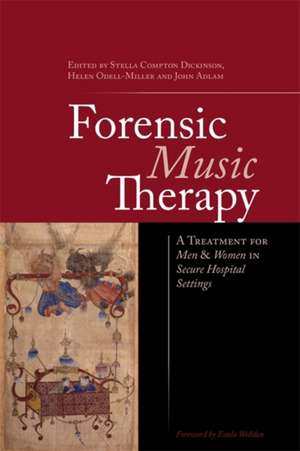
Forensic Music Therapy: A Treatment for Men and Women in Secure Hospital Settings
Contribuţii de Victoria Sleight, Philip Hughes Editat de John Adlam Contribuţii de Petra Hervey, Phyllis Annesley Editat de Helen Odell-Miller Contribuţii de Lindsay Jones, Sarah Hill, Ian Merrick, Irene Cormac, Alex Maguire, Lyndsay Jones Editat de Stella Compton-Dickinson Contribuţii de Rebecca Roberts Cuvânt înainte de Estela Welldon Contribuţii de Manjit Gahir, Rebecca Lawdayen Limba Engleză Paperback – 15 oct 2012
This book will give music therapists, forensic and clinical psychotherapists and psychologists, cognitive analytic therapists, psychiatrists, and others working in the field a wider understanding of choices, as well as demonstrating the effectiveness of tailored music therapy programmes for this complex client group.
Preț: 203.55 lei
Preț vechi: 288.09 lei
-29%
Puncte Express: 305
Carte disponibilă
Livrare economică 17 noiembrie-01 decembrie
Livrare prin curier în România Termenul estimat este afișat lângă disponibilitate.
Transport gratuit de la 400.00 lei Plată online sau ramburs, în funcție de opțiunile comenzii.
Retur gratuit în 14 zile Comandă securizată și suport în română.
Specificații
ISBN-13: 9781849052528
ISBN-10: 1849052522
Pagini: 256
Ilustrații: black & white tables, figures
Dimensiuni: 230 x 312 x 194 mm
Greutate: 0.37 kg
Editura: JESSICA KINGSLEY PUBLISHERS
Colecția Jessica Kingsley Publishers
Locul publicării:London, United Kingdom
ISBN-10: 1849052522
Pagini: 256
Ilustrații: black & white tables, figures
Dimensiuni: 230 x 312 x 194 mm
Greutate: 0.37 kg
Editura: JESSICA KINGSLEY PUBLISHERS
Colecția Jessica Kingsley Publishers
Locul publicării:London, United Kingdom
V-ar putea interesa
-
 Handbook of Neurologic Music TherapyMichael H. Thaut-24%Preț: 413.71 lei543.06 lei
 -
 Oxford Textbook of Correctional PsychiatryReena Kapoor-5%Preț: 1030.97 lei1085.22 lei
 -
 Forensic PsychiatryNigel Eastman-5%Preț: 480.71 lei506.00 lei
 -
 -5%Preț: 248.85 lei261.95 lei
 -
 Music Therapy Handbook, Second EditionMichael Viega-5%Preț: 472.90 lei497.79 lei
 -
 -27%Preț: 252.95 lei347.04 lei
 -
 The Creative Dementia Practice Handbook: Arts for Health and WellbeingMaria Pasiecznik Parsons-23%Preț: 142.16 lei184.33 lei
 -
 -28%Preț: 237.22 lei328.29 lei
 -
 Treatment Approaches for Body Image in Art TherapyEileen Misluk-Gervase-28%Preț: 211.78 lei293.95 lei
 -
 Dynamic Security: The Democratic Therapeutic Community in PrisonCaroline StewartPreț: 255.56 lei
 -
 -21%Preț: 384.37 lei484.48 lei
 -
 -21%Preț: 340.34 lei429.44 lei
 -
 Voicework in Music Therapy: Research and PracticeJoost Hurkmans-23%Preț: 342.12 lei445.31 lei
 -
 -24%Preț: 331.72 lei433.72 lei
 -
 -24%Preț: 298.04 lei391.74 lei
 -
 Music Therapy with Families: Therapeutic Approaches and Theoretical PerspectivesStine Lindahl Jacobsen-27%Preț: 241.47 lei329.39 lei
 -
 -23%Preț: 378.04 lei493.21 lei
Recenzii
The book presents rich material about the variety of aspects that a music therapist meets in secure hospital settings with patients with mental illness, presenting the very complexity of this work. I strongly recommend this book to music therapists working in the field because I believe reading the book will support music therapists in their work and especially support how to communicate the special contributions of music therapy in secured psychiatric hospital settings.
This book is a real achievement - the descriptions of the work are scarily powerful and the theoretical arguments are clear - it triumphs over many obstacles - I hope it gets the recognition it deserves.
A beautifully orchestrated book which is a stimulating read for anyone working in forensic mental health.The book exemplifies a forensic approach in its consideration of the institutional setting, the importance of music therapy's clinical contribution and breaks new ground in its research section.
This wide ranging book brings music therapy to life from the perspective of patients, therapists, supervisors, managers and multidisciplinary team members. Its vibrant and informative clinical material really allows the reader to understand the unique contribution music therapy makes to the treatment challenges with which forensic patients present us.
Forensic Music Therapy is the first book of its kind, illuminating the clinical effectiveness of music therapy with this immensely challenging population. In addition to making a major contribution to music therapy and research, it will also be a valuable resource to related disciplines working in this area.
Music therapy has at times been neglected and ignored in our work with forensic patients in secure hospital settings. This, fortunately, is no longer so, thanks to the wisdom, creativity, courage and determination of our colleagues which is represented so clearly and movingly in the diverse work described in this volume. I strongly recommend immersion in these rich and vivid clinical vignettes which will help add another important dimension, not only to the clinical work but also in the ability to think in creative ways when feeling stuck in this important and difficult work. Whether or not you are musically oriented, reading this book carefully will both enlighten and enchant you.
It has clear statement of purpose, setting out to present and examine the contexts and challenges relevant to a range of forensic practices, including high, medium and low secure hospitals... It is both informative and thought-provoking... It is a fantastic resource for all music therapists, as well as students and clinicians from related disciplines... This is also valuable to all therapist... This book is about the nature of music therapy as much as it is about forensic practice.
This book is a real achievement - the descriptions of the work are scarily powerful and the theoretical arguments are clear - it triumphs over many obstacles - I hope it gets the recognition it deserves.
A beautifully orchestrated book which is a stimulating read for anyone working in forensic mental health.The book exemplifies a forensic approach in its consideration of the institutional setting, the importance of music therapy's clinical contribution and breaks new ground in its research section.
This wide ranging book brings music therapy to life from the perspective of patients, therapists, supervisors, managers and multidisciplinary team members. Its vibrant and informative clinical material really allows the reader to understand the unique contribution music therapy makes to the treatment challenges with which forensic patients present us.
Forensic Music Therapy is the first book of its kind, illuminating the clinical effectiveness of music therapy with this immensely challenging population. In addition to making a major contribution to music therapy and research, it will also be a valuable resource to related disciplines working in this area.
Music therapy has at times been neglected and ignored in our work with forensic patients in secure hospital settings. This, fortunately, is no longer so, thanks to the wisdom, creativity, courage and determination of our colleagues which is represented so clearly and movingly in the diverse work described in this volume. I strongly recommend immersion in these rich and vivid clinical vignettes which will help add another important dimension, not only to the clinical work but also in the ability to think in creative ways when feeling stuck in this important and difficult work. Whether or not you are musically oriented, reading this book carefully will both enlighten and enchant you.
It has clear statement of purpose, setting out to present and examine the contexts and challenges relevant to a range of forensic practices, including high, medium and low secure hospitals... It is both informative and thought-provoking... It is a fantastic resource for all music therapists, as well as students and clinicians from related disciplines... This is also valuable to all therapist... This book is about the nature of music therapy as much as it is about forensic practice.
Cuprins
Foreword by Dr Estela Welldon, Founder and Honorary Elected President for Life, International Association for Forensic Psychotherapy. Introduction. Stella Compton Dickinson, Research Lead in Arts Therapies, Nottinghamshire Healthcare NHS Trust Forensic Services, Prof Helen Odell-Miller, Professor of Music Therapy, Anglia Ruskin University, Cambridge and John Adlam, Consultant Adult Forensic Psychotherapist, S London and Maudsley Foundation NHS Trust. List of Contributors. Part I. The Institutional Setting. 1. Care and Control: Delivering Forensic Psychological Therapies in the High Secure Hospital Setting. Dr Phyllis Annesley, Consultant Clinical Psychologist, National High Secure Healthcare Service for Women, Rampton Hospital, Nottinghamshire Healthcare NHS Trust and Dr Lindsay Jones, Consultant Clinical Psychologist and Cognitive Analytic Therapy Practitioner, NHS North Yorkshire and York. 2. Inside and Outside the Walls: Music Therapy Supervision in a Forensic Setting. Prof Helen Odell-Miller, Professor of Music Therapy, Anglia Ruskin University, Cambridge. 3. Music Therapy with Long-stay In-patients: Communication Issues and Collaboration with the Clinical Team. Philip Hughes, Music Therapist, NHS, Hertfordshire and Irene Cormac, Consultant Forensic Psychiatrist, Rampton Hospital, Nottinghamshire Healthcare NHS Trust. 4. Buffering and Containing Attacks Upon the Work in a Medium Secure Service. Sarah Hill, Head of Arts Therapies and Vocational Services Manager at North London Forensic Service, Barnet, Enfield and Haringey Mental Health Trust. Part II. Clinical – Music Therapy from Adolescent to Adult Offenders. 5. A Case of Work, Rest and Play: Music Therapy in Early Onset Psychosis. Stella Compton Dickinson, Research Lead in Arts Therapies, Nottinghamshire Healthcare NHS Trust Forensic Services. 6. Walking the Line: Music Therapy in the Context of the Recovery Approach in a High Secure Hospital. Alex Maguire, Senior Music Therapist, Broadmoor Hospital, Berkshire and Ian Merrick, Clinical Specialist Occupational Therapist, Broadmoor Hospital, Berkshire. 7. Working with Conflict: A Summary of Developments in the Long-term Treatment of a Man Suffering with Paranoid Schizophrenia who Committed Manslaughter. Stella Compton Dickinson, Research Lead in Arts Therapies, Nottinghamshire Healthcare NHS Trust Forensic Services and Dr Manjit Gahir, Consultant Forensic Psychiatrist and Lead Consultant, National High Secure Deaf Service, Rampton Hospital, Nottinghamshire Healthcare NHS Trust. 8. Music, Mourning and the Matrix: Death and Loss within a Forensic Music Therapy Group. Rebecca Roberts, Music Therapist, Rampton Hospital, Nottinghamshire Healthcare NHS Trust. 9. 'The Lost Boy': An Exploration of Dissociation using Cognitive Analytic Music Therapy. Stella Compton Dickinson, Research Lead in Arts Therapies, Nottinghamshire Healthcare NHS Trust Forensic Services. Part III. Research. 10. Risks, Ruptures and the Role of the Co-therapist in Group Cognitive Analytic Music Therapy (G-CAMT): A Pilot Group at a High Secure Hospital. Victoria Sleight, Music Therapist, Rampton Hospital, Nottinghamshire Healthcare NHS Trust and Stella Compton Dickinson, Research Lead in Arts Therapies, Nottinghamshire Healthcare NHS Trust Forensic Services. 11. Integrating Models for Integrated Care Pathways: Introducing Group Cognitive Analytic Music Therapy (G-CAMT) to a Women's Enhanced Medium-secure Setting (WEMSS). Rebecca Lawday, Chartered Forensic Psychologist, Women's Services at Arnold Lodge, Nottinghamshire Healthcare NHS Trust and Stella Compton Dickinson, Research Lead in Arts Therapies, Nottinghamshire Healthcare NHS Trust Forensic Services. 12. Containment or Contamination? Music Therapy, Personality Disorder and the Forensic Mental Health Team. Petra Hervey, Music Therapist and Cognitive Behavioural Therapist, Sheffield Health & Social Care NHS Trust and Helen Odell-Miller, Professor of Music Therapy, Anglia Ruskin University, Cambridge. Appendices. List of Figures. Index.