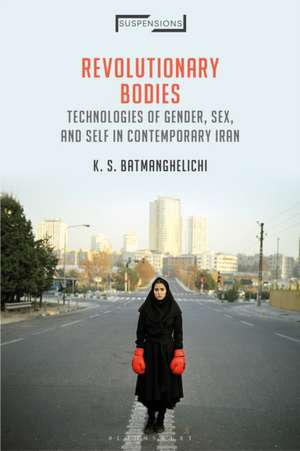
Revolutionary Bodies: Technologies of Gender, Sex, and Self in Contemporary Iran: Suspensions: Contemporary Middle Eastern and Islamicate Thought
Autor K. S. Batmanghelichien Limba Engleză Paperback – 30 iun 2022
Through a diverse blend of sources -a popular cultural women's journal, a red-light district, cases studies of temporary marriages, iconic public statues, and an HIV-AIDS advocacy organization in Tehran - this work argues that conceptions of gender and sexuality have been mediated in public discourse and experienced and modified by women themselves over the past thirty years of the Islamic Republic.
Expanding upon existing philosophical theory, technological research and scholarship on gender and sexuality in Iran, this book focuses much needed attention on under-studied, marginalized communities, such as widows living with HIV. This work interrogates how bodily technologies are constructed discursively and socially in Iran and the values and perspectives which are incorporated in them.
Din seria Suspensions: Contemporary Middle Eastern and Islamicate Thought
- 26%
 Preț: 263.65 lei
 - 17%
 Preț: 265.59 lei
 - 26%
 Preț: 264.31 lei
 - 26%
 Preț: 244.59 lei
 - 27%
 Preț: 177.50 lei
 - 18%
 Preț: 235.71 lei
 - 27%
 Preț: 178.50 lei
 - 17%
 Preț: 267.12 lei
 - 17%
 Preț: 265.47 lei
 - 17%
 Preț: 244.56 lei
 - 26%
 Preț: 239.06 lei
 - 24%
 Preț: 252.31 lei
 - 20%
 Preț: 223.75 lei
 - 31%
 Preț: 205.13 lei
 - 29%
 Preț: 199.46 lei
 - 37%
 Preț: 588.11 lei
Preț: 203.88 lei
Preț vechi: 279.30 lei
-27%
Puncte Express: 306
Carte tipărită la comandă
Livrare economică 08-22 iunie
Specificații
ISBN-13: 9781350195387
ISBN-10: 1350195383
Pagini: 256
Ilustrații: 22 bw illus
Dimensiuni: 156 x 234 mm
Greutate: 0.36 kg
Editura: Bloomsbury Publishing
Colecția Bloomsbury Academic
Seria Suspensions: Contemporary Middle Eastern and Islamicate Thought
Locul publicării:London, United Kingdom
ISBN-10: 1350195383
Pagini: 256
Ilustrații: 22 bw illus
Dimensiuni: 156 x 234 mm
Greutate: 0.36 kg
Editura: Bloomsbury Publishing
Colecția Bloomsbury Academic
Seria Suspensions: Contemporary Middle Eastern and Islamicate Thought
Locul publicării:London, United Kingdom
Cuprins
List of Figures
Acknowledgements
A Note On Transliteration
Introduction
1. Reform: An Art Of Visual Persuasion
2. Red-lights In Parks: A Social History Of Park-E Razi
3. Safety valves and post-revolutionary "prostitution"
4. Naked Modesty And The Reformation Of Statues
5. When Hiv/Aids Meets Government Morality
Conclusion
Bibliography
Index
Acknowledgements
A Note On Transliteration
Introduction
1. Reform: An Art Of Visual Persuasion
2. Red-lights In Parks: A Social History Of Park-E Razi
3. Safety valves and post-revolutionary "prostitution"
4. Naked Modesty And The Reformation Of Statues
5. When Hiv/Aids Meets Government Morality
Conclusion
Bibliography
Index
Recenzii
This is a well-written book on a very important topic, which readers will find interesting and perhaps surprising.
Batmanghelichi provides a fascinating analysis of how the regulation of sexuality has evolved in Iran. The book takes us on an illuminating journey from reforming the visual arts, to regulating prostitution in red-light parks before the 1979 revolution and relying on temporary marriage after the revolution, to refashioning "modest" statues post-revolution, and finally to contradictory government approaches to dealing with HIV/AIDs. This is a must read if you want to understand sexuality before and after the Islamic revolution.
In this perceptive, well documented and illustrated study, Batmanghelichi depicts the scope, determination as well as failures of Iran's policy of moral cleansing targeting women's sexuality. Combining historical analysis and ethnographic research, this is a welcome addition to the literature on the resilience of women's sexuality to the power of moral engineering grounded in religion.
Drawing on an innovating combination of archival, historical material; social policies including sexual health policies; art, women's magazines, and the rearrangement of public spaces in Iran over the last 100 years under two very different states, the author skillfully counters current understandings of the Islamic regime's treatment of women, their bodies, their dress and as a rupture from the Pahlavi era treatment of women. This book convincing argues that the policies of both regimes, and their perspectives on women, a part of a a continuum that views women and their public representation as central to national ideology as imagined by the state, regardless of each regime's particular political perspective. Readers are taken on an intriguing tour of a century of social and oral history and exploration of policy directives. This tour highlights the failures of these successive regimes to understand the diversity of Iranian women, to successfully manipulate women's bodies as a collective vehicle for state ideology, or to entrench their desired ideological hegemony. An unparalleled account of the role and the centrality of female citizens in the political imaginations of both the current Iranian regime and the Pahlavi monarchy it unseated, this is a work of original and interestingly sourced scholarship, and of thoughtful analysis.
Batmanghelichi provides a fascinating analysis of how the regulation of sexuality has evolved in Iran. The book takes us on an illuminating journey from reforming the visual arts, to regulating prostitution in red-light parks before the 1979 revolution and relying on temporary marriage after the revolution, to refashioning "modest" statues post-revolution, and finally to contradictory government approaches to dealing with HIV/AIDs. This is a must read if you want to understand sexuality before and after the Islamic revolution.
In this perceptive, well documented and illustrated study, Batmanghelichi depicts the scope, determination as well as failures of Iran's policy of moral cleansing targeting women's sexuality. Combining historical analysis and ethnographic research, this is a welcome addition to the literature on the resilience of women's sexuality to the power of moral engineering grounded in religion.
Drawing on an innovating combination of archival, historical material; social policies including sexual health policies; art, women's magazines, and the rearrangement of public spaces in Iran over the last 100 years under two very different states, the author skillfully counters current understandings of the Islamic regime's treatment of women, their bodies, their dress and as a rupture from the Pahlavi era treatment of women. This book convincing argues that the policies of both regimes, and their perspectives on women, a part of a a continuum that views women and their public representation as central to national ideology as imagined by the state, regardless of each regime's particular political perspective. Readers are taken on an intriguing tour of a century of social and oral history and exploration of policy directives. This tour highlights the failures of these successive regimes to understand the diversity of Iranian women, to successfully manipulate women's bodies as a collective vehicle for state ideology, or to entrench their desired ideological hegemony. An unparalleled account of the role and the centrality of female citizens in the political imaginations of both the current Iranian regime and the Pahlavi monarchy it unseated, this is a work of original and interestingly sourced scholarship, and of thoughtful analysis.