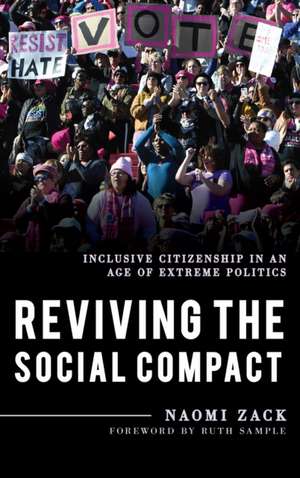
Reviving the Social Compact: Inclusive Citizenship in an Age of Extreme Politics: Explorations in Contemporary Social-Political Philosophy
Autor Naomi Zack Cuvânt înainte de Ruth Sampleen Limba Engleză Paperback – 5 noi 2018
Analyzing present and evolving events, Zackreveals how race has exceeded intersection after formal rights have failed to correct ongoing discrimination; how class is no longer based on real life interests and has been manufactured and manipulated for political contest; how women have made spectacular progress but how the fame of elite women has left out poor, non-white women, transgender people, and sex workers; how natural disasters have not been (and perhaps cannot be) adequately prepared for or responded to by government; how environmental preservation becomes politicized; how homelessness could be fixed through capitalism; and how immigration reform has pivoted from inclusion to expulsion and why hospitality is an important civic virtue.
Reviving the Social Compact is a call for good citizenship. Voting is the first step-because in a divided two-party system, a change from one party to the other is tantamount to revolution-and a new understanding of the social compact can lead to the stable civic life we need at this time.



Preț: 221.35 lei
Preț vechi: 293.42 lei
-25%
Puncte Express: 332
Carte tipărită la comandă
Livrare economică 28 noiembrie-12 decembrie
Livrare prin curier în România Termenul estimat este afișat lângă disponibilitate.
Transport gratuit de la 400.00 lei Plată online sau ramburs, în funcție de opțiunile comenzii.
Retur gratuit în 14 zile Comandă securizată și suport în română.
Specificații
ISBN-13: 9781538120125
ISBN-10: 1538120127
Pagini: 208
Ilustrații: 3 Tables
Dimensiuni: 153 x 230 x 16 mm
Greutate: 0.36 kg
Editura: Bloomsbury Publishing
Colecția Rowman & Littlefield
Seria Explorations in Contemporary Social-Political Philosophy
Locul publicării:New York, United States
ISBN-10: 1538120127
Pagini: 208
Ilustrații: 3 Tables
Dimensiuni: 153 x 230 x 16 mm
Greutate: 0.36 kg
Editura: Bloomsbury Publishing
Colecția Rowman & Littlefield
Seria Explorations in Contemporary Social-Political Philosophy
Locul publicării:New York, United States
Cuprins
Foreword by Ruth Sample
Author's Preface and Acknowledgments
Introduction
Part I - Politics, Race, Class, and Feminism
1. Turbo-Charged Politics
2. The Junction of Race
3. The Political Creation of Class
4. The Amazing Success of Feminism
Part II -- The Need for the Social Compact
5. The Social Contract and the Social Compact
6. Natural Disaster in Society
7. Unnatural Disaster in Nature
8. Homelessness and Monetization
9. Immigration and Expulsion
Conclusion
Index
Author's Preface and Acknowledgments
Introduction
Part I - Politics, Race, Class, and Feminism
1. Turbo-Charged Politics
2. The Junction of Race
3. The Political Creation of Class
4. The Amazing Success of Feminism
Part II -- The Need for the Social Compact
5. The Social Contract and the Social Compact
6. Natural Disaster in Society
7. Unnatural Disaster in Nature
8. Homelessness and Monetization
9. Immigration and Expulsion
Conclusion
Index
Recenzii
Elected officials have lost sight of Locke's vision and the founders' interpretation of the social contract. Government has become an arena for partisan bickering and turbocharged politics, where little is accomplished and the common good is ignored. According to Zack (Univ. of Oregon), when government protects only the few and elected officials lose their moral compass, everyone suffers. When tribalism and hyper-partisanship replace community and compromise is a dirty word, Americans must be saved from themselves. The challenge is for citizens to reimagine change and do what politicians refuse to do. Herein lies the concept of the social compact, in which a commonwealth (a small group) or a coalition instigates action when all levels of government "abdicate" responsibility in a vital area, such environmental matters or racial-ethnic discrimination. Zack views elections as "a bridge between the social compact and the social contract," which can be tantamount to a "revolution" in an era of intense polarization. She reminds readers what being a good citizen means: "Good citizenship requires a moral dimension, as well as knowledge and action."
A timely analysis of the contemporary political scene combined with a prescription for revitalizing the social compact that underlies it. This is political philosophy at its best!
What happens when government breaks the social contract? In this insightful and compelling book, Zack answers that residents must step up to fill the void with an inclusive social compact to buffer the disasters of a corrupt and morally bankrupt government. She powerfully demonstrates that current conceptions of race, class, and gender do not adequately represent the reality on the ground. Deftly moving between philosophical discourse and current events, Zack's analysis pushes up against the limits of identity politics, and conceptions of the good citizen, to illuminate the way forward.
Zack's book addresses a critical moral issue in modern American society: how social contracts and social compacts function in the presence of the changing dynamics of political systems and political parties, in terms of its impact on the issues of race, class, disasters, terrorism and immigration. Where social contracts become outdated or fail, then the more informal social compacts in society become critical to the continued and effective functioning of a liberal democratic society. This is an important book with a message that needs to be heard and understood by those with both formal and informal voices, who care about living in a moral society.
Supercharged politics prevents government from meeting its obligations to the people according to the social contract and endangers our democracy. Naomi Zack's brilliant book argues that we can save it if we reclaim the almost forgotten idea that it depends on a social compact among the people that is prior to government and requires that they work independently of government to create a culture of inclusion.
A timely analysis of the contemporary political scene combined with a prescription for revitalizing the social compact that underlies it. This is political philosophy at its best!
What happens when government breaks the social contract? In this insightful and compelling book, Zack answers that residents must step up to fill the void with an inclusive social compact to buffer the disasters of a corrupt and morally bankrupt government. She powerfully demonstrates that current conceptions of race, class, and gender do not adequately represent the reality on the ground. Deftly moving between philosophical discourse and current events, Zack's analysis pushes up against the limits of identity politics, and conceptions of the good citizen, to illuminate the way forward.
Zack's book addresses a critical moral issue in modern American society: how social contracts and social compacts function in the presence of the changing dynamics of political systems and political parties, in terms of its impact on the issues of race, class, disasters, terrorism and immigration. Where social contracts become outdated or fail, then the more informal social compacts in society become critical to the continued and effective functioning of a liberal democratic society. This is an important book with a message that needs to be heard and understood by those with both formal and informal voices, who care about living in a moral society.
Supercharged politics prevents government from meeting its obligations to the people according to the social contract and endangers our democracy. Naomi Zack's brilliant book argues that we can save it if we reclaim the almost forgotten idea that it depends on a social compact among the people that is prior to government and requires that they work independently of government to create a culture of inclusion.