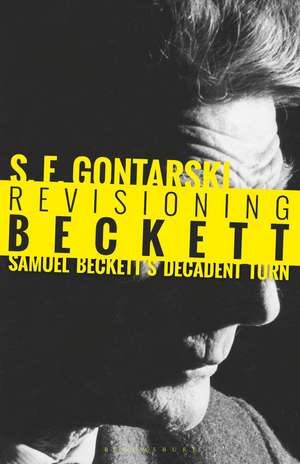
Revisioning Beckett: Samuel Beckett’s Decadent Turn
Autor Professor S. E. Gontarski Cuvânt înainte de Professor Anthony Uhlmannen Limba Engleză Hardback – 31 mai 2018
Gontarski approaches Beckett from multiple viewpoints: from his running afoul of the Irish Censorship of Publications Acts in the 1930s through the 1950s, his preoccupations to "find literature in the pornography, or beneath the pornography," his battles with the Lord Chamberlain in the mid-1950s over London stagings of his first two plays, and his close professional and personal associations with publishers who celebrated the work of the demimonde. Much of that term encompasses an opening to the fullness of human experience denied in previous centuries, and much of that has been sexual or decadent. As Gontarski shows, the aesthetics that emerges from such early career encounters and associations continues to inform Beckett's work and develops into experimental modes that upend literary models and middle-class values, an aesthetics that, furthermore, has inspired any number of visual artists to re-vision Beckett.
Preț: 860.90 lei
Preț vechi: 1001.05 lei
-14%
Puncte Express: 1291
Carte tipărită la comandă
Livrare economică 07-21 decembrie
Livrare prin curier în România Termenul estimat este afișat lângă disponibilitate.
Transport gratuit pentru acest produs Plată online sau ramburs, în funcție de opțiunile comenzii.
Retur gratuit în 14 zile Comandă securizată și suport în română.
Specificații
ISBN-13: 9781501337635
ISBN-10: 1501337637
Pagini: 316
Ilustrații: 4 b/w illustrations
Dimensiuni: 140 x 216 x 23 mm
Greutate: 0.51 kg
Ediția:HPOD
Editura: Bloomsbury Publishing
Colecția Bloomsbury Academic
Locul publicării:New York, United States
ISBN-10: 1501337637
Pagini: 316
Ilustrații: 4 b/w illustrations
Dimensiuni: 140 x 216 x 23 mm
Greutate: 0.51 kg
Ediția:HPOD
Editura: Bloomsbury Publishing
Colecția Bloomsbury Academic
Locul publicării:New York, United States
Cuprins
Acknowledgments
Foreword Anthony Uhlmann (Western Sydney University, Australia)
Demonology, Sade-ism, and Samuel Beckett's Decadent Turn: An Introduction
I. A Professional Life
1. Samuel Beckett and Lace Curtain Irish Modernisms
2. Publishing in America: Sam and Barney
3. Eleutheria: Samuel Beckett's Suppressed Bohemian Manifesto
II. A Theatrical Life
4. Textual Aberrations, Ghost Texts and the British Godot: A Saga of Censorship
5. 'Nothingness in Words Enclosed?': Waiting for Godot
6. An End to Endings: Samuel Beckett's End Game(s)
7. Samuel Beckett's Art of Self-Collaboration
8. Beckett's Keyhole Art: Voyeurism, Schaulust and the Perversions of Theatre
9. 'He Wants to Know If It Hurts!': The Body as Text in Samuel Beckett's Theatre
III. A Philosophical Life
10. Theatrical and Theoretical Intersections: Samuel Beckett, Herbert Blau, Civil Rights and the Politics of Godot
11. Beckett and the Revisioning of Modernism(s): Molloy
12. A Sense of Unending: Fictions for the End of Time
13. The Death of Style: Samuel Beckett's Art of Repetition, Pastiche and Cut-ups
Bibliography
Index
Foreword Anthony Uhlmann (Western Sydney University, Australia)
Demonology, Sade-ism, and Samuel Beckett's Decadent Turn: An Introduction
I. A Professional Life
1. Samuel Beckett and Lace Curtain Irish Modernisms
2. Publishing in America: Sam and Barney
3. Eleutheria: Samuel Beckett's Suppressed Bohemian Manifesto
II. A Theatrical Life
4. Textual Aberrations, Ghost Texts and the British Godot: A Saga of Censorship
5. 'Nothingness in Words Enclosed?': Waiting for Godot
6. An End to Endings: Samuel Beckett's End Game(s)
7. Samuel Beckett's Art of Self-Collaboration
8. Beckett's Keyhole Art: Voyeurism, Schaulust and the Perversions of Theatre
9. 'He Wants to Know If It Hurts!': The Body as Text in Samuel Beckett's Theatre
III. A Philosophical Life
10. Theatrical and Theoretical Intersections: Samuel Beckett, Herbert Blau, Civil Rights and the Politics of Godot
11. Beckett and the Revisioning of Modernism(s): Molloy
12. A Sense of Unending: Fictions for the End of Time
13. The Death of Style: Samuel Beckett's Art of Repetition, Pastiche and Cut-ups
Bibliography
Index
Recenzii
There is much here for scholars of Beckett, and more broadly of modernism, decadence, drama and performance studies, literary theory, censorship, and history of the book ... He foregrounds Beckett's modernist decadence as ever self-inventing and relating to the contemporary age. His discussions encourage important new lines of study, especially regarding performance studies, African American theater, prison theater, queer studies, and manuscript and
archival studies, as well as attention to Beckett's later prose, poetry, and drama.
Samuel Beckett is recognized as one who subverted the Modernist enterprise, not least by questioning the limits of language to create a reality with any stability prior to its own linguistic expression. The 'empirical turn' of the new century redefined a Beckett whose work (to echo Yeats) is not a rootless flower but the speech of a man. In Revisioning Beckett, S. E. Gontarski further confronts the 'decadent turn,' in a series of essays ranging from Beckett's close readings of Max Nordau and the Marquis de Sade, through his surreal confrontations with censorship ('knitted doilies' to conceal genital warts) and the changing fashions of figuration, to the absurdist paradoxes of creation by undoing.
This collection of Gontarski's recent essays is essential reading for Beckett scholarship and for studies of Irish modernism more generally. Gontarski combines thoughtful research with an encyclopedic knowledge of Beckett. All the essays are original, provocative and the product of clear and vigorous thinking.
S. E. Gontarski brings a glorious variety of contexts - from modernist aesthetics to publishing and theatre practice - to bear in Revisioning Beckett. Underlying these absorbing re-enagements by a major critic is a conviction that the rich poverty of Beckett's art is nourished by Decadence: the abiding fascination of the abject and despised. The essays collected here mediate that fascination afresh for a new generation of Beckett scholars and readers.
It is the professional and theatrical lives Beckett led which are throwing up the real surprises [in this volume], and, thanks to Gontarski, these new stories are richly fascinating. Thank Godot for Stan Gontarski!
This collection of occasional pieces offers important articulations of a piece with Gontarski's sustained scholarship of over forty years. It is a compendium that offers numerous insights and interesting analyses largely accessible to the lay reader as well as to the Beckett scholar versed in Gontarski's previous critical work.
archival studies, as well as attention to Beckett's later prose, poetry, and drama.
Samuel Beckett is recognized as one who subverted the Modernist enterprise, not least by questioning the limits of language to create a reality with any stability prior to its own linguistic expression. The 'empirical turn' of the new century redefined a Beckett whose work (to echo Yeats) is not a rootless flower but the speech of a man. In Revisioning Beckett, S. E. Gontarski further confronts the 'decadent turn,' in a series of essays ranging from Beckett's close readings of Max Nordau and the Marquis de Sade, through his surreal confrontations with censorship ('knitted doilies' to conceal genital warts) and the changing fashions of figuration, to the absurdist paradoxes of creation by undoing.
This collection of Gontarski's recent essays is essential reading for Beckett scholarship and for studies of Irish modernism more generally. Gontarski combines thoughtful research with an encyclopedic knowledge of Beckett. All the essays are original, provocative and the product of clear and vigorous thinking.
S. E. Gontarski brings a glorious variety of contexts - from modernist aesthetics to publishing and theatre practice - to bear in Revisioning Beckett. Underlying these absorbing re-enagements by a major critic is a conviction that the rich poverty of Beckett's art is nourished by Decadence: the abiding fascination of the abject and despised. The essays collected here mediate that fascination afresh for a new generation of Beckett scholars and readers.
It is the professional and theatrical lives Beckett led which are throwing up the real surprises [in this volume], and, thanks to Gontarski, these new stories are richly fascinating. Thank Godot for Stan Gontarski!
This collection of occasional pieces offers important articulations of a piece with Gontarski's sustained scholarship of over forty years. It is a compendium that offers numerous insights and interesting analyses largely accessible to the lay reader as well as to the Beckett scholar versed in Gontarski's previous critical work.