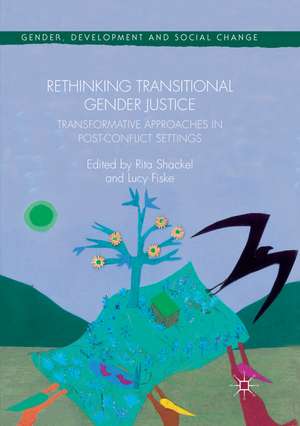
Rethinking Transitional Gender Justice: Gender, Development and Social Change
Editat de Rita Shackel, Lucy Fiskeen Limba Engleză Paperback – 19 dec 2018
Din seria Gender, Development and Social Change
- 18%
 Preț: 1111.48 lei
 - 15%
 Preț: 620.97 lei
 - 18%
 Preț: 789.68 lei
 -
 Preț: 372.96 lei
 -
 Preț: 366.19 lei
 - 15%
 Preț: 614.05 lei
 - 18%
 Preț: 704.83 lei
 - 18%
 Preț: 706.04 lei
 -
 Preț: 470.75 lei
 - 18%
 Preț: 897.90 lei
 - 15%
 Preț: 476.17 lei
 - 18%
 Preț: 781.58 lei
 - 18%
 Preț: 952.58 lei
 - 18%
 Preț: 910.71 lei
 - 18%
 Preț: 957.42 lei
 -
 Preț: 429.68 lei
 - 15%
 Preț: 637.02 lei
 -
 Preț: 436.51 lei
 -
 Preț: 357.42 lei
 - 9%
 Preț: 808.58 lei
 - 18%
 Preț: 987.97 lei
 - 18%
 Preț: 898.46 lei
Preț: 753.16 lei
Preț vechi: 827.65 lei
-9%
Puncte Express: 1130
Carte tipărită la comandă
Livrare economică 17-23 noiembrie
Livrare prin curier în România Termenul estimat este afișat lângă disponibilitate.
Transport gratuit pentru acest produs Plată online sau ramburs, în funcție de opțiunile comenzii.
Retur gratuit în 14 zile Comandă securizată și suport în română.
Specificații
ISBN-13: 9783030085650
ISBN-10: 3030085651
Pagini: 408
Ilustrații: XXI, 384 p.
Dimensiuni: 148 x 210 x 23 mm
Greutate: 0.53 kg
Ediția:Softcover reprint of the original 1st ed. 2019
Editura: Palgrave MacMillan
Colecția Gender, Development and Social Change
Seria Gender, Development and Social Change
Locul publicării:Cham, Switzerland
ISBN-10: 3030085651
Pagini: 408
Ilustrații: XXI, 384 p.
Dimensiuni: 148 x 210 x 23 mm
Greutate: 0.53 kg
Ediția:Softcover reprint of the original 1st ed. 2019
Editura: Palgrave MacMillan
Colecția Gender, Development and Social Change
Seria Gender, Development and Social Change
Locul publicării:Cham, Switzerland
Cuprins
Chapter 1. Introduction.- Section I: Rethinking Institutions.- Chapter 2. The Rise (and Fall?) of Transitional Gender Justice: A survey of the field.- Chapter 3. Ebola and Post Conflict Gender Justice: Lessons from Liberia.- Chapter 4. Making Clients Out of Citizens: Deconstructing women’s economic empowerment and humanitarianism in post conflict interventions.- Chapter 5. Using War to Shift Peacetime Norms: The example of forced marriage in Sierra Leone.- Chapter 6. More Than a Victim: Thinking through foreign correspondents’ representations of women in conflict.- Section II: Rethinking Interventions.- Chapter 7. WPS, Gender and Foreign Military Interveners: Experience from Iraq and Afghanistan.- Chapter 8. Addressing masculinities in peace negotiations: an opportunity for gender justice.- Chapter 9. Recalling Violence: gender and memory work in contemporary post-conflict Peru.- Chapter 10.- ICC Prosecutions of Sexual and Gender Based Violence: Challenges and successes.- Section III: Learning from the Field.- Chapter 11. Speaking from the Ground: Transitional gender justice in Nepal.- Chapter 12: Quechua Women: agency in the testimonies of the CVR - Peru public hearings.- Chapter 13.- The effects of indigenous patriarchal systems on women's participation in public decision making in conflict settings: the case of Somalia.- Chapter 14. ‘Women are not ready to [vote for] their own’: Remaking democracy, making citizens after the 2007 post-election violence in Kenya.- Chapter 15.- ‘An education without any fear?’: Higher education and gender justice in Afghanistan.- Chapter 16. Transitioning with Disability: Justice for women with disabilities in post-war Sri Lanka.- Chapter 17. Conclusion.
Textul de pe ultima copertă
This book draws together established and emerging scholars from sociology, law, history, political science and education to examine the global and local issues in the pursuit of gender justice in post-conflict settings. This examination is especially important given the disappointing progress made to date in spite of concerted efforts over the last two decades. With contributions from both academics and practitioners working at national and international levels, this work integrates theory and practice, examining both global problems and highly contextual case studies including Kenya, Somalia, Peru, Afghanistan and DRC. The contributors aim to provide a comprehensive and compelling argument for the need to fundamentally rethink global approaches to gender justice.
Rita Shackel is Associate Professor of Law at The University of Sydney Law School, Australia. Her research program is broadly focused on evaluation and reform of legal and social justice processes, with a specific focus on sexual and gender based violence and the needs of victims and survivors especially women and children.
Lucy Fiske is Senior Lecturer in Social and Political Sciences at the University of Technology Sydney, Australia. Her research focuses on forced migration, human rights and gender justice.
Rita Shackel is Associate Professor of Law at The University of Sydney Law School, Australia. Her research program is broadly focused on evaluation and reform of legal and social justice processes, with a specific focus on sexual and gender based violence and the needs of victims and survivors especially women and children.
Lucy Fiske is Senior Lecturer in Social and Political Sciences at the University of Technology Sydney, Australia. Her research focuses on forced migration, human rights and gender justice.
Caracteristici
Recognizes both the importance of improving gender justice in conflict and post-conflict settings and the disappointing progress to date Draws together established and emerging scholars from sociology, law, history, political science and education Provides a compelling argument for the need to fundamentally rethink global approaches to gender justice in post conflict societies The authors live and work on every continent, enabling diverse perspectives on different conflicts