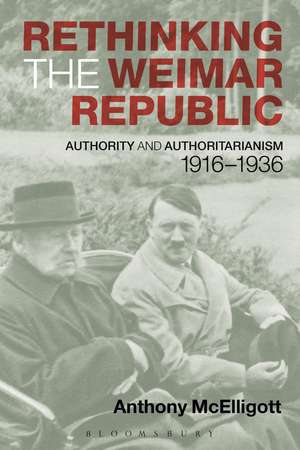
Rethinking the Weimar Republic: Authority and Authoritarianism, 1916-1936
Autor Professor Anthony McElligotten Limba Engleză Paperback – 19 dec 2013
This study challenges conventional approaches to the history of the Weimar Republic by stretching its chronological-political parameters from 1916 to 1936, arguing that neither 1918 nor 1933 constituted distinctive breaks in early 20th-century German history.
This book:
- Covers all of the key debates such as inheritance of the past, the nature of authority and culture
- Rethinks topics of traditional concern such as the economy, Article 48, the Nazi vote and political violence
- Discusses hitherto neglected areas, such as provincial life and politics, the role of law and Republican cultural politics
Preț: 283.15 lei
Preț vechi: 332.30 lei
-15%
Puncte Express: 425
Carte tipărită la comandă
Livrare economică 26 noiembrie-10 decembrie
Livrare prin curier în România Termenul estimat este afișat lângă disponibilitate.
Transport gratuit de la 400.00 lei Plată online sau ramburs, în funcție de opțiunile comenzii.
Retur gratuit în 14 zile Comandă securizată și suport în română.
Specificații
ISBN-13: 9780340731901
ISBN-10: 0340731907
Pagini: 384
Ilustrații: 4 b&w line drawings
Dimensiuni: 156 x 234 x 23 mm
Greutate: 0.59 kg
Editura: Bloomsbury Publishing
Colecția Bloomsbury Academic
Locul publicării:London, United Kingdom
ISBN-10: 0340731907
Pagini: 384
Ilustrații: 4 b&w line drawings
Dimensiuni: 156 x 234 x 23 mm
Greutate: 0.59 kg
Editura: Bloomsbury Publishing
Colecția Bloomsbury Academic
Locul publicării:London, United Kingdom
V-ar putea interesa
-
 Man of WarDuff Hart-DavisPreț: 122.82 lei
 -
 Weimar GermanyAnthony McElligott-13%Preț: 295.50 lei338.57 lei
 -
 The Last Days of Richard IIIJohn Ashdown-Hill-10%Preț: 95.04 lei106.03 lei
 -
 Armies of the Seven Years WarDigby SmithPreț: 315.12 lei
 -
 The Story of Colchester ZooS C KershawPreț: 165.38 lei
 -
 The Great Famine: Ireland's Agony 1845-1852Dr Ciarán Ó MurchadhaPreț: 174.77 lei
 -
 Food and Identity in England, 1540-1640: Eating to ImpressDr Paul S. Lloyd-33%Preț: 836.20 lei1243.06 lei
 -
 A History of the English-Speaking Peoples Volume II: The New WorldSir Sir Winston S. Churchill-24%Preț: 192.71 lei253.78 lei
 -
 A History of the English-Speaking Peoples Volume III: The Age of RevolutionSir Sir Winston S. Churchill-24%Preț: 189.48 lei250.15 lei
 -
 A History of the English-Speaking Peoples Volume IV: The Great DemocraciesSir Sir Winston S. Churchill-25%Preț: 187.63 lei248.97 lei
 -
 Step By Step: Political Writings: 1936-1939Sir Sir Winston S. Churchill-24%Preț: 181.76 lei240.63 lei
 -
 The Spirit of VenicePaul StrathernPreț: 144.00 lei
Cuprins
1. Introduction: A Republic without Authority?
2. 1916/19: The Antinomies of Authority
3. Authority Revitalized: Weimar's foreign policy
4. The Authority of Money
5. The Authority of Law: the Judiciary
6. The Quest for Cultural Authority
7. Renegade Authority: The Junker Landrat
8. Authority Between Democracy and Dictatorship
9. Postscript: Dictatorship Unbounded 1933-36
Bibliography
Index
2. 1916/19: The Antinomies of Authority
3. Authority Revitalized: Weimar's foreign policy
4. The Authority of Money
5. The Authority of Law: the Judiciary
6. The Quest for Cultural Authority
7. Renegade Authority: The Junker Landrat
8. Authority Between Democracy and Dictatorship
9. Postscript: Dictatorship Unbounded 1933-36
Bibliography
Index
Recenzii
[A] thought-provoking new approach to the Weimar Republic . [This] well-researched book provides a perceptive analysis of Weimar's struggle to maintain authority and of the Republic's relationship to both the German Empire and the Third Reich.
This is an excellent and insightful book that challenges the reader to look anew at a familiar subject. McElligott demonstrates a masterful command of a huge range of material (there are over 100 pages of endnotes) and manages to combine an overview of the ebb and flow of the historiography on a variety of different aspects of life under the Weimar Republic with genuinely new insights drawn from the primary sources.
This is an impressive book and one that deserves to be taken seriously ... McElligott is to be commended for having written something substantially different from the conventional histories of Weimar. For, in doing so, he has provided a valuable new perspective on how and why Germany's first experiment in democracy ended in such bitter failure.
In a narrative that skilfully blends discourses, cultural and political practices, McElligott shows the difficulties inherent in the Republic's struggle for legitimacy ... A useful and stimulating synthesis
McElligott's comprehensive and challenging work will reward every reader who specializes in interwar European or twentieth-century German history, as well as those who do comparative work on authoritarianism. It includes some absolutely top-notch maps and a treasure trove of endnotes.
More than 80 years after its demise, the Weimar Republic continues to fascinate. McElligott's own edited collection has enriched understanding of the republic's political instability and cultural dynamism. The chapter titled "Authority between Democracy and Dictatorship" is perhaps the volume's most compelling contribution, as McElligott discusses the Weimar constitution's inadequacies (or rather, the perception of such by contemporaries) and the widespread appeal during periods of acute crisis (1923, 1930-33) of dictatorship as a remedy for the failures of Germany's parliamentary democracy. A must read for any scholar interested in the origins of the Nazi dictatorship. Summing Up: Essential. Graduate students, faculty.
McElligott's persuasive analysis of the multifaceted nature of Weimar's political culture is an important step toward a more open, contingent, and complex historical image of the Weimar Republic.
Anyone interested in the Weimar period will benefit from reading this impressively researched work. McElligott's 220 pages of text are supported by 110 pages of endnotes, with references to a wealth of archival and printed sources and an enormous body of secondary literature.
All of the chapters are packed with provocative insights ... Undergraduates and specialists alike will profit from reading this book.
McElligott's impressive mastery of an enormous body of research guides him on a distinctive path through the dense thickets of Weimar historiography to a provocative new interpretation of the nature of authority in Germany's first democracy.
McElligott's study offers a significant and highly persuasive examination of the Weimar Republic's struggle for authority, a notion he embeds in both politics and culture. Offering strikingly new perspectives on the everyday struggles over authority at the national and local levels, McElligott challenges previous interpretations of Weimar's founding and of its collapse. This book is a must-read for scholars and students with an interest in Weimar and Nazi Germany.
A stimulating new analysis of Weimar politics, society and culture - vivid, thoughtful, and thought-provoking.
This is an excellent and insightful book that challenges the reader to look anew at a familiar subject. McElligott demonstrates a masterful command of a huge range of material (there are over 100 pages of endnotes) and manages to combine an overview of the ebb and flow of the historiography on a variety of different aspects of life under the Weimar Republic with genuinely new insights drawn from the primary sources.
This is an impressive book and one that deserves to be taken seriously ... McElligott is to be commended for having written something substantially different from the conventional histories of Weimar. For, in doing so, he has provided a valuable new perspective on how and why Germany's first experiment in democracy ended in such bitter failure.
In a narrative that skilfully blends discourses, cultural and political practices, McElligott shows the difficulties inherent in the Republic's struggle for legitimacy ... A useful and stimulating synthesis
McElligott's comprehensive and challenging work will reward every reader who specializes in interwar European or twentieth-century German history, as well as those who do comparative work on authoritarianism. It includes some absolutely top-notch maps and a treasure trove of endnotes.
More than 80 years after its demise, the Weimar Republic continues to fascinate. McElligott's own edited collection has enriched understanding of the republic's political instability and cultural dynamism. The chapter titled "Authority between Democracy and Dictatorship" is perhaps the volume's most compelling contribution, as McElligott discusses the Weimar constitution's inadequacies (or rather, the perception of such by contemporaries) and the widespread appeal during periods of acute crisis (1923, 1930-33) of dictatorship as a remedy for the failures of Germany's parliamentary democracy. A must read for any scholar interested in the origins of the Nazi dictatorship. Summing Up: Essential. Graduate students, faculty.
McElligott's persuasive analysis of the multifaceted nature of Weimar's political culture is an important step toward a more open, contingent, and complex historical image of the Weimar Republic.
Anyone interested in the Weimar period will benefit from reading this impressively researched work. McElligott's 220 pages of text are supported by 110 pages of endnotes, with references to a wealth of archival and printed sources and an enormous body of secondary literature.
All of the chapters are packed with provocative insights ... Undergraduates and specialists alike will profit from reading this book.
McElligott's impressive mastery of an enormous body of research guides him on a distinctive path through the dense thickets of Weimar historiography to a provocative new interpretation of the nature of authority in Germany's first democracy.
McElligott's study offers a significant and highly persuasive examination of the Weimar Republic's struggle for authority, a notion he embeds in both politics and culture. Offering strikingly new perspectives on the everyday struggles over authority at the national and local levels, McElligott challenges previous interpretations of Weimar's founding and of its collapse. This book is a must-read for scholars and students with an interest in Weimar and Nazi Germany.
A stimulating new analysis of Weimar politics, society and culture - vivid, thoughtful, and thought-provoking.