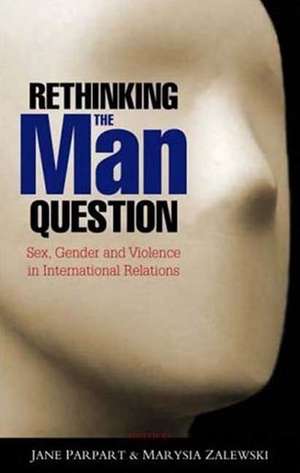
Rethinking the Man Question: Sex, Gender and Violence in International Relations
Editat de Jane L. Parpart, Doctor Marysia Zalewskien Limba Engleză Paperback – 25 apr 2008
Following on from the seminal The Man Question in International Relations this book looks at the increasingly violent and 'toxic' nature of world politics post 9/11. Contributors including Raewyn Connell, Kimberley Hutchings, Cynthia Enloe, Kevin Dunn and Sandra Whitworth consider the diverse theoretical and practical implications of masculinity for international relations in the modern world. Covering theoretical issues including masculine theories of war, masculinity and the military, cyborg soldiers, post-traumatic stress disorder and white male privilege. The book also focuses on the ways in which masculinity configures world events from conscientious objection in South Africa to 'porno-nationalism' in India, from myths and heroes in Kosovo to the makings of Zimbabwe.
This essential work will define the field for many years to come.
Preț: 202.79 lei
Preț vechi: 248.11 lei
-18%
Puncte Express: 304
Carte tipărită la comandă
Livrare economică 24 noiembrie-08 decembrie
Livrare prin curier în România Termenul estimat este afișat lângă disponibilitate.
Transport gratuit de la 400.00 lei Plată online sau ramburs, în funcție de opțiunile comenzii.
Retur gratuit în 14 zile Comandă securizată și suport în română.
Specificații
ISBN-13: 9781842779804
ISBN-10: 184277980X
Pagini: 240
Dimensiuni: 138 x 216 x 15 mm
Greutate: 0.3 kg
Editura: Bloomsbury Publishing
Colecția Zed Books
Locul publicării:London, United Kingdom
ISBN-10: 184277980X
Pagini: 240
Dimensiuni: 138 x 216 x 15 mm
Greutate: 0.3 kg
Editura: Bloomsbury Publishing
Colecția Zed Books
Locul publicării:London, United Kingdom
Cuprins
Preface: The Man Question, Gender and Global Power - Raewyn Connell
Introduction: Rethinking the Man Question - Marysia Zalewski and Jane Parpart
1. Cognitive Shortcuts - Kimberly Hutchings
2. Interrogating White Male Privilege - Kevin Dunn
3. The Machine in the May - Terrell Carver
4. Bodies of Technology and the Politics of Flesh - Cristina Masters
5. Militarized Masculinity and Post Traumatic Stress Disorder - Sandra Whitworth
6. Contesting the Masculine State - Daniel Conway
7. National Myths and the Creation of Heroes - Jamie Munn
8. 'Porno-Nationalism' and the Male Subject - Dibyesh Anand
9. Masculinity/ies, Gender and Violence in the Struggle for Zimbabwe - Jane Parpart
Afterword - Cynthia Enloe
Introduction: Rethinking the Man Question - Marysia Zalewski and Jane Parpart
1. Cognitive Shortcuts - Kimberly Hutchings
2. Interrogating White Male Privilege - Kevin Dunn
3. The Machine in the May - Terrell Carver
4. Bodies of Technology and the Politics of Flesh - Cristina Masters
5. Militarized Masculinity and Post Traumatic Stress Disorder - Sandra Whitworth
6. Contesting the Masculine State - Daniel Conway
7. National Myths and the Creation of Heroes - Jamie Munn
8. 'Porno-Nationalism' and the Male Subject - Dibyesh Anand
9. Masculinity/ies, Gender and Violence in the Struggle for Zimbabwe - Jane Parpart
Afterword - Cynthia Enloe
Recenzii
More sophisticated than its predecessor, Rethinking the Man Question is a powerful collection with real and disturbing policy implications. The essays here are deeply integrated with the new global study of masculinity and contemporary international relations theory. Together, they make a convincing case for putting gender at the centre of the way we think about international relations.
Located at the intersection of feminism, masculinity studies, post colonial studies and international relations, this striking collection demonstrates the extraordinary resilience and malleability of gendered power and violence in today's toxic post 9/11 world and opens up new terrain in the study and practice of national and global politics
This impressive collection deftly extends the feminist inquiry into International Relations by interrogating men and masculinity. Scholars and students are able to both see men as gendered actors, as well as understand the gender of institutions and organizations. Taken alongside analyses of women, this collection will reframe the field -- integrating masculinity, but ever mindful of power differences.
How come there is such vigorous resistance to women's equality in spite of decades of progressive social changes? These essays expose the desperate grip of masculinist logics and effects on both the field of international relations and also on life itself and its meanings around the globe today. Yet there are new possibilities for effectively loosening the grip of gender on current social institutions and practices. These essays point readers toward them.
Located at the intersection of feminism, masculinity studies, post colonial studies and international relations, this striking collection demonstrates the extraordinary resilience and malleability of gendered power and violence in today's toxic post 9/11 world and opens up new terrain in the study and practice of national and global politics
This impressive collection deftly extends the feminist inquiry into International Relations by interrogating men and masculinity. Scholars and students are able to both see men as gendered actors, as well as understand the gender of institutions and organizations. Taken alongside analyses of women, this collection will reframe the field -- integrating masculinity, but ever mindful of power differences.
How come there is such vigorous resistance to women's equality in spite of decades of progressive social changes? These essays expose the desperate grip of masculinist logics and effects on both the field of international relations and also on life itself and its meanings around the globe today. Yet there are new possibilities for effectively loosening the grip of gender on current social institutions and practices. These essays point readers toward them.