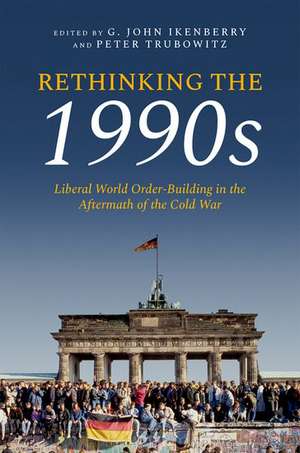
Rethinking the 1990s: Liberal World Order-Building in the Aftermath of the Cold War
Editat de G. John Ikenberry, Peter Trubowitzen Limba Engleză Hardback – 12 noi 2025
Preț: 437.32 lei
Preț vechi: 608.69 lei
-28%
Puncte Express: 656
Carte tipărită la comandă
Livrare economică 27 noiembrie-02 decembrie
Livrare prin curier în România Termenul estimat este afișat lângă disponibilitate.
Transport gratuit pentru acest produs Plată online sau ramburs, în funcție de opțiunile comenzii.
Retur gratuit în 14 zile Comandă securizată și suport în română.
Specificații
ISBN-13: 9780197813096
ISBN-10: 0197813097
Pagini: 376
Dimensiuni: 156 x 234 x 25 mm
Greutate: 0.7 kg
Editura: Oxford University Press
Colecția OUP USA
Locul publicării:New York, United States
ISBN-10: 0197813097
Pagini: 376
Dimensiuni: 156 x 234 x 25 mm
Greutate: 0.7 kg
Editura: Oxford University Press
Colecția OUP USA
Locul publicării:New York, United States
Recenzii
As we strive to understand the profound upheaval in the international order, it makes sense to go back to the 1990s, a time when liberalism seemed triumphant and ask if its decline was inevitable. To tackle this question, Ikenberry and Trubowitz have assembled a dream team of political scientists and historians, who walk us through topics ranging from economic and financial hegemony to NATO's march eastward, to the emergence of a global human rights regime. In the end, the rich scholarship in this book provides us with no easy answer and instead urges us to unpack our long-standing assumptions about the source of the order's expansion and the origins of its current challenges. It is a critical read at this uncertain moment.
Coming off the success of the Cold War, the 1990s were a breakthrough moment for the American international liberal project. Yet, in retrospect, the seeds of backlash and opposition both inside the West and beyond were being sown. This masterful collaborative volume brings leading IR thinkers together to assess the legacies, positive and negative alike, of this fateful decade.
Rethinking the 1990s is the best book available on how the world tried to get to grips with the sudden end of the Cold War. If the 1990s is the crucial decade for understanding our times, this book provides an excellent way of grasping what its key issues actually were.
The past endlessly changes as it is rethought in the present and its relevance in the creation of the latter is rethought. And so, as this excellent volume shows, very much with the 1990s. ..a very valuable collection that deserves attention.
...the book is highly recommended to anyone engaged in the study of international relations or tracing the path from the fall of the Soviet Union to the present.
Rethinking the 1990s offers a genuinely instructive way of writing about a decade that too often lends itself to retrospective certainties: it reconstructs constraints, recovers choice, and treats liberal order-building as a set of political projects marked by domestic costs, institutional stickiness and highly uneven reception. It is a strong and timely collection, and one that will reward readers interested not only in the liberal order's post-Cold War moment, but also in the longer afterlife of the choices made during that decade.
Coming off the success of the Cold War, the 1990s were a breakthrough moment for the American international liberal project. Yet, in retrospect, the seeds of backlash and opposition both inside the West and beyond were being sown. This masterful collaborative volume brings leading IR thinkers together to assess the legacies, positive and negative alike, of this fateful decade.
Rethinking the 1990s is the best book available on how the world tried to get to grips with the sudden end of the Cold War. If the 1990s is the crucial decade for understanding our times, this book provides an excellent way of grasping what its key issues actually were.
The past endlessly changes as it is rethought in the present and its relevance in the creation of the latter is rethought. And so, as this excellent volume shows, very much with the 1990s. ..a very valuable collection that deserves attention.
...the book is highly recommended to anyone engaged in the study of international relations or tracing the path from the fall of the Soviet Union to the present.
Rethinking the 1990s offers a genuinely instructive way of writing about a decade that too often lends itself to retrospective certainties: it reconstructs constraints, recovers choice, and treats liberal order-building as a set of political projects marked by domestic costs, institutional stickiness and highly uneven reception. It is a strong and timely collection, and one that will reward readers interested not only in the liberal order's post-Cold War moment, but also in the longer afterlife of the choices made during that decade.
Notă biografică
G. John Ikenberry is the Albert G. Milbank Professor of Politics and International Affairs at Princeton University in the Department of Politics and the School of Public and International Affairs. He is also a Global Eminence Scholar at Kyung Hee University in Seoul, Korea. In 2018-2019, Ikenberry was a Visiting Fellow at All Souls College, Oxford University. In 2013-2014, he was the 72nd Eastman Visiting Professor at Balliol College, Oxford. Ikenberry is a Fellow of the American Academy of Arts and Sciences. Ikenberry is the author of eight books, most recently, A World Safe for Democracy: Liberal Internationalism in the Making of Modern World Order, and Debating Worlds: Contested Narratives of Global Modernity and World Order.Peter Trubowitz is Professor of International Relations and Director of the Phelan United States Center at the London School of Economics and Political Science, and Associate Fellow at Chatham House, the Royal Institute of International Affairs. His research focuses on international security, domestic politics and foreign policy, and party politics. His published work includes Geopolitics and Democracy: The Western Liberal Order from Foundation to Fracture, with Brian Burgoon, Politics and Strategy: Partisan Ambition and American Statecraft, and Defining the National Interest: Conflict and Change in American Foreign Policy, which won the annual J. David Greenstone Prize for best book on politics and history.