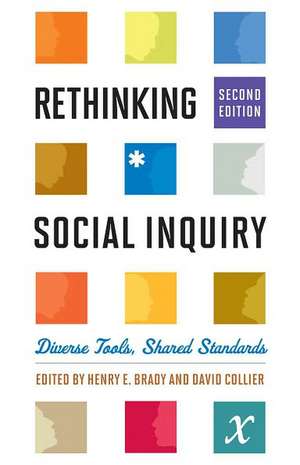
Rethinking Social Inquiry: Diverse Tools, Shared Standards
Editat de Henry E. Brady, David Collieren Limba Engleză Hardback – 16 sep 2010
Preț: 732.88 lei
Preț vechi: 1097.93 lei
-33%
Puncte Express: 1099
Carte tipărită la comandă
Livrare economică 23 noiembrie-07 decembrie
Livrare prin curier în România Termenul estimat este afișat lângă disponibilitate.
Transport gratuit pentru acest produs Plată online sau ramburs, în funcție de opțiunile comenzii.
Retur gratuit în 14 zile Comandă securizată și suport în română.
Specificații
ISBN-13: 9781442203433
ISBN-10: 1442203439
Pagini: 428
Dimensiuni: 167 x 246 x 28 mm
Greutate: 0.75 kg
Ediția:Revised.
Editura: Bloomsbury Publishing
Colecția Rowman & Littlefield
Locul publicării:New York, United States
ISBN-10: 1442203439
Pagini: 428
Dimensiuni: 167 x 246 x 28 mm
Greutate: 0.75 kg
Ediția:Revised.
Editura: Bloomsbury Publishing
Colecția Rowman & Littlefield
Locul publicării:New York, United States
V-ar putea interesa
-
 Changing Times: Work and Leisure in Postindustrial SocietyJonathan Gershuny-28%Preț: 406.06 lei566.41 lei
 -
 Conducting Research in Juvenile and Criminal Justice SettingsMichael G. Vaughn-12%Preț: 348.16 lei395.27 lei
 -
 Facilitating Practitioner Research: Developing Transformational PartnershipsSusan Groundwater-SmithPreț: 321.42 lei
 -
 Weber and Durkheim: A Methodological ComparisonHenrik JensenPreț: 411.78 lei
 -
 The Social Psychology of Collective ActionSara BreinlingerPreț: 410.44 lei
 -
 Virtual EthnographyChristine M Hine-8%Preț: 573.98 lei623.89 lei
 -
 Analyzing Quantitative DataNorman Blaikie-27%Preț: 682.59 lei935.06 lei
 -
 Qualitative Research through Case StudiesMax Travers-15%Preț: 593.58 lei698.33 lei
 -
 Using Diaries for Social ResearchAndrew M Alaszewski-15%Preț: 590.29 lei694.45 lei
 -
 How to Design and Report ExperimentsAndy FieldPreț: 479.33 lei
 -
 Transforming Qualitative DataHarry F. Wolcott-18%Preț: 1375.87 lei1677.89 lei
 -
 -15%Preț: 460.39 lei541.65 lei
 -
 -15%Preț: 484.25 lei569.71 lei
 -
 Researching the VulnerablePranee Liamputtong-8%Preț: 421.89 lei458.57 lei
 -
 Foundations of Qualitative ResearchJerry W. Willis-27%Preț: 816.65 lei1118.69 lei
 -
 International Development StudiesAndrew Sumner-15%Preț: 527.27 lei620.32 lei
 -
 Longitudinal Data Analysis for the Behavioral Sciences Using RJeffrey D. Long-27%Preț: 942.96 lei1291.72 lei
 -
 Conducting Online SurveysValerie M. Sue-15%Preț: 615.32 lei723.91 lei
 -
 Multiple Case Study AnalysisRobert E. Stake-8%Preț: 430.36 lei467.78 lei
 -
 2010 Census: Operations & OutcomesKatherine M de Luca-27%Preț: 1383.05 lei1887.03 lei
Cuprins
Introduction to the Second Edition: A Sea Change in Political Methodology
Part I: A Debate on Methodology
A. Framing the Debate
1. Refocusing the Discussion of Methodology
2. The Quest for Standards: King, Keohane, and Verba's Designing Social Inquiry
B. Critiques of the Quantitative Template
3. Doing Good and Doing Better: How Far Does the Quantitative Template Get Us?
4. Some Unfulfilled Promises of Quantitative Imperialism
5. How Inference in the Social (but Not the Physical) Sciences Neglects Theoretical Anomaly
C. Linking the Quantitative and Qualitative Traditions
6. Bridging the Quantitative-Qualitative Divide
7. The Importance of Research Design
D. Diverse Tools, Shared Standards
8. Critiques, Responses, and Trade-Offs: Drawing Together the Debate
9. Sources of Leverage in Causal Inference: Toward an Alternative View of Methodology
Part II. Causal Inference: Old Dilemmas, New Tools
Introduction to Part II
E. Qualitative Tools for Causal Inference
10. Process Tracing and Causal Inference
11. On Types of Scientific Inquiry: The Role of Qualitative Reasoning
12. Data-Set Observations versus Causal-Process Observations: The 2000 U.S. Presidential Election
Addendum: Teaching Process Tracing
F. Quantitative Tools for Causal Inference
13. Regression-Based Inference: A Case Study in Failed Causal Assessment
14. Design-Based Inference: Beyond the Pitfalls of Regression Analysis?
Glossary
Bibliography
Part I: A Debate on Methodology
A. Framing the Debate
1. Refocusing the Discussion of Methodology
2. The Quest for Standards: King, Keohane, and Verba's Designing Social Inquiry
B. Critiques of the Quantitative Template
3. Doing Good and Doing Better: How Far Does the Quantitative Template Get Us?
4. Some Unfulfilled Promises of Quantitative Imperialism
5. How Inference in the Social (but Not the Physical) Sciences Neglects Theoretical Anomaly
C. Linking the Quantitative and Qualitative Traditions
6. Bridging the Quantitative-Qualitative Divide
7. The Importance of Research Design
D. Diverse Tools, Shared Standards
8. Critiques, Responses, and Trade-Offs: Drawing Together the Debate
9. Sources of Leverage in Causal Inference: Toward an Alternative View of Methodology
Part II. Causal Inference: Old Dilemmas, New Tools
Introduction to Part II
E. Qualitative Tools for Causal Inference
10. Process Tracing and Causal Inference
11. On Types of Scientific Inquiry: The Role of Qualitative Reasoning
12. Data-Set Observations versus Causal-Process Observations: The 2000 U.S. Presidential Election
Addendum: Teaching Process Tracing
F. Quantitative Tools for Causal Inference
13. Regression-Based Inference: A Case Study in Failed Causal Assessment
14. Design-Based Inference: Beyond the Pitfalls of Regression Analysis?
Glossary
Bibliography
Recenzii
Praise for the Second Edition: The new edition of Rethinking Social Inquiry is, quite simply, the best treatise yet on the intersection of qualitative and quantitative methods. The book places causal-process tracing on a new foundation and provides a framework for skeptically evaluating natural experiments. The discussions are conceptually, statistically, and historically rigorous; the examples will have broad appeal.
I love this book and its pragmatic, ecumenical message. In an era where deep, if artificial, methodological divisions unnecessarily hamstring social research, this book is especially timely. Written by some of the most skilled and innovative methodologists in political science, the individual essays are consistently excellent. But it is the larger message about the need for methodological breadth and variety that will make the book such a valuable teaching tool.
Praise for the First Edition: Rethinking Social Inquiry is a breakthrough book. It powerfully makes the case for social inquiry as a rigorous quest for valid causal inference that must exploit to the full the insights and strengths of both statistical and case-based methods. Brady and Collier and their fellow contributors show the pitfalls of mechanically applying dogmas from 'quantitative' or 'qualitative' extremes. Shared standards are possible; and researchers using diverse research designs can work together to build illuminating, empirically grounded theories. All political scientists-indeed all social scientists-should read and reflect on this compelling set of arguments.
Praise for the First Edition: King, Keohane, and Verba's Designing Social Inquiry aimed at incorporating qualitative research methods into the conceptual framework of quantitative methodology. But was the attempt successful? What is the relationship between qualitative and quantitative methods? In this volume, Brady, Collier, and several other prominent social scientists address these questions in powerful essays. Everyone interested in research methods, and certainly everyone teaching the subject, will want to read this book.
Praise for the First Edition: [This] book serves a threefold purpose: it gives an excellent brief overview of the fundamentals of quantitative research, including a critique; it describes in detail tools for qualitative research; it gives a perspective o how to use both to maximize research results.
The authors display a sophisticated understanding of the diverse strengths and pitfalls of quantitative and qualitative methods of inference within the context of a common commitment to the idea that political science is a scientific enterprise. The essays in this collection ought to be on the reading list of the introductory methods course that all graduate programs offer.
The first edition of Rethinking Social Inquiry was a game changing contribution that decisively moved the methodological discussion into a post-KKV era. This second edition is the new cutting edge. It retains the key insights from the previous version while advancing major new methodological tools, both qualitative and quantitative. No social scientist can afford to be without this book.
The revised and reorganized edition of this foundational book expertly draws out the complementarities of quantitative and qualitative methods, including an updated debate with King, Keohane, and Verba. New chapters and online exercises yield novel insights into the rigorous use of process tracing and greatly enhance the book's utility and value.
I love this book and its pragmatic, ecumenical message. In an era where deep, if artificial, methodological divisions unnecessarily hamstring social research, this book is especially timely. Written by some of the most skilled and innovative methodologists in political science, the individual essays are consistently excellent. But it is the larger message about the need for methodological breadth and variety that will make the book such a valuable teaching tool.
Praise for the First Edition: Rethinking Social Inquiry is a breakthrough book. It powerfully makes the case for social inquiry as a rigorous quest for valid causal inference that must exploit to the full the insights and strengths of both statistical and case-based methods. Brady and Collier and their fellow contributors show the pitfalls of mechanically applying dogmas from 'quantitative' or 'qualitative' extremes. Shared standards are possible; and researchers using diverse research designs can work together to build illuminating, empirically grounded theories. All political scientists-indeed all social scientists-should read and reflect on this compelling set of arguments.
Praise for the First Edition: King, Keohane, and Verba's Designing Social Inquiry aimed at incorporating qualitative research methods into the conceptual framework of quantitative methodology. But was the attempt successful? What is the relationship between qualitative and quantitative methods? In this volume, Brady, Collier, and several other prominent social scientists address these questions in powerful essays. Everyone interested in research methods, and certainly everyone teaching the subject, will want to read this book.
Praise for the First Edition: [This] book serves a threefold purpose: it gives an excellent brief overview of the fundamentals of quantitative research, including a critique; it describes in detail tools for qualitative research; it gives a perspective o how to use both to maximize research results.
The authors display a sophisticated understanding of the diverse strengths and pitfalls of quantitative and qualitative methods of inference within the context of a common commitment to the idea that political science is a scientific enterprise. The essays in this collection ought to be on the reading list of the introductory methods course that all graduate programs offer.
The first edition of Rethinking Social Inquiry was a game changing contribution that decisively moved the methodological discussion into a post-KKV era. This second edition is the new cutting edge. It retains the key insights from the previous version while advancing major new methodological tools, both qualitative and quantitative. No social scientist can afford to be without this book.
The revised and reorganized edition of this foundational book expertly draws out the complementarities of quantitative and qualitative methods, including an updated debate with King, Keohane, and Verba. New chapters and online exercises yield novel insights into the rigorous use of process tracing and greatly enhance the book's utility and value.
Notă biografică
Henry E. Brady is Robson Professor of Political Science and Public Policy at the University of California, Berkeley, and director of the Berkeley Survey Research Center. David Collier is professor of political science and a former chair of political science and of Latin American studies at the University of California, Berkeley.