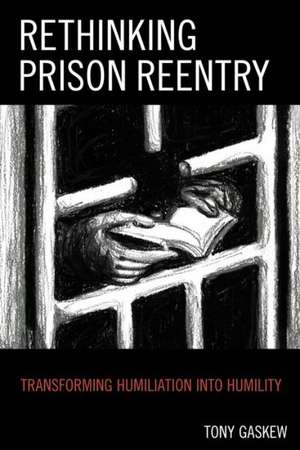
Rethinking Prison Reentry
Autor Tony Gaskewen Limba Engleză Hardback – 26 aug 2014
| Toate formatele și edițiile | Preț | Express |
|---|---|---|
| Paperback (1) | 307.70 lei 6-8 săpt. | |
| Bloomsbury Publishing – 15 feb 2016 | 307.70 lei 6-8 săpt. | |
| Hardback (1) | 676.33 lei 6-8 săpt. | |
| Bloomsbury Publishing – 26 aug 2014 | 676.33 lei 6-8 săpt. |
Preț: 676.33 lei
Preț vechi: 834.98 lei
-19%
Puncte Express: 1014
Preț estimativ în valută:
119.53€ • 140.63$ • 104.35£
119.53€ • 140.63$ • 104.35£
Carte tipărită la comandă
Livrare economică 06-20 aprilie
Specificații
ISBN-13: 9780739183120
ISBN-10: 0739183125
Pagini: 206
Ilustrații: black & white illustrations, black & white tables, figures
Dimensiuni: 155 x 231 x 23 mm
Greutate: 0.52 kg
Editura: Bloomsbury Publishing
ISBN-10: 0739183125
Pagini: 206
Ilustrații: black & white illustrations, black & white tables, figures
Dimensiuni: 155 x 231 x 23 mm
Greutate: 0.52 kg
Editura: Bloomsbury Publishing
Cuprins
Chapter 1: The Killing Fields of Chicago
Chapter 2: Uncovering Black Cultural Privilege
Chapter 3: The Great White Shark
Chapter 4: Jim Crow Jr.
Chapter 5: Are You a 30 Percenter or a 70 Percenter?
Chapter 2: Uncovering Black Cultural Privilege
Chapter 3: The Great White Shark
Chapter 4: Jim Crow Jr.
Chapter 5: Are You a 30 Percenter or a 70 Percenter?
Recenzii
'Black bodies, white justice' is just one proposition calling for rethinking raised in this provocative book. Prior to his academic career, Gaskew was a detective with the Melbourne (Florida) Police Department, where he became a member of Florida's Organized Crime Drug Enforcement Task Force. Since 2007, he has taught prisoners at McKean Federal Correctional Institution. From this experience the author has evolved a passionate, highly personal critique drawn from his life experiences. The author's argument might be summarized as follows: whites are numerically the greatest criminal offenders, whereas blacks disproportionately offend and are incarcerated. Black crime causation initially stems from slavery, then from Jim Crow policies, and most recently from racism, thanks to white privilege. Persistent white supremacy keeps prisons full of black bodies. But Gaskew, who is African American, has plenty of sharp words for his own race. Many black convicts are narcissistic and show scant regard for their communities and children left behind. Black cultural privilege is a pedagogical resource that, once fully understood, can redirect lives. This is a timely, fact-filled stem-winder. Summing Up: Essential. Upper-division undergraduates, graduate students, professionals.
In Rethinking Prison Reentry: Transforming Humiliation into Humility, Gaskew provides an insightful look into the cultural, social, and intellectual processes and nuances underpinning the transformation of incarcerated Black males into incarcerated students. . . .Overall, this book serves as an incitement to action for those involved in criminal justice and those incarcerated.
Tony Gaskew's new research is a carefully crafted study of the role of the prison industry and the intergenerational destruction it has wrought upon people of color in the United States. It is a must read for those interested in social justice, peacebuilding, criminal justice, and African American studies.
Rethinking Prison Reentry provides an insightful, introspective, sensitive, but powerful statement about the importance of redemption for incarcerated black students and youth. This work should be, without question, a required reading for all those interested in a more proactive approach to the criminal justice system, race and ethnic relations, and the overarching impact on the black community within American society.
This is a very powerful, well-researched book on issues we know far too little about or choose intentionally to ignore. Gaskew takes the reader through the corrections system using the multiple lenses of his vast experience in law enforcement and as scholar and teacher, and his own lived experience as a black man in America. This book connects the dots in new ways, and is easy to read and refreshingly candid. This book will also challenge the reader to examine and re-examine some deeply held beliefs and myths about our criminal justice system, the role of corrections, and our notions of race and justice. Gaskew does not stop at a critique, but powerfully presents and argues for the ways in which our corrections system can offer new hope and opportunities for redemption and transformation to us all.
In Rethinking Prison Reentry: Transforming Humiliation into Humility, Gaskew provides an insightful look into the cultural, social, and intellectual processes and nuances underpinning the transformation of incarcerated Black males into incarcerated students. . . .Overall, this book serves as an incitement to action for those involved in criminal justice and those incarcerated.
Tony Gaskew's new research is a carefully crafted study of the role of the prison industry and the intergenerational destruction it has wrought upon people of color in the United States. It is a must read for those interested in social justice, peacebuilding, criminal justice, and African American studies.
Rethinking Prison Reentry provides an insightful, introspective, sensitive, but powerful statement about the importance of redemption for incarcerated black students and youth. This work should be, without question, a required reading for all those interested in a more proactive approach to the criminal justice system, race and ethnic relations, and the overarching impact on the black community within American society.
This is a very powerful, well-researched book on issues we know far too little about or choose intentionally to ignore. Gaskew takes the reader through the corrections system using the multiple lenses of his vast experience in law enforcement and as scholar and teacher, and his own lived experience as a black man in America. This book connects the dots in new ways, and is easy to read and refreshingly candid. This book will also challenge the reader to examine and re-examine some deeply held beliefs and myths about our criminal justice system, the role of corrections, and our notions of race and justice. Gaskew does not stop at a critique, but powerfully presents and argues for the ways in which our corrections system can offer new hope and opportunities for redemption and transformation to us all.